Skip to main content
General Chemistry
My Course
Learn
Exam Prep
AI Tutor
Study Guides
Textbook Solutions
Flashcards
Explore
Try the app
My Course
Learn
Exam Prep
AI Tutor
Study Guides
Textbook Solutions
Flashcards
Explore
Try the app
Back
Gibbs Free Energy Calculations definitions
You can tap to flip the card.
Gibbs Free Energy
You can tap to flip the card.
👆
Gibbs Free Energy
A thermodynamic quantity used to predict the spontaneity of a chemical reaction.
Track progress
Control buttons has been changed to "navigation" mode.
1/15
Related flashcards
Related practice
Recommended videos
Gibbs Free Energy Calculations quiz
Gibbs Free Energy Calculations
15 Terms
Gibbs Free Energy Calculations
19. Chemical Thermodynamics
3 problems
Topic
Gibbs Free Energy & Equilibrium
19. Chemical Thermodynamics
7 problems
Topic
Jules
19. Chemical Thermodynamics - Part 1 of 2
5 topics
11 problems
Chapter
Jules
19. Chemical Thermodynamics - Part 2 of 2
4 topics
12 problems
Chapter
Jules
Guided course
00:44
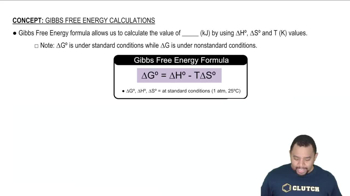
The Gibbs Free Energy Formula
1
views
Guided course
00:32
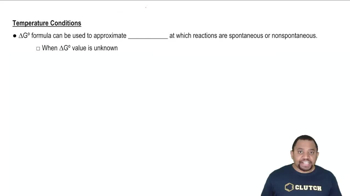
Standard Gibbs Free Energy and Temperature
4
views
Guided course
01:29
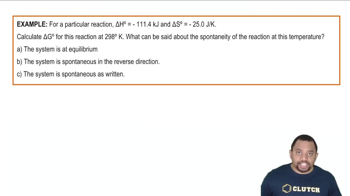
The Gibbs Free Energy Formula Example
1
views
Terms in this set (15)
Hide definitions
Gibbs Free Energy
A thermodynamic quantity used to predict the spontaneity of a chemical reaction.
Standard Conditions
Conditions of 1 atmosphere pressure and 25 °C used for measuring standard Gibbs free energy.
Enthalpy
A measure of the total energy of a thermodynamic system, often denoted as H.
Entropy
A measure of the disorder or randomness in a system, often denoted as S.
Kelvin
The SI base unit of temperature, used in thermodynamic calculations.
Spontaneity
The tendency of a chemical reaction to occur without external influence.
Formation
The process of creating a compound from its elements in their standard states.
Moles
A unit of measurement for amount of substance, used in chemical equations.
Kilojoules
A unit of energy equal to 1,000 joules, used in Gibbs free energy calculations.
Summation
The process of adding together quantities, often used in calculating Gibbs free energy.
Products
Substances formed as a result of a chemical reaction.
Reactants
Substances consumed during a chemical reaction.
Chart
A visual representation of data, often used to provide Gibbs free energy values.
Sigma
A symbol representing summation in mathematical equations.
Natural State
The most stable form of an element under standard conditions.
 BackBack
 00:44
00:44