
Textbook Question
What is the systematic name for each of the following molecules or ions? Include cis or trans prefixes for diastereoisomers. Platinum is Pt(II) in square planar complexes and Pt(IV) in octahedral complexes.
(1)
(2)
(3)
(4)
 Verified step by step guidance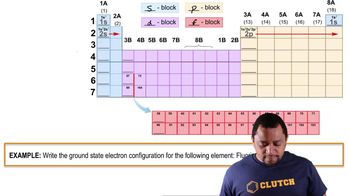
 01:33
01:33
 03:12
03:12 01:53
01:53What is the systematic name for each of the following molecules or ions? Include cis or trans prefixes for diastereoisomers. Platinum is Pt(II) in square planar complexes and Pt(IV) in octahedral complexes.
(1)
(2)
(3)
(4)
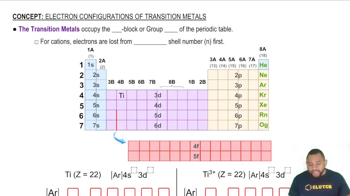
Locate on the periodic table the transition elements with the following electron configurations. Identify each element.
(c) [Kr] 4d25s2
(d) [Xe] 4f36s2
Locate on the periodic table the transition elements with the following electron configurations. Identify each element.
(a) [Ar] 3d74s2
(b) [Ar] 3d54s1
The complete reaction of 2.60 g of chromium metal with 50.00 mL of 1.200 M H2SO4 in the absence of air gave a blue solution and a colorless gas that was collected at 25°C and a pressure of 735 mm Hg. (e) When an excess of KCN is added to the solution, the color changes, and the paramagnetism of the solution
decreases. Explain.
Consider the following ethylenediamine complexes.
(a) Which complexes are chiral, and which are achiral?
(b) Draw the enantiomer of each chiral complex.
(c) Which, if any, of the chiral complexes are enantiomers of one another?
Consider the following isomers [Cr(NH3)2Cl4]-.
(a) Label the isomers as cis or trans.
(b) Which isomers are identical, and which are different?
(c) Do any of these isomers exist as enantiomers? Explain.