Skip to main content
Financial Accounting
My Course
Learn
Exam Prep
AI Tutor
Study Guides
Flashcards
Explore
Try the app
My Course
Learn
Exam Prep
AI Tutor
Study Guides
Flashcards
Explore
Try the app
Back
Retained Earnings: Prior Period Adjustments definitions
You can tap to flip the card.
Retained Earnings
You can tap to flip the card.
👆
Retained Earnings
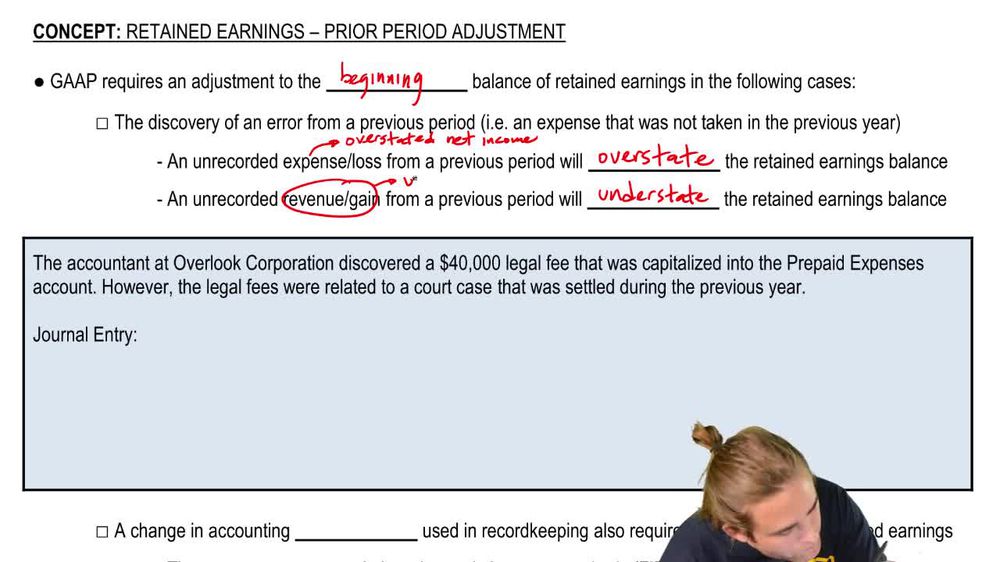
Equity account reflecting cumulative net income minus dividends, adjusted for prior period errors or changes in accounting principles.
Track progress
Control buttons has been changed to "navigation" mode.
1/15
Related flashcards
Related practice
Recommended videos
Retained Earnings: Prior Period Adjustments quiz #1
Retained Earnings: Prior Period Adjustments
10 Terms
Retained Earnings: Prior Period Adjustments
12. Stockholders' Equity
10 problems
Topic
Preferred Stock
12. Stockholders' Equity
10 problems
Topic
12. Stockholders' Equity
12 topics
15 problems
Chapter
Guided course
04:17
Prior Period Adjustment: Change in Accounting Principle
3
views
Guided course
05:24
Prior Period Adjustment: Errors
3
views
Terms in this set (15)
Hide definitions
Retained Earnings
Equity account reflecting cumulative net income minus dividends, adjusted for prior period errors or changes in accounting principles.
Prior Period Adjustment
Correction made to the beginning balance of equity to fix errors or reflect changes in accounting principles from previous periods.
Error
Mistake in financial records, such as unrecorded expenses or revenues, requiring correction to ensure accurate financial statements.
Change in Accounting Principle
Switch in methods or rules used for financial reporting, often involving inventory costing, to improve comparability across periods.
Cumulative Effect
Total impact on financial statements from correcting an error or changing a principle, applied to the beginning balance of equity.
Debit
Entry on the left side of an account, used to decrease equity or increase assets, such as reducing retained earnings for prior expenses.
Credit
Entry on the right side of an account, used to increase equity or decrease assets, such as increasing retained earnings for prior revenues.
Prepaid Expenses
Assets representing payments made in advance for services or goods, which may require adjustment if misclassified.
Inventory
Current asset representing goods held for sale, whose valuation can change with different costing methods or corrections.
FIFO
Inventory costing method assuming earliest goods purchased are sold first, affecting reported inventory and cost of goods sold.
LIFO
Inventory costing method assuming latest goods purchased are sold first, impacting inventory and expense figures.
Weighted Average Method
Inventory valuation approach averaging costs of all units available for sale, influencing both inventory and cost of goods sold.
Cost of Goods Sold
Expense representing the direct costs of producing goods sold during a period, affected by inventory accounting methods.
Comparability
Quality of financial information that allows users to identify similarities and differences across periods or entities.
Net Income
Profit remaining after all expenses are deducted from revenues, forming the basis for changes in retained earnings.
 BackBack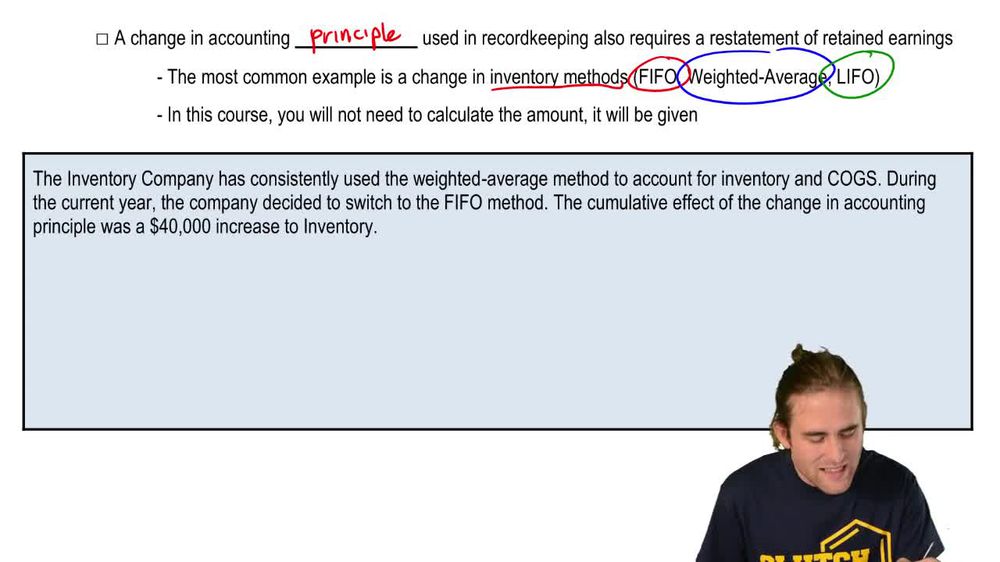
 04:17
04:17