Use set notation, and list all the elements of each set. {x | x is a natural number not greater than 4}
Ch. R - Review of Basic Concepts

Chapter 1, Problem 26
Simplify each expression. Assume all variables represent nonzero real numbers. (-2x5)5
Verified step by step guidance1
Identify the expression to simplify: \((-2x^{5})^{5}\). This means the entire quantity \(-2x^{5}\) is raised to the 5th power.
Apply the power of a product rule, which states that \((ab)^{n} = a^{n} b^{n}\). So rewrite the expression as \((-2)^{5} \cdot (x^{5})^{5}\).
Calculate the power of the coefficient: \((-2)^{5}\). Remember that raising a negative number to an odd power keeps it negative.
Use the power of a power rule for the variable part: \((x^{5})^{5} = x^{5 \cdot 5} = x^{25}\).
Combine the results to write the simplified expression as \((-2)^{5} \cdot x^{25}\).

Verified video answer for a similar problem:
This video solution was recommended by our tutors as helpful for the problem above.
Video duration:
1mWas this helpful?
Key Concepts
Here are the essential concepts you must grasp in order to answer the question correctly.
Laws of Exponents
The laws of exponents govern how to simplify expressions involving powers. For example, when raising a power to another power, multiply the exponents (i.e., (a^m)^n = a^(m*n)). This rule is essential for simplifying expressions like (-2x^5)^5.
Recommended video:
Guided course
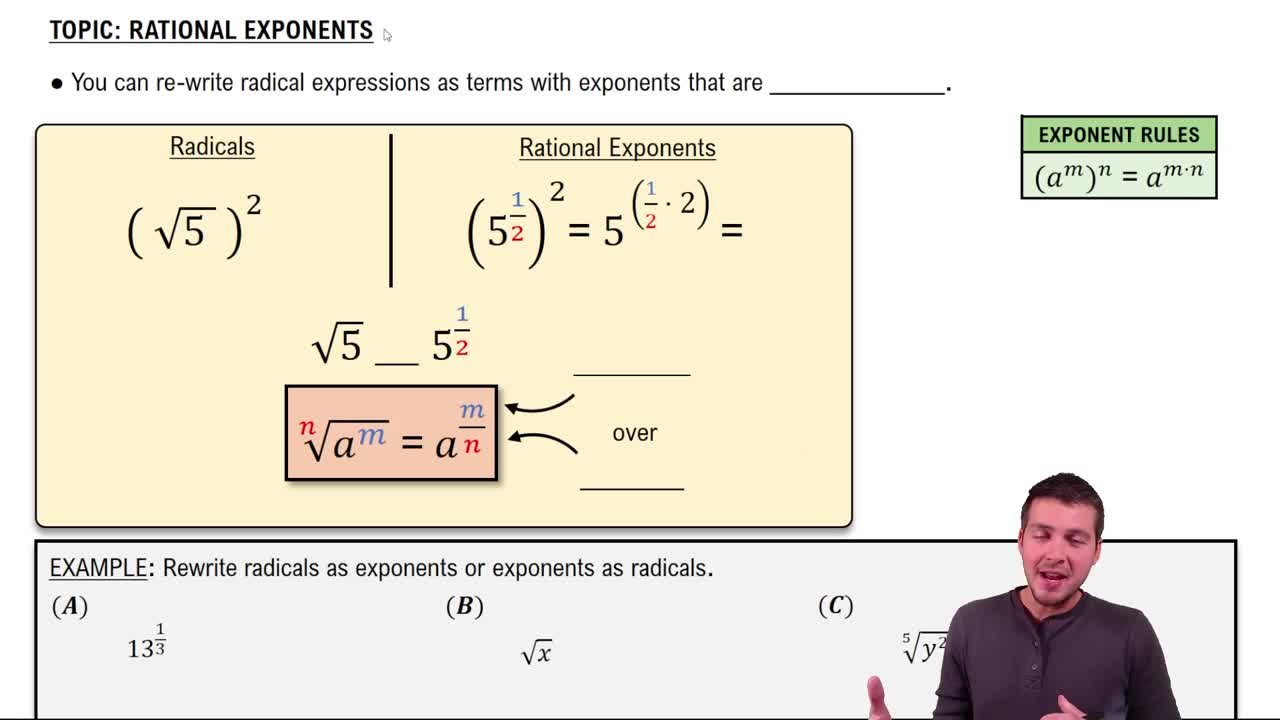
Rational Exponents
Distributive Property of Exponents over Multiplication
When an expression inside parentheses is raised to a power, the exponent applies to each factor inside. For instance, (ab)^n = a^n * b^n. This helps in breaking down (-2x^5)^5 into (-2)^5 * (x^5)^5 for easier simplification.
Recommended video:
Guided course
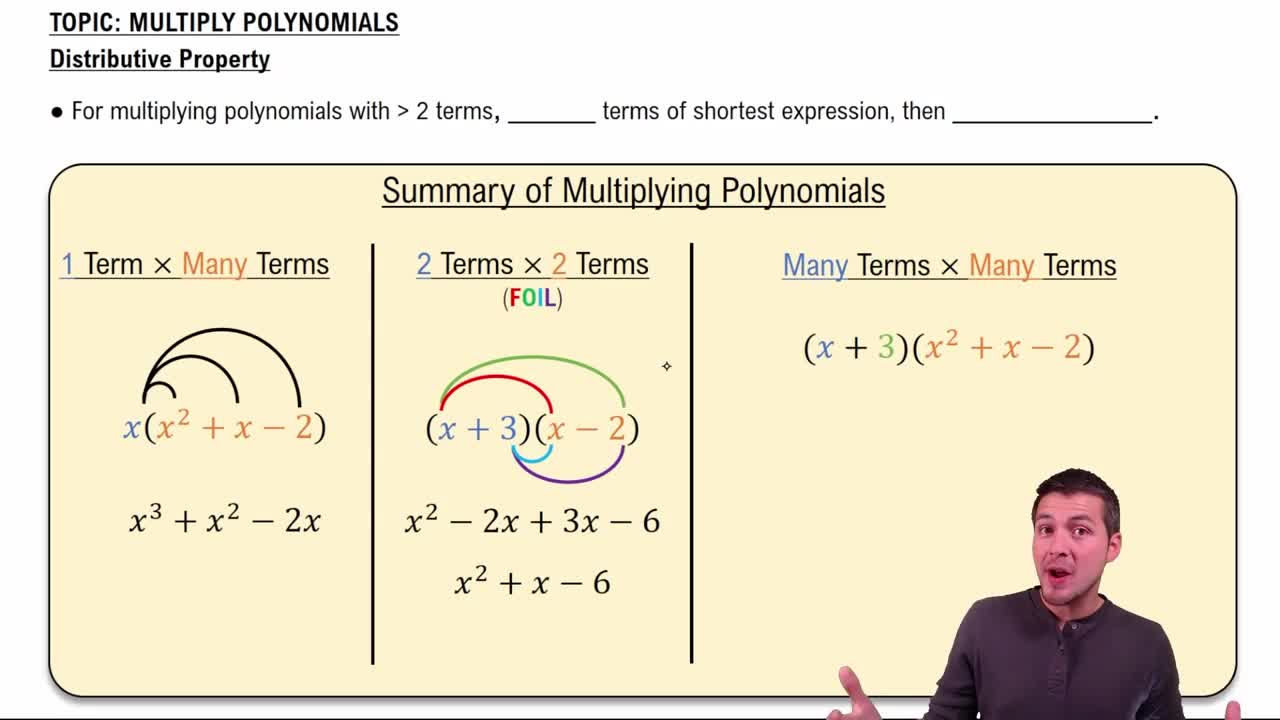
Multiply Polynomials Using the Distributive Property
Handling Negative Bases and Variables
When raising a negative number to a power, the sign depends on whether the exponent is even or odd. An odd exponent keeps the negative sign, while an even exponent makes it positive. Also, variables raised to powers follow exponent rules, assuming variables are nonzero.
Recommended video:
Guided course
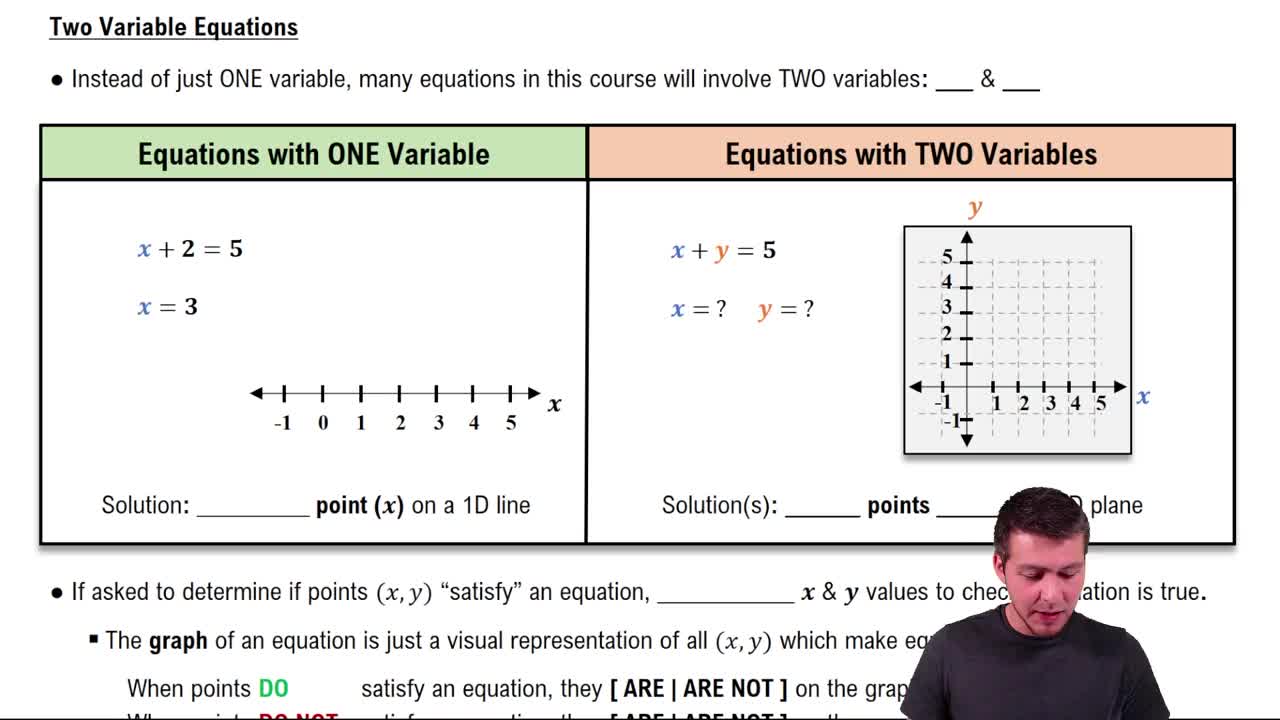
Equations with Two Variables
Related Practice
Textbook Question
8
views
Textbook Question
If the expression is in exponential form, write it in radical form and evaluate if possible. If it is in radical form, write it in exponential form. Assume all variables represent positive real numbers. -12x1/2
3
views
Textbook Question
Write each rational expression in lowest terms. 8k + 16 / 9k + 18
6
views
Textbook Question
Use set notation, and list all the elements of each set. {x | x is a natural number greater than 8 and less than 15}
8
views
Textbook Question
Multiply or divide as indicated. Write answers in lowest terms as needed. (5/9)∙(2/7)
8
views
Textbook Question
If the expression is in exponential form, write it in radical form and evaluate if possible. If it is in radical form, write it in exponential form. Assume all variables represent positive real numbers. -5z2/3
1
views