Use set notation, and list all the elements of each set. {x | x is a natural number not greater than 4}
Ch. R - Review of Basic Concepts

Chapter 1, Problem 26
Add or subtract, as indicated.
Verified step by step guidance1
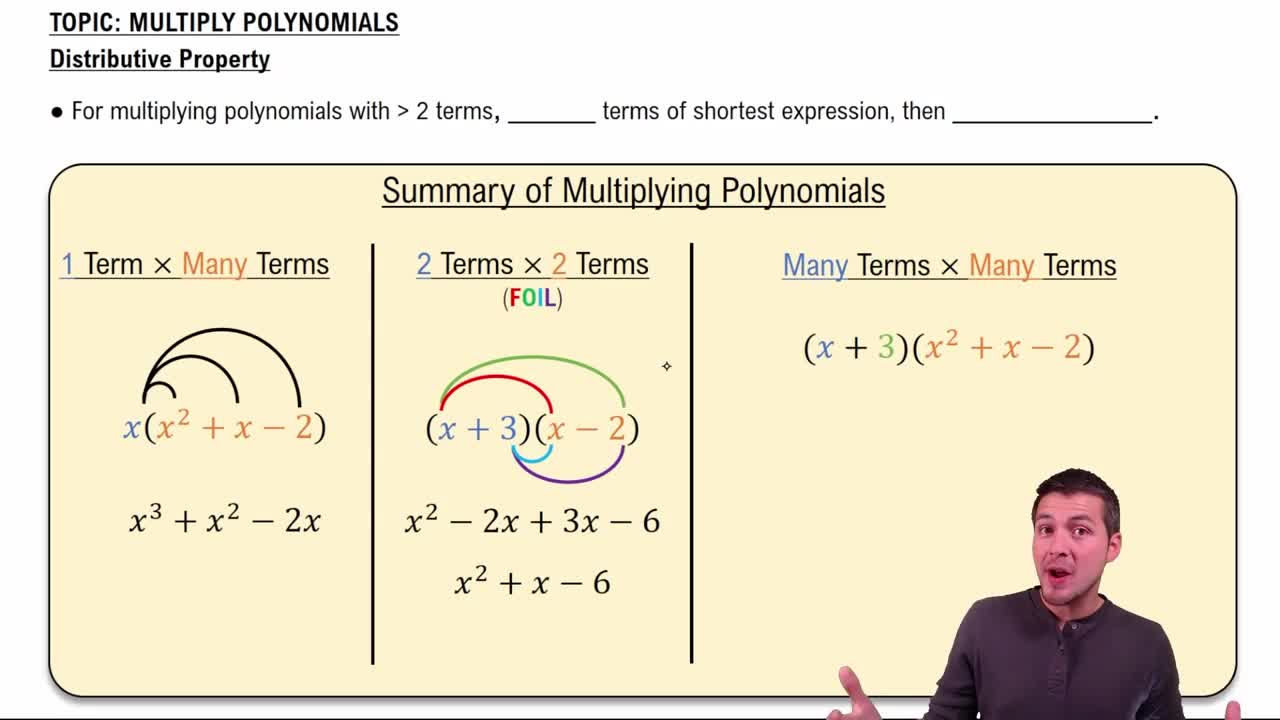
First, apply the distributive property to each term inside the parentheses. Multiply 3 by each term in the first parentheses: \(3 \times 8p^2\) and \(3 \times (-5p)\).
Next, apply the distributive property to the second parentheses, multiplying -5 by each term inside: \(-5 \times 3p^2\), \(-5 \times (-2p)\), and \(-5 \times 4\).
Rewrite the expression with the distributed terms: \(24p^2 - 15p - 15p^2 + 10p - 20\).
Combine like terms by grouping the \(p^2\) terms together and the \(p\) terms together: \((24p^2 - 15p^2) + (-15p + 10p) - 20\).
Simplify each group to get the final expression in standard form, combining coefficients of like terms.

Verified video answer for a similar problem:
This video solution was recommended by our tutors as helpful for the problem above.
Video duration:
1mWas this helpful?
Key Concepts
Here are the essential concepts you must grasp in order to answer the question correctly.
Distributive Property
The distributive property allows you to multiply a single term by each term inside a parenthesis. For example, a(b + c) = ab + ac. This is essential for expanding expressions like 3(8p^2 - 5p) by multiplying 3 with each term inside the parentheses.
Recommended video:
Guided course
Multiply Polynomials Using the Distributive Property
Combining Like Terms
Combining like terms involves adding or subtracting terms that have the same variable raised to the same power. For instance, 8p^2 and -15p^2 can be combined because both are terms with p squared. This simplifies the expression after distribution.
Recommended video:
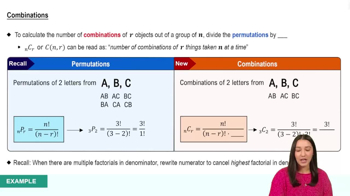
Combinations
Polynomial Subtraction
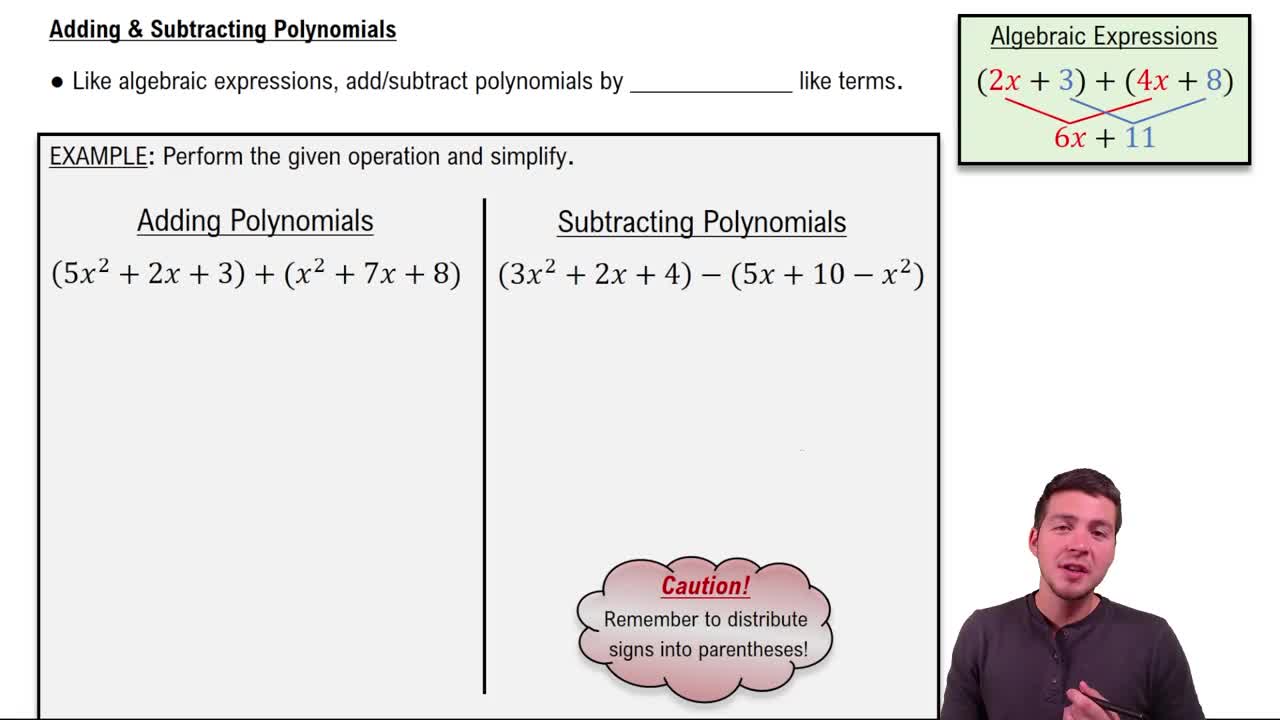
Polynomial subtraction requires careful attention to signs when subtracting one polynomial from another. You must distribute the negative sign across all terms in the second polynomial before combining like terms to avoid errors.
Recommended video:
Guided course
Adding and Subtracting Polynomials
Related Practice
Textbook Question
8
views
Textbook Question
Factor out the greatest common factor from each polynomial. See Example 1. 5(a+3)3-2(a+3)+(a+3)2
3
views
Textbook Question
Find each sum or difference. -6 + (-13)
3
views
Textbook Question
Insert ∈ or ∉ in each blank to make the resulting statement true. 6 _____ {3, 4, 5, 6}
3
views
Textbook Question
Concept Check When directed to completely factor the polynomial ,a student wrote . When the teacher did not give him full credit, he complained because when his answer is multiplied out, the result is the original polynomial. Give the correct answer.
5
views
Textbook Question
If the expression is in exponential form, write it in radical form and evaluate if possible. If it is in radical form, write it in exponential form. Assume all variables represent positive real numbers. -5z2/3
1
views