Ch. R - Review of Basic Concepts
Lial - College Algebra 13th Edition
Lial13th EditionCollege AlgebraISBN: 9780136881063Not the one you use?Change textbook
Chapter 1, Problem 70

Perform the indicated operations. See Examples 2–6.
z3(9z)+4z(2+3z)-z^3(9-z) + 4z(2+3z)

Verified step by step guidance
1
First, recognize that the expression involves distributing terms and combining like terms. The expression is -z3(9-z)+4z(2+3z).
Distribute -z3 across the terms inside the first parentheses: multiply -z3 by 9 and then by -z separately.
Distribute 4z across the terms inside the second parentheses: multiply 4z by 2 and then by 3z separately.
After distribution, write out all the terms explicitly and combine like terms by adding or subtracting coefficients of the same powers of z.
Simplify the expression by combining the coefficients and writing the final polynomial in standard form, ordered by descending powers of z.

Verified video answer for a similar problem:

This video solution was recommended by our tutors as helpful for the problem above.
Video duration:
1m
Was this helpful?

Key Concepts

Here are the essential concepts you must grasp in order to answer the question correctly.

Polynomial Operations

Polynomial operations involve addition, subtraction, multiplication, and division of polynomial expressions. Understanding how to combine like terms and apply distributive properties is essential for simplifying expressions like the given problem.
Recommended video:
Guided course
8:38
Performing Row Operations on Matrices

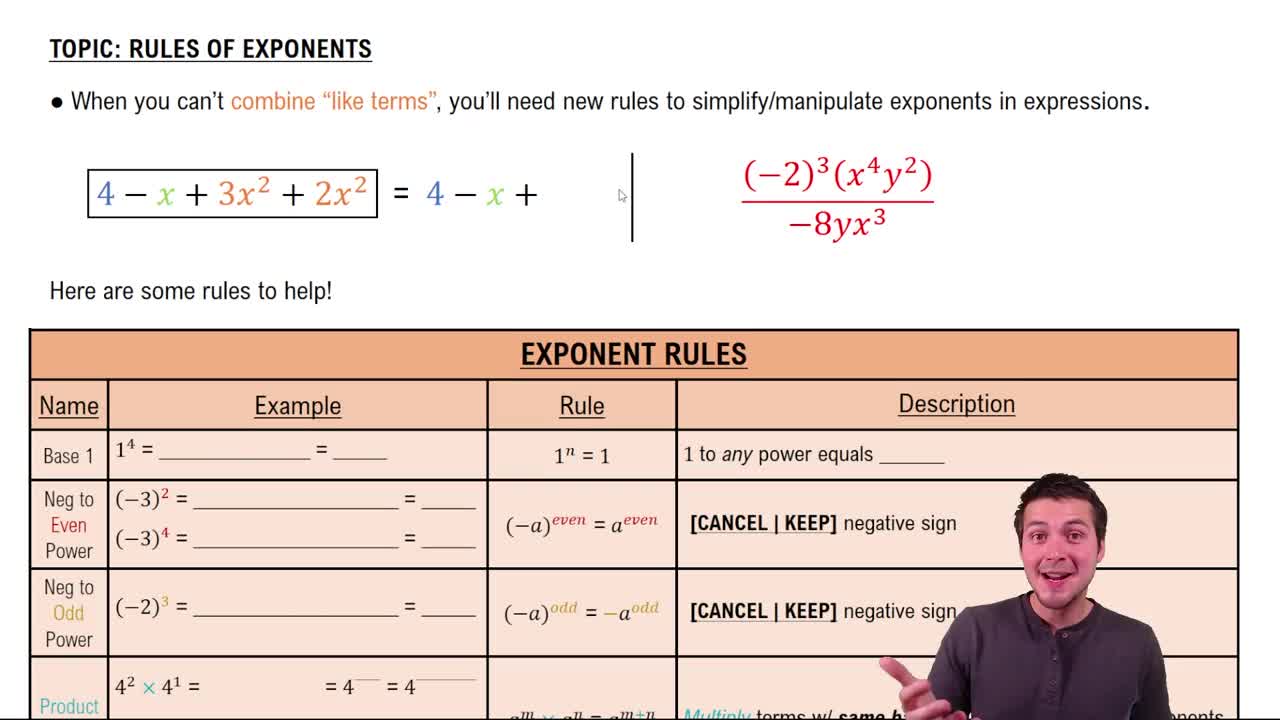
Exponent Rules

Exponent rules govern how to handle powers of variables, such as multiplying powers with the same base or raising a power to another power. Recognizing that z^3 means z multiplied by itself three times helps in correctly expanding and simplifying terms.
Recommended video:
Guided course
7:39
Introduction to Exponent Rules

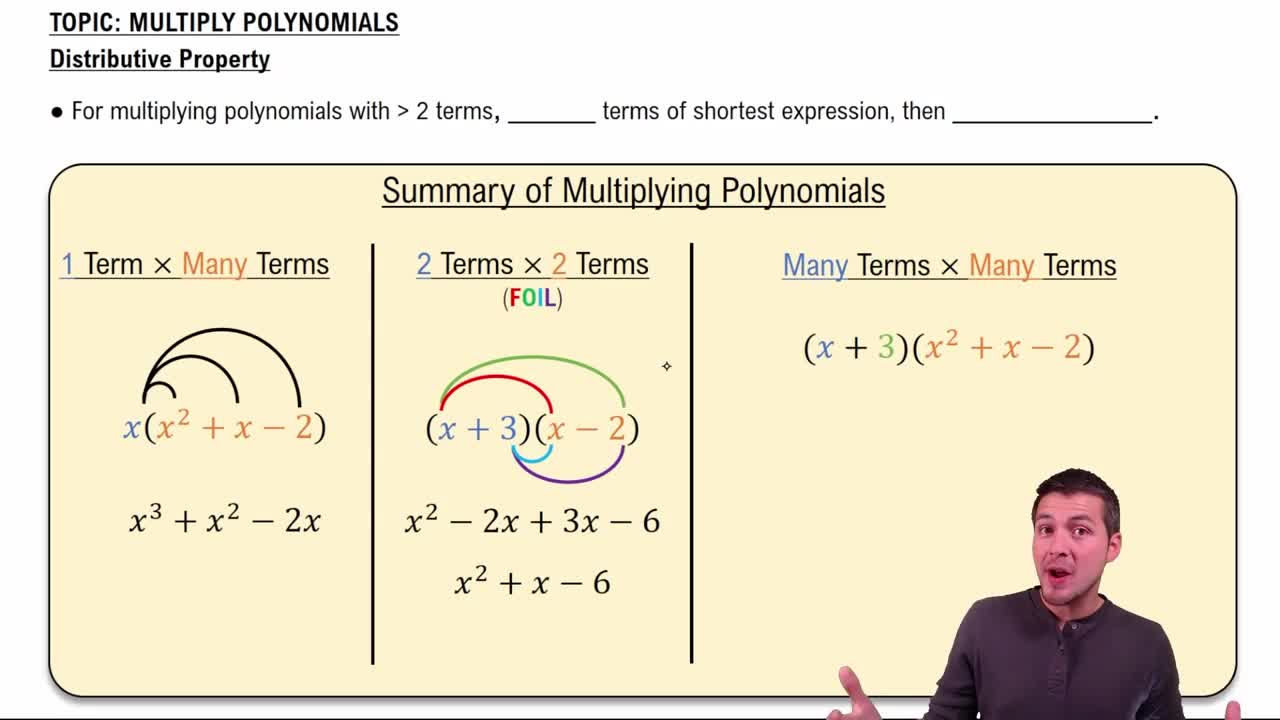
Distributive Property

The distributive property states that a(b + c) = ab + ac. This property is crucial for expanding expressions like -z^3(9 - z) and 4z(2 + 3z), allowing each term inside the parentheses to be multiplied by the term outside.
Recommended video:
Guided course
04:15
Multiply Polynomials Using the Distributive Property