Ch. R - Review of Basic Concepts
Lial - College Algebra 13th Edition
Lial13th EditionCollege AlgebraISBN: 9780136881063Not the one you use?Change textbook
Chapter 1, Problem 69

Add or subtract as indicated. Write answers in lowest terms as needed. 7/12 - 1/3

Verified step by step guidance
1
Identify the fractions involved: \( \frac{7}{12} \) and \( \frac{1}{3} \).
Find a common denominator for the fractions. Since 12 is a multiple of 3, the least common denominator (LCD) is \( 12 \).
Rewrite \( \frac{1}{3} \) with the denominator 12 by multiplying numerator and denominator by 4: \( \frac{1 \times 4}{3 \times 4} = \frac{4}{12} \).
Perform the subtraction with the common denominator: \( \frac{7}{12} - \frac{4}{12} = \frac{7 - 4}{12} = \frac{3}{12} \).
Simplify the resulting fraction \( \frac{3}{12} \) by dividing numerator and denominator by their greatest common divisor (GCD), which is 3.

Verified video answer for a similar problem:

This video solution was recommended by our tutors as helpful for the problem above.
Video duration:
2m
Was this helpful?

Key Concepts

Here are the essential concepts you must grasp in order to answer the question correctly.

Finding a Common Denominator

To add or subtract fractions, they must have the same denominator. This involves finding the least common denominator (LCD), which is the smallest number that both denominators divide into evenly. For example, for 7/12 and 1/3, the LCD is 12.
Recommended video:
Guided course
02:58
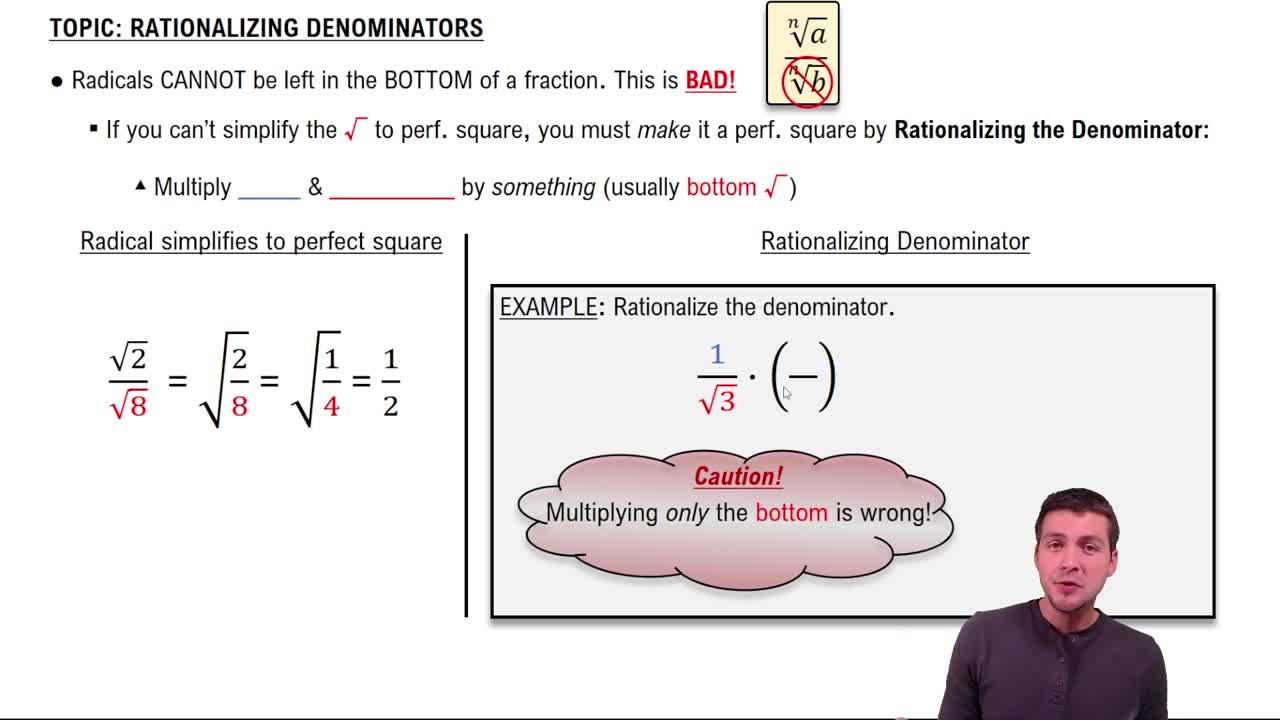
Rationalizing Denominators

Performing Fraction Subtraction

Once fractions have a common denominator, subtract the numerators while keeping the denominator the same. For instance, with 7/12 and 4/12 (equivalent of 1/3), subtract 7 - 4 to get 3/12.
Recommended video:
Guided course
05:45
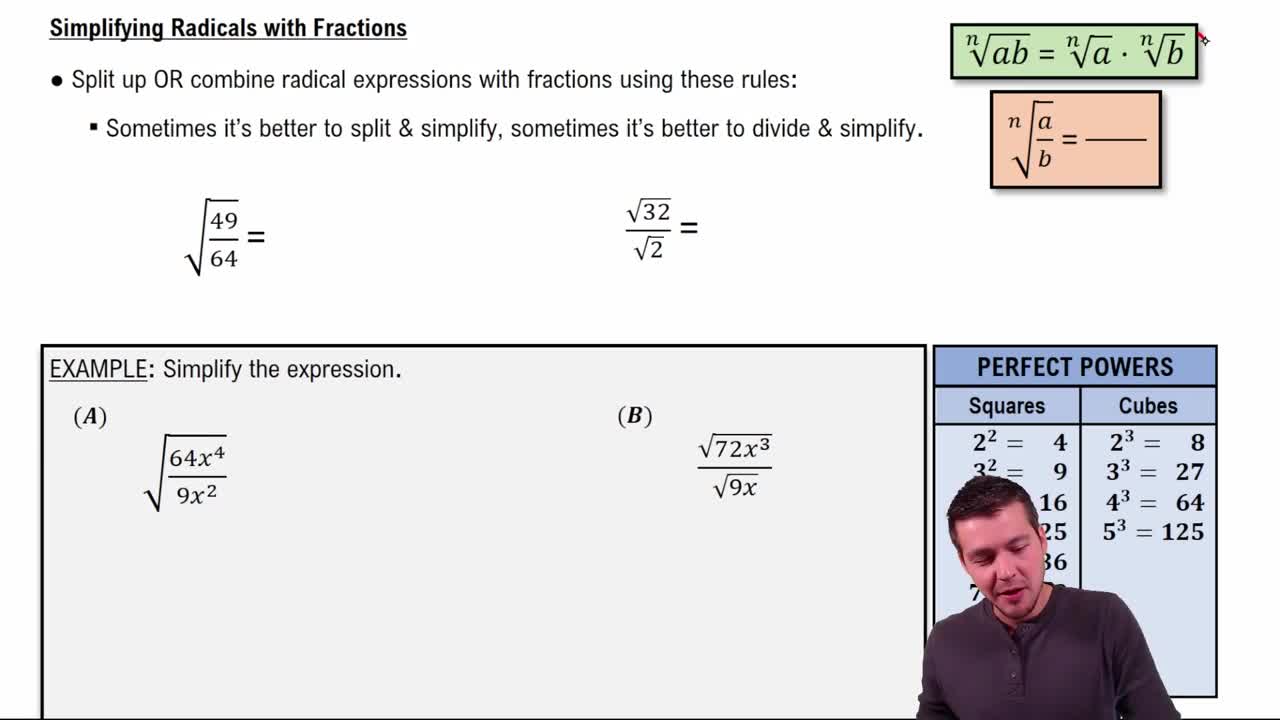
Radical Expressions with Fractions

Simplifying Fractions to Lowest Terms

After performing the operation, simplify the fraction by dividing numerator and denominator by their greatest common divisor (GCD). For example, 3/12 simplifies to 1/4 by dividing both by 3.
Recommended video:
Guided course
05:45
Radical Expressions with Fractions