Ch. R - Review of Basic Concepts
Lial - College Algebra 13th Edition
Lial13th EditionCollege AlgebraISBN: 9780136881063Not the one you use?Change textbook
Chapter 1, Problem 89

Perform each division. See Examples 9 and 10. (q2+4q-32)/(q-4)

Verified step by step guidance
1
Identify the division problem as a polynomial division: \(\frac{q^2 + 4q - 32}{q - 4}\).
Set up the division using either long division or synthetic division. For long division, write \(q^2 + 4q - 32\) under the division bar and \(q - 4\) outside.
Divide the leading term of the numerator \(q^2\) by the leading term of the denominator \(q\) to get the first term of the quotient: \(q\).
Multiply the entire divisor \(q - 4\) by this term \(q\) and subtract the result from the original polynomial to find the new remainder.
Repeat the process with the new remainder: divide the leading term of the remainder by \(q\), multiply the divisor by this term, subtract again, and continue until the degree of the remainder is less than the degree of the divisor.

Verified video answer for a similar problem:

This video solution was recommended by our tutors as helpful for the problem above.
Video duration:
1m
Was this helpful?

Key Concepts

Here are the essential concepts you must grasp in order to answer the question correctly.

Polynomial Division

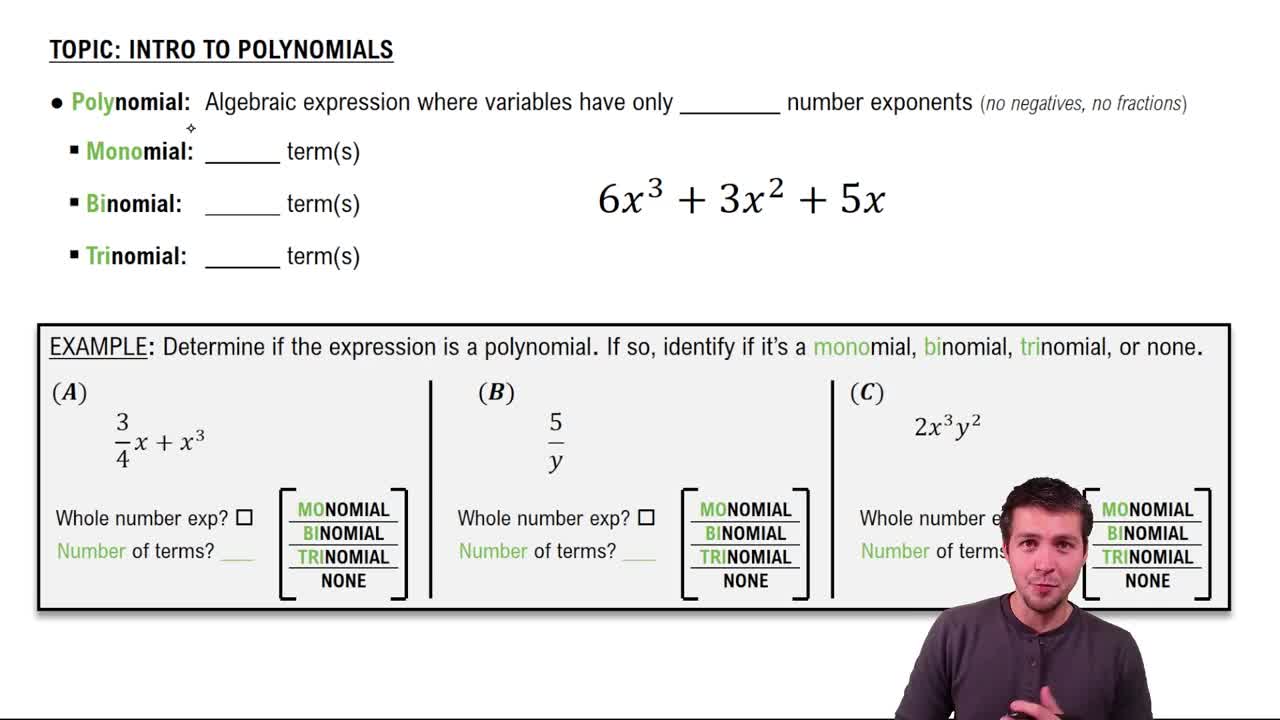
Polynomial division is the process of dividing one polynomial by another, similar to long division with numbers. It helps simplify expressions or find quotients and remainders. In this problem, dividing (q^2 + 4q - 32) by (q - 4) involves determining how many times the divisor fits into the dividend.
Recommended video:
Guided course
05:13
Introduction to Polynomials

Factoring Polynomials

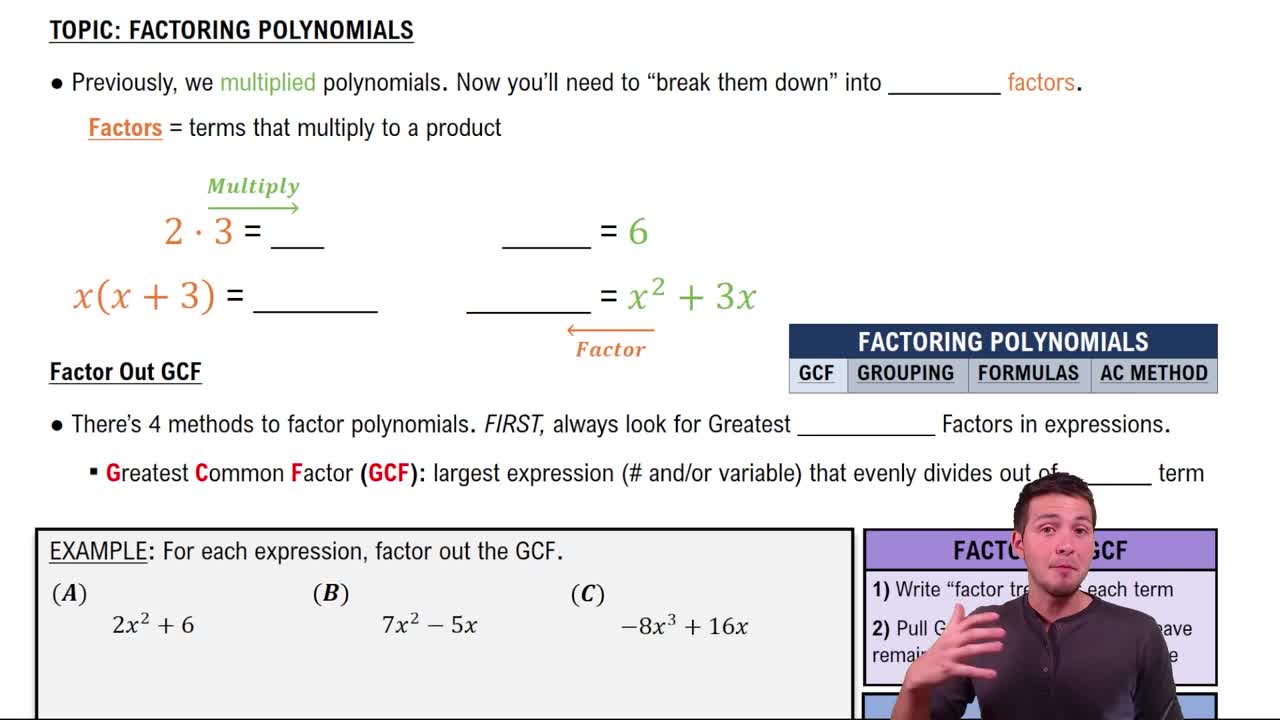
Factoring involves rewriting a polynomial as a product of simpler polynomials. Recognizing factors can simplify division problems by canceling common terms. For example, factoring q^2 + 4q - 32 may reveal a factor of (q - 4), making division straightforward.
Recommended video:
Guided course
07:30
Introduction to Factoring Polynomials

Remainder Theorem

The Remainder Theorem states that the remainder of dividing a polynomial f(x) by (x - c) is f(c). This helps verify the result of polynomial division and determine if the divisor is a factor. Evaluating the polynomial at q = 4 can confirm if (q - 4) divides evenly.
Recommended video:
05:10
Higher Powers of i