Ch. R - Review of Basic Concepts
Lial - College Algebra 13th Edition
Lial13th EditionCollege AlgebraISBN: 9780136881063Not the one you use?Change textbook
Chapter 1, Problem 89

Let U = {0, 1, 2, 3, 4, 5, 6, 7, 8, 9, 10, 11, 12, 13}, M = {0, 2, 4, 6, 8}, N = {1, 3, 5, 7, 9, 11, 13}, Q = {0, 2, 4, 6, 8, 10, 12}, and R = {0, 1, 2, 3, 4}.Use these sets to find each of the following. Identify any disjoint sets. N′

Verified step by step guidance
1
Step 1: Understand the problem. You are given a universal set \(U\) and several subsets \(M\), \(N\), \(Q\), and \(R\). The task is to find the complement of set \(N\), denoted as \(N^{\prime}\), relative to the universal set \(U\).
Step 2: Recall the definition of the complement of a set. The complement \(N^{\prime}\) consists of all elements in the universal set \(U\) that are NOT in \(N\). Mathematically, \(N^{\prime} = \{ x \in U : x \notin N \}\).
Step 3: List the elements of \(N\) explicitly: \(N = \{1, 3, 5, 7, 9, 11, 13\}\).
Step 4: Identify all elements in \(U\) that are not in \(N\). Since \(U = \{0, 1, 2, 3, 4, 5, 6, 7, 8, 9, 10, 11, 12, 13\}\), remove all elements of \(N\) from \(U\) to find \(N^{\prime}\).
Step 5: Write the complement set \(N^{\prime}\) explicitly as the set of elements remaining after removing \(N\) from \(U\). This will give you the final answer for \(N^{\prime}\).

Verified video answer for a similar problem:

This video solution was recommended by our tutors as helpful for the problem above.
Video duration:
1m
Was this helpful?

Key Concepts

Here are the essential concepts you must grasp in order to answer the question correctly.

Universal Set and Complement

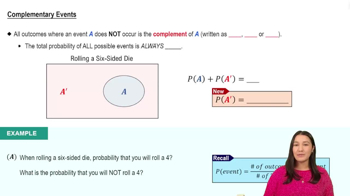
The universal set U contains all elements under consideration. The complement of a set N, denoted N′, includes all elements in U that are not in N. Understanding complements helps in identifying elements outside a given subset within the universal set.
Recommended video:
4:23
Complementary Events

Set Notation and Membership

Set notation uses curly braces to list elements, and membership indicates whether an element belongs to a set. Recognizing which elements belong to each set is essential for operations like finding complements or intersections.
Recommended video:
05:18
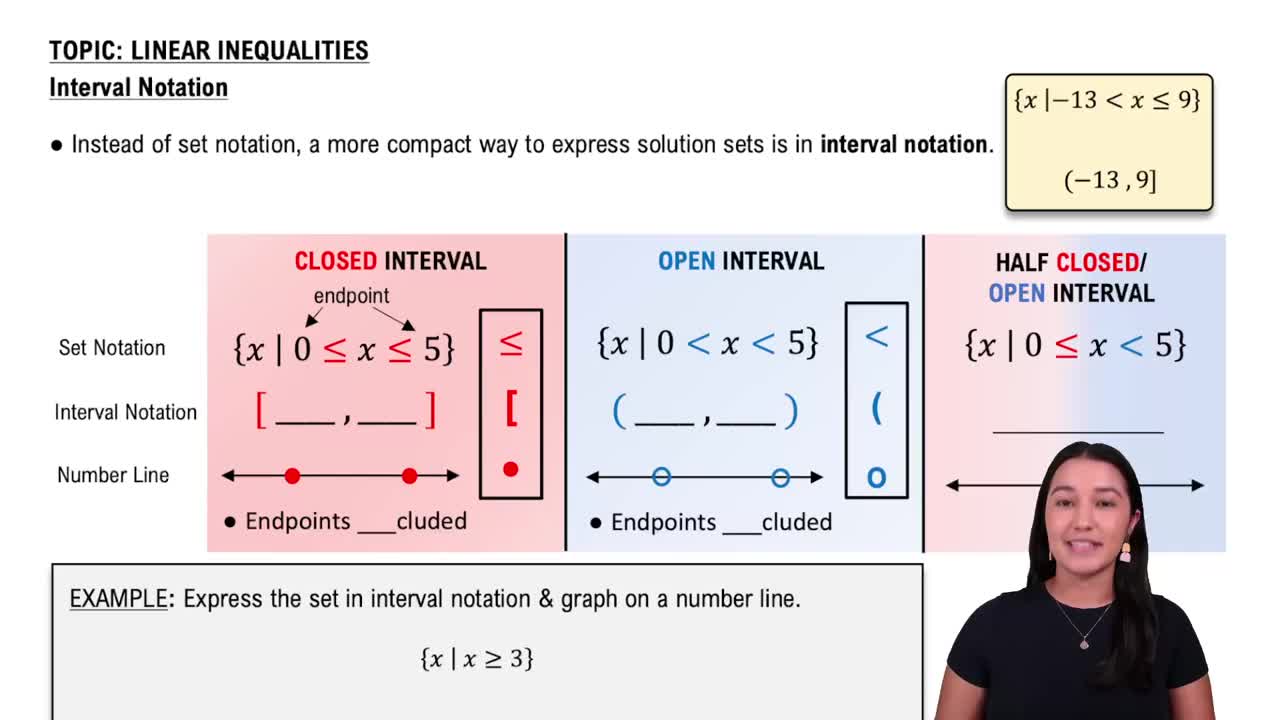
Interval Notation

Disjoint Sets

Two sets are disjoint if they have no elements in common. Identifying disjoint sets involves checking for empty intersections, which is important for understanding relationships between sets and solving related problems.
Recommended video:
05:18
Interval Notation