Ch. 4 - Inverse, Exponential, and Logarithmic Functions
Lial - College Algebra 13th Edition
Lial13th EditionCollege AlgebraISBN: 9780136881063Not the one you use?Change textbook
Chapter 5, Problem 22

For ƒ(x) = 3x and g(x)= (1/4)x find each of the following. Round answers to the nearest thousandth as needed. g(-5/2)

Verified step by step guidance
1
Identify the function g(x) given as \(g(x) = \left( \frac{1}{4} \right)^x\).
Substitute the given value \(x = -\frac{5}{2}\) into the function: \(g\left(-\frac{5}{2}\right) = \left( \frac{1}{4} \right)^{-\frac{5}{2}}\).
Recall the property of exponents: \(a^{-b} = \frac{1}{a^b}\). Use this to rewrite the expression as \(\left( \frac{1}{4} \right)^{-\frac{5}{2}} = 4^{\frac{5}{2}}\).
Express \(4^{\frac{5}{2}}\) as \(\left(4^{\frac{1}{2}}\right)^5\) or \(\left(\sqrt{4}\right)^5\) to simplify the calculation.
Calculate \(\sqrt{4}\), then raise the result to the 5th power, and round the final answer to the nearest thousandth.

Verified video answer for a similar problem:

This video solution was recommended by our tutors as helpful for the problem above.
Video duration:
1m
Was this helpful?

Key Concepts

Here are the essential concepts you must grasp in order to answer the question correctly.

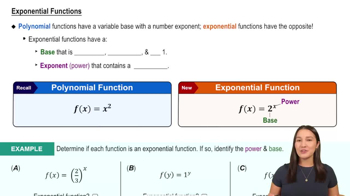
Exponential Functions

Exponential functions have the form f(x) = a^x, where the base a is a positive constant. They model growth or decay processes and have unique properties such as a constant ratio between successive outputs. Understanding how to evaluate these functions for any real exponent is essential.
Recommended video:
6:13
Exponential Functions

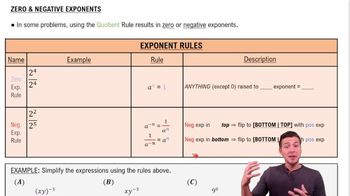
Negative and Fractional Exponents

Negative exponents represent the reciprocal of the base raised to the positive exponent, e.g., a^(-n) = 1/a^n. Fractional exponents correspond to roots, such as a^(1/2) = √a. Evaluating functions at negative or fractional inputs requires applying these rules correctly.
Recommended video:
Guided course
6:37
Zero and Negative Rules

Rounding and Approximation

When calculating values that result in irrational or long decimal numbers, rounding to a specified decimal place is necessary. Rounding to the nearest thousandth means keeping three digits after the decimal point, ensuring answers are both precise and manageable.
Recommended video:
4:20
Graph Hyperbolas at the Origin