Ch. 4 - Inverse, Exponential, and Logarithmic Functions
Lial - College Algebra 13th Edition
Lial13th EditionCollege AlgebraISBN: 9780136881063Not the one you use?Change textbook
Chapter 5, Problem 21

For ƒ(x) = 3x and g(x)= (1/4)x find each of the following. Round answers to the nearest thousandth as needed. g(3/2)

Verified step by step guidance
1
Identify the function g(x) given as \(g(x) = \left( \frac{1}{4} \right)^x\).
Substitute the given input value \(x = \frac{3}{2}\) into the function: \(g\left( \frac{3}{2} \right) = \left( \frac{1}{4} \right)^{\frac{3}{2}}\).
Rewrite the expression using properties of exponents: \(\left( \frac{1}{4} \right)^{\frac{3}{2}} = \left( \left( \frac{1}{4} \right)^3 \right)^{\frac{1}{2}}\) or equivalently \(\sqrt{\left( \frac{1}{4} \right)^3}\).
Calculate the inner exponentiation \(\left( \frac{1}{4} \right)^3\) by raising both numerator and denominator to the power 3.
Take the square root of the result from the previous step to find \(g\left( \frac{3}{2} \right)\), then round your answer to the nearest thousandth.

Verified video answer for a similar problem:

This video solution was recommended by our tutors as helpful for the problem above.
Video duration:
1m
Was this helpful?

Key Concepts

Here are the essential concepts you must grasp in order to answer the question correctly.

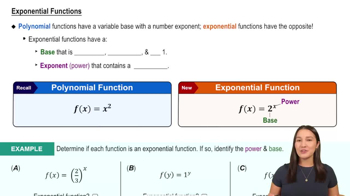
Exponential Functions

Exponential functions have the form f(x) = a^x, where the base a is a positive constant. They model growth or decay processes and are defined for all real numbers x. Understanding how to evaluate these functions at given inputs is essential for solving problems like finding g(3/2).
Recommended video:
6:13
Exponential Functions

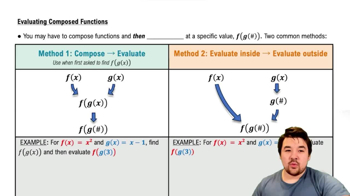
Evaluating Functions at a Given Input

Evaluating a function means substituting the input value into the function's formula and simplifying. For example, to find g(3/2), replace x with 3/2 in g(x) = (1/4)^x and calculate the result. This process requires knowledge of exponent rules and arithmetic.
Recommended video:
4:26
Evaluating Composed Functions

Rounding to a Specified Decimal Place

Rounding involves approximating a number to a certain number of decimal places for simplicity or clarity. Here, answers should be rounded to the nearest thousandth, meaning three digits after the decimal point. Proper rounding ensures the final answer is both accurate and easy to interpret.
Recommended video:
4:47
The Number e