Distance to the Horizon The distance that a person can see to the horizon on a clear day from a point above the surface of Earth varies directly as the square root of the height at that point. If a person 144 m above the surface of Earth can see 18 km to the horizon, how far can a person see to the horizon from a point 64 m above the surface?
Ch. 3 - Polynomial and Rational Functions

Chapter 4, Problem 31
Use synthetic division to divide ƒ(x) by x-k for the given value of k. Then express ƒ(x) in the form ƒ(x) = (x-k) q(x) + r. ƒ(x) = 3x4 + 4x3 - 10x2 + 15; k = -1
Verified step by step guidance1
Write down the coefficients of the polynomial ƒ(x) = 3x^4 + 4x^3 - 10x^2 + 0x + 15. Note that the coefficient of x is 0, so the coefficients are: 3, 4, -10, 0, 15.
Set up synthetic division using k = -1. Write -1 to the left and the coefficients 3, 4, -10, 0, 15 in a row to the right.
Bring down the first coefficient (3) as it is. Then multiply this number by k (-1) and write the result under the next coefficient. Add the column and write the sum below.
Repeat the multiply and add process for each coefficient: multiply the last sum by -1, write it under the next coefficient, then add down the column. Continue until all coefficients have been processed.
The final row of numbers (except the last one) represents the coefficients of the quotient polynomial q(x). The last number is the remainder r. Express ƒ(x) as ƒ(x) = (x - (-1)) q(x) + r, or ƒ(x) = (x + 1) q(x) + r.

Verified video answer for a similar problem:
This video solution was recommended by our tutors as helpful for the problem above.
Video duration:
6mWas this helpful?
Key Concepts
Here are the essential concepts you must grasp in order to answer the question correctly.
Synthetic Division
Synthetic division is a shortcut method for dividing a polynomial by a linear factor of the form x - k. It simplifies the long division process by using only the coefficients of the polynomial and the value k, making calculations faster and less error-prone.
Recommended video:
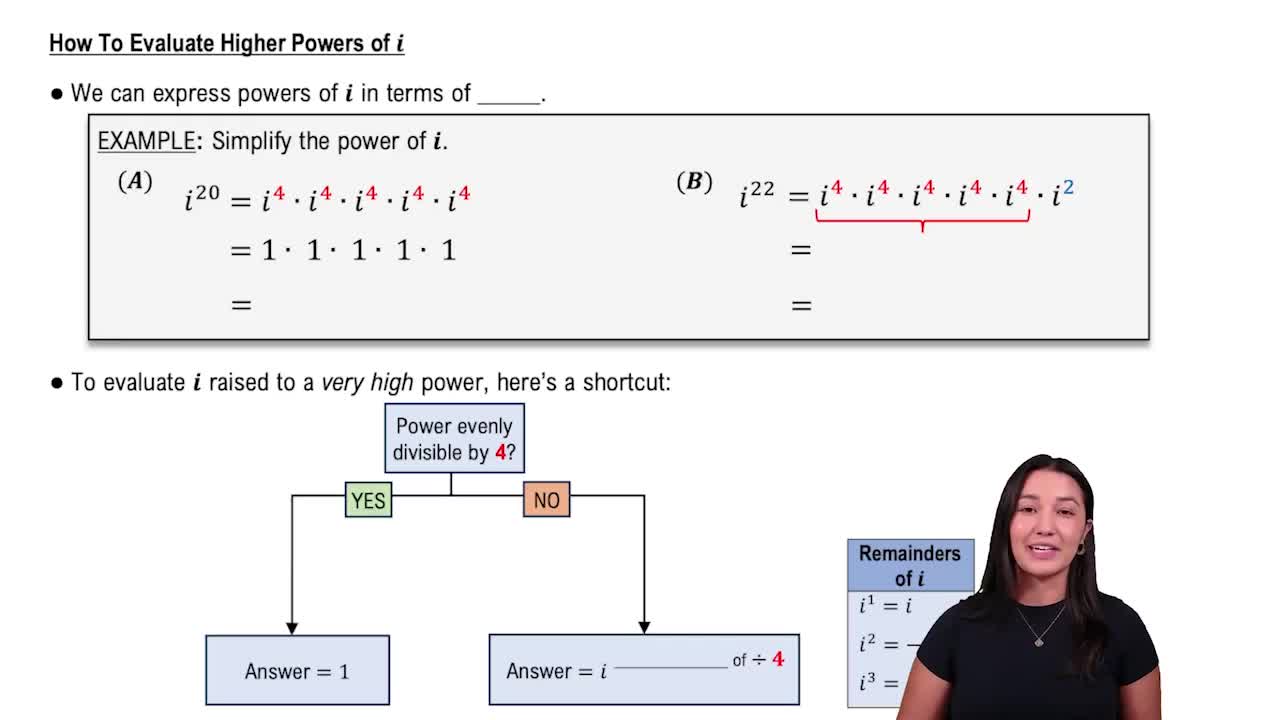
Higher Powers of i
Polynomial Division and Remainder Theorem
When dividing a polynomial ƒ(x) by (x - k), the result can be expressed as ƒ(x) = (x - k)q(x) + r, where q(x) is the quotient polynomial and r is the remainder. The Remainder Theorem states that the remainder r equals ƒ(k), the value of the polynomial evaluated at k.
Recommended video:
Guided course
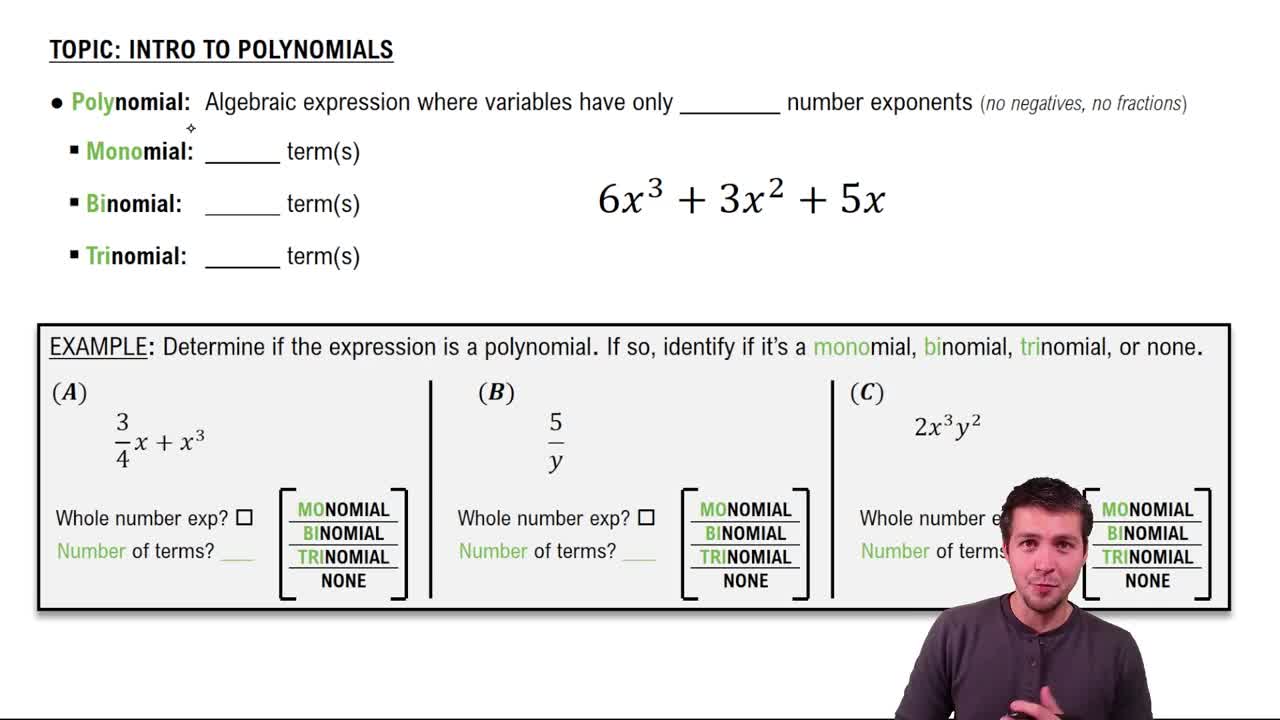
Introduction to Polynomials
Polynomial Coefficients and Degree
Understanding the degree of the polynomial and its coefficients is essential for setting up synthetic division correctly. The degree indicates the number of terms, and each coefficient must be placed in order, including zeros for missing terms, to ensure accurate division.
Recommended video:
Guided course
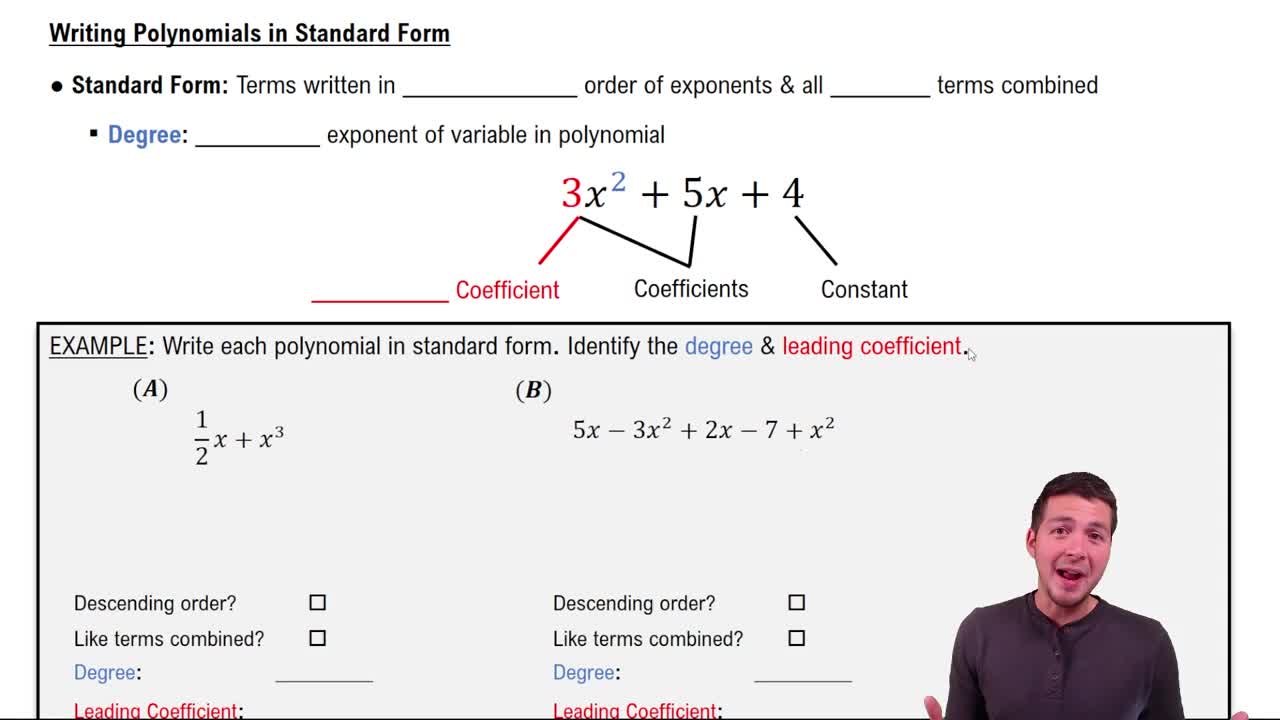
Standard Form of Polynomials
Related Practice
Textbook Question
Textbook Question
Factor into linear factors given that k is a zero. (multiplicity )
Textbook Question
Show that each polynomial function has a real zero as described in parts (a) and (b). In Exercises 31 and 32, also work part (c). ƒ(x)=3x^3-8x^2+x+2 Find the zero in part (b) to three decimal places.
2
views
Textbook Question
Show that each polynomial function has a real zero as described in parts (a) and (b). In Exercises 31 and 32, also work part (c). ƒ(x)=3x^3-8x^2+x+2 between 2 and 3
4
views
Textbook Question
Solve each polynomial inequality. Give the solution set in interval notation. -(x - 3)(x - 4)2 (x - 5) > 0
3
views
Textbook Question
Show that each polynomial function has a real zero as described in parts (a) and (b). In Exercises 31 and 32, also work part (c). ƒ(x)=3x^3-8x^2+x+2 between -1 and 0
2
views
