Distance to the Horizon The distance that a person can see to the horizon on a clear day from a point above the surface of Earth varies directly as the square root of the height at that point. If a person 144 m above the surface of Earth can see 18 km to the horizon, how far can a person see to the horizon from a point 64 m above the surface?
Ch. 3 - Polynomial and Rational Functions

Chapter 4, Problem 31a
Show that each polynomial function has a real zero as described in parts (a) and (b). In Exercises 31 and 32, also work part (c). ƒ(x)=3x^3-8x^2+x+2 between -1 and 0
Verified step by step guidance1
First, identify the polynomial function given: \(f(x) = 3x^3 - 8x^2 + x + 2\).
Evaluate the function at the endpoints of the interval given, which are \(x = -1\) and \(x = 0\). Calculate \(f(-1)\) and \(f(0)\) separately by substituting these values into the function.
Check the signs of \(f(-1)\) and \(f(0)\). If \(f(-1)\) and \(f(0)\) have opposite signs (one positive and one negative), then by the Intermediate Value Theorem, there must be at least one real zero of \(f(x)\) between \(-1\) and \(0\).
Recall that the Intermediate Value Theorem states: If a function \(f\) is continuous on a closed interval \([a, b]\) and \(f(a)\) and \(f(b)\) have opposite signs, then there exists at least one \(c\) in \((a, b)\) such that \(f(c) = 0\).
Since polynomial functions are continuous everywhere, this theorem applies directly to \(f(x)\) on the interval \([-1, 0]\), confirming the existence of a real zero between \(-1\) and \(0\) if the sign change is observed.

Verified video answer for a similar problem:
This video solution was recommended by our tutors as helpful for the problem above.
Video duration:
3mWas this helpful?
Key Concepts
Here are the essential concepts you must grasp in order to answer the question correctly.
Polynomial Functions
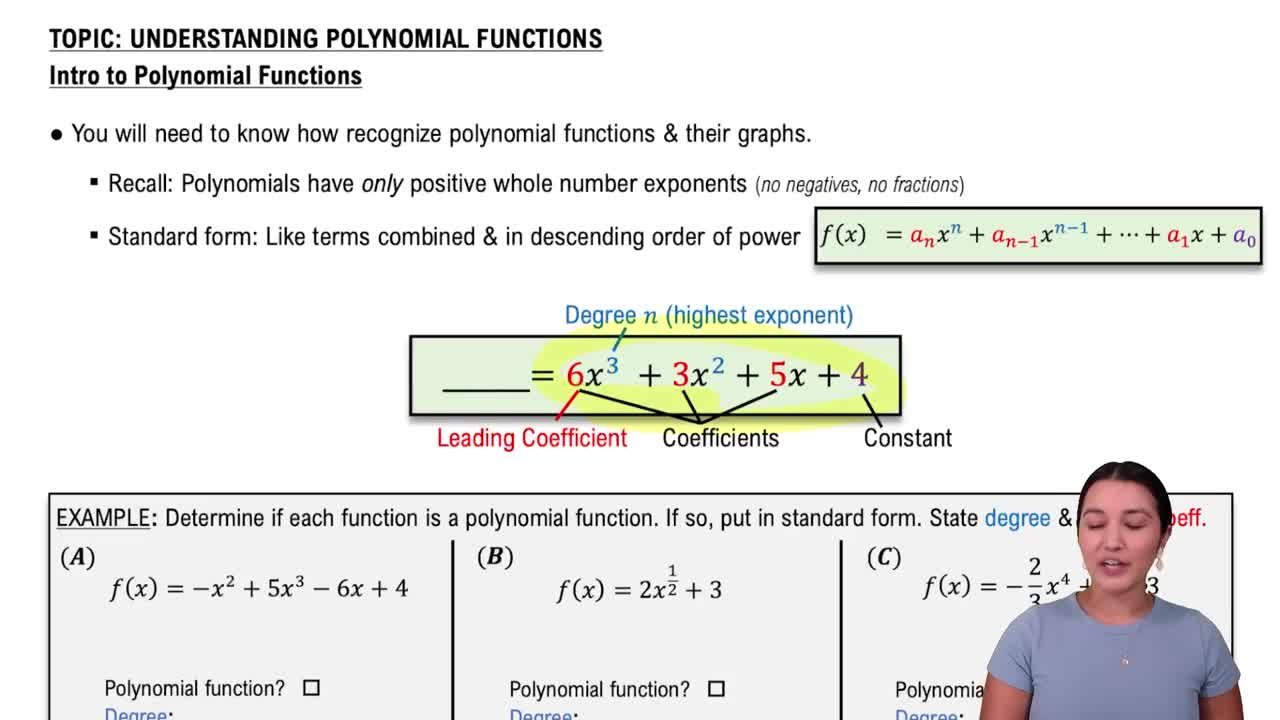
A polynomial function is an expression consisting of variables and coefficients combined using addition, subtraction, multiplication, and non-negative integer exponents. Understanding the degree and behavior of polynomial functions helps in analyzing their roots and graph shapes.
Recommended video:
Introduction to Polynomial Functions
Intermediate Value Theorem
The Intermediate Value Theorem states that if a continuous function changes sign over an interval [a, b], then it must have at least one root in that interval. This theorem is essential for proving the existence of real zeros between two points.
Recommended video:
Introduction to Hyperbolas
Evaluating Functions at Specific Points
Evaluating a polynomial at specific values helps determine the sign of the function at those points. By checking values at the endpoints of an interval, one can apply the Intermediate Value Theorem to confirm the presence of a root within that interval.
Recommended video:
Evaluating Composed Functions
Related Practice
Textbook Question
Textbook Question
Use synthetic division to divide ƒ(x) by x-k for the given value of k. Then express ƒ(x) in the form ƒ(x) = (x-k) q(x) + r. ƒ(x) = 3x4 + 4x3 - 10x2 + 15; k = -1
5
views
Textbook Question
Factor into linear factors given that k is a zero. (multiplicity )
Textbook Question
Show that each polynomial function has a real zero as described in parts (a) and (b). In Exercises 31 and 32, also work part (c). ƒ(x)=3x^3-8x^2+x+2 Find the zero in part (b) to three decimal places.
2
views
Textbook Question
Factor into linear factors given that k is a zero. (multiplicity )
Textbook Question
Show that each polynomial function has a real zero as described in parts (a) and (b). In Exercises 31 and 32, also work part (c). ƒ(x)=3x^3-8x^2+x+2 between 2 and 3
4
views
