
Textbook Question
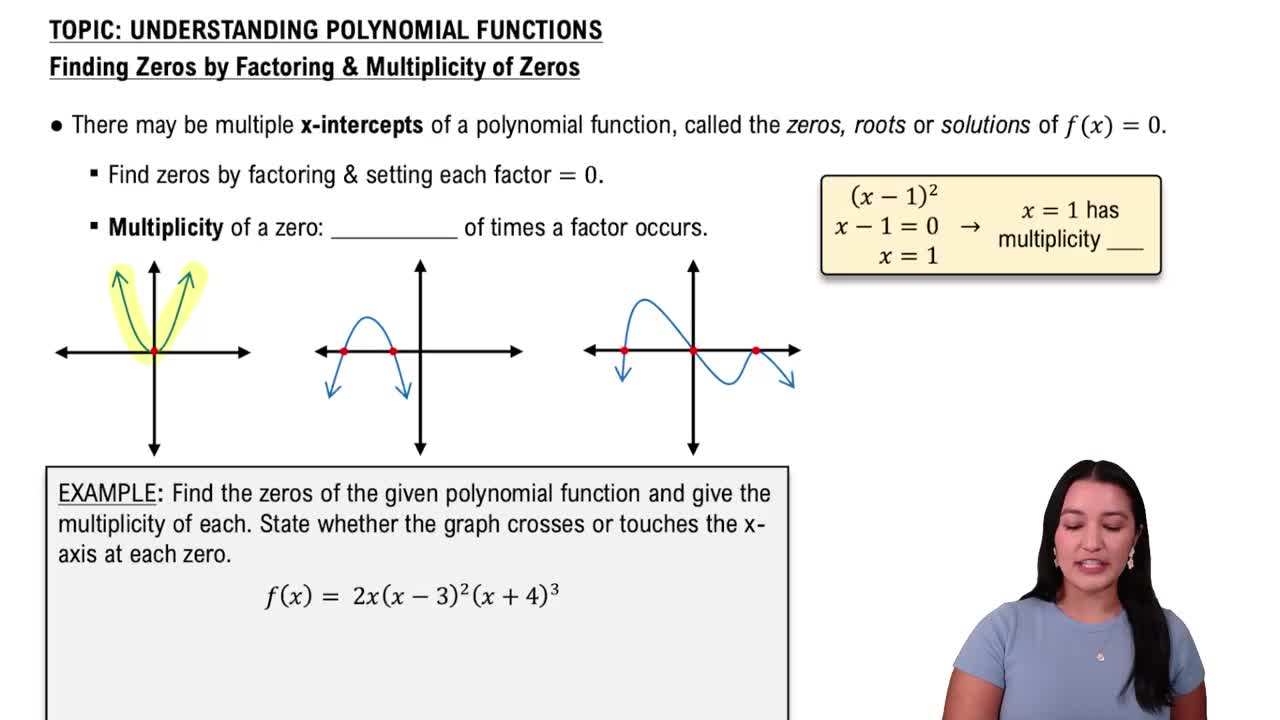
For each polynomial function, find all zeros and their multiplicities.

 Verified step by step guidance
 05:10
05:10
 03:42
03:42 06:04
06:04For each polynomial function, find all zeros and their multiplicities.
Solve each polynomial inequality. Give the solution set in interval notation. x4 + 6x2 + 1 ≥ 4x3 + 4x
Graph each polynomial function. ƒ(x)=(x-2)2(x+3)
Give the equations of any vertical, horizontal, or oblique asymptotes for the graph of each rational function. ƒ(x)=(4x2+25)/(x2+9)
Several graphs of the quadratic function ƒ(x) = ax2 + bx + c are shown below. For the given restrictions on a, b, and c, select the corresponding graph from choices A–F. (Hint: Use the discriminant.) a < 0; b2 - 4ac < 0
Use the intermediate value theorem to show that each polynomial function has a real zero between the numbers given. ƒ(x)=3x2-x-4; 1 and 2