Ch. 3 - Polynomial and Rational Functions
Lial - College Algebra 13th Edition
Lial13th EditionCollege AlgebraISBN: 9780136881063Not the one you use?Change textbook
Chapter 4, Problem 47

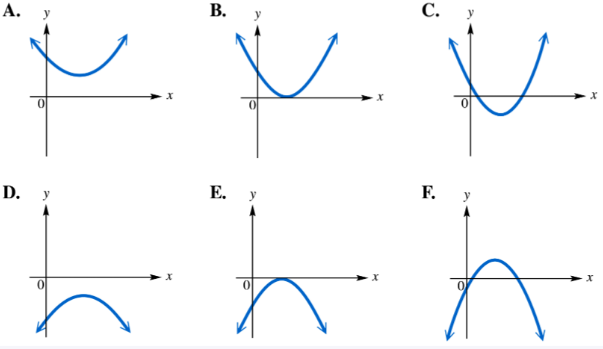
Several graphs of the quadratic function ƒ(x) = ax2 + bx + c are shown below. For the given restrictions on a, b, and c, select the corresponding graph from choices A–F. (Hint: Use the discriminant.) a < 0; b2 - 4ac < 0

Verified step by step guidance
1
Recall the quadratic function is given by \(f(x) = ax^2 + bx + c\), where \(a\), \(b\), and \(c\) are constants.
Note the given conditions: \(a < 0\) and the discriminant \(b^2 - 4ac < 0\). The discriminant determines the nature of the roots of the quadratic equation.
Since \(a < 0\), the parabola opens downward, meaning the graph is concave down.
Because the discriminant \(b^2 - 4ac < 0\), the quadratic has no real roots, so the graph does not intersect the x-axis.
To select the correct graph, look for a downward-opening parabola that lies entirely above or below the x-axis without crossing it.

Verified video answer for a similar problem:

This video solution was recommended by our tutors as helpful for the problem above.
Video duration:
3m
Was this helpful?

Key Concepts

Here are the essential concepts you must grasp in order to answer the question correctly.

Quadratic Function and Its Graph

A quadratic function is a polynomial of degree two, expressed as f(x) = ax^2 + bx + c. Its graph is a parabola that opens upward if a > 0 and downward if a < 0. The coefficients a, b, and c determine the shape and position of the parabola on the coordinate plane.
Recommended video:
5:26
Graphs of Logarithmic Functions

Discriminant of a Quadratic Equation

The discriminant, given by b^2 - 4ac, helps determine the nature of the roots of a quadratic equation. If the discriminant is less than zero, the quadratic has no real roots and the parabola does not intersect the x-axis. This information is crucial for identifying the correct graph.
Recommended video:
04:11
The Discriminant

Effect of Coefficients on the Parabola

The coefficient a controls the direction and width of the parabola, with a < 0 indicating it opens downward. The values of b and c affect the vertex's position and the parabola's vertical shift. Understanding these effects helps match the quadratic function to its graph under given restrictions.
Recommended video:
5:28
Horizontal Parabolas