Ch. 3 - Polynomial and Rational Functions
Lial - College Algebra 13th Edition
Lial13th EditionCollege AlgebraISBN: 9780136881063Not the one you use?Change textbook
Chapter 4, Problem 23

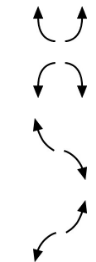
Use one of the end behavior diagrams below, to describe the end behavior of the graph of each polynomial function.
Graph showing four polynomial function curves with varying shapes and directions on a coordinate plane.
ƒ(x)=4x3+3x21 ƒ(x)=-4x^3+3x^2-1

Verified step by step guidance
1
Identify the leading term of the polynomial function. For the function \(f(x) = -4x^3 + 3x^2 - 1\), the leading term is \(-4x^3\) because it has the highest power of \(x\).
Determine the degree of the polynomial, which is the exponent of the leading term. Here, the degree is 3, an odd number.
Look at the leading coefficient, which is the coefficient of the leading term. In this case, it is \(-4\), a negative number.
Use the degree and leading coefficient to describe the end behavior: For an odd degree polynomial with a negative leading coefficient, as \(x \to \infty\), \(f(x) \to -\infty\), and as \(x \to -\infty\), \(f(x) \to \infty\).
Summarize the end behavior in an end behavior diagram or notation: as \(x \to -\infty\), \(f(x) \to \infty\); as \(x \to \infty\), \(f(x) \to -\infty\).

Verified video answer for a similar problem:

This video solution was recommended by our tutors as helpful for the problem above.
Video duration:
4m
Was this helpful?

Key Concepts

Here are the essential concepts you must grasp in order to answer the question correctly.

Polynomial Functions and Their Degrees

A polynomial function is an expression consisting of variables raised to whole-number exponents with coefficients. The degree of the polynomial is the highest exponent of the variable, which largely determines the shape and end behavior of its graph. For example, in ƒ(x) = -4x^3 + 3x^2 - 1, the degree is 3.
Recommended video:
06:04
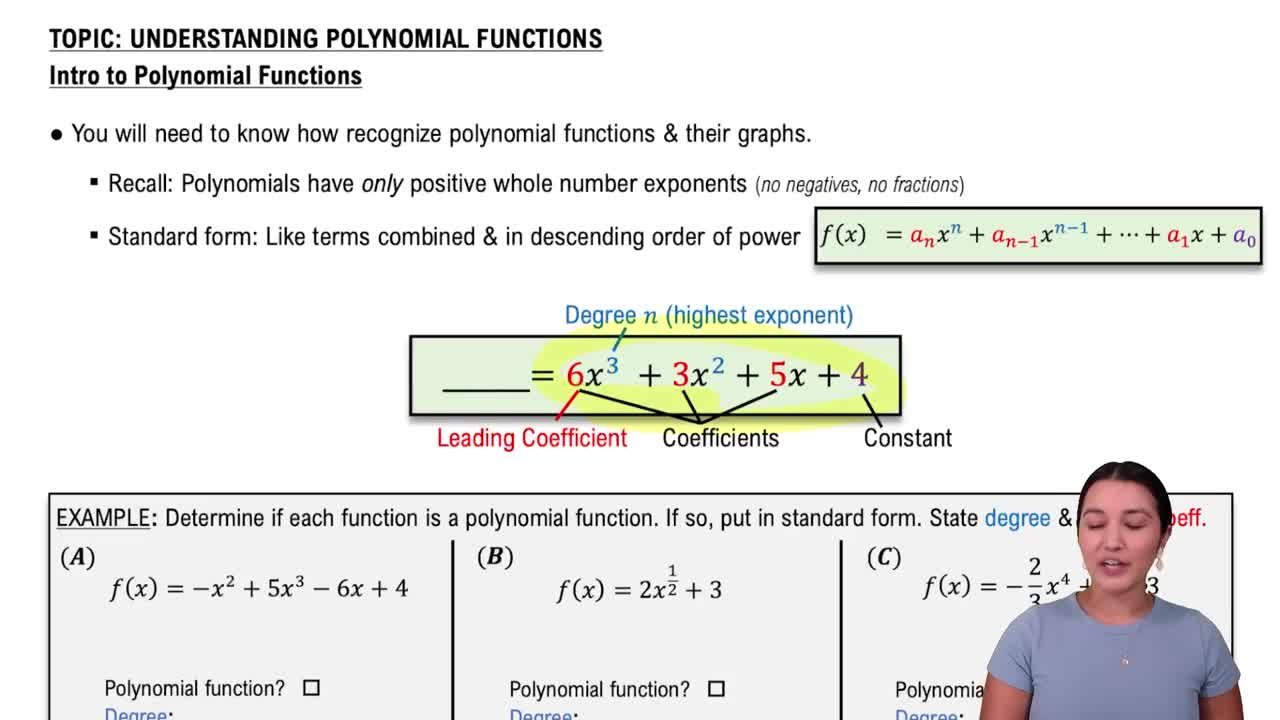
Introduction to Polynomial Functions

Leading Coefficient and Its Effect on End Behavior

The leading coefficient is the coefficient of the term with the highest degree. It influences the direction the graph heads as x approaches positive or negative infinity. A negative leading coefficient, like -4 in the example, typically causes the graph to fall on the right end and rise on the left end for odd-degree polynomials.
Recommended video:
06:08
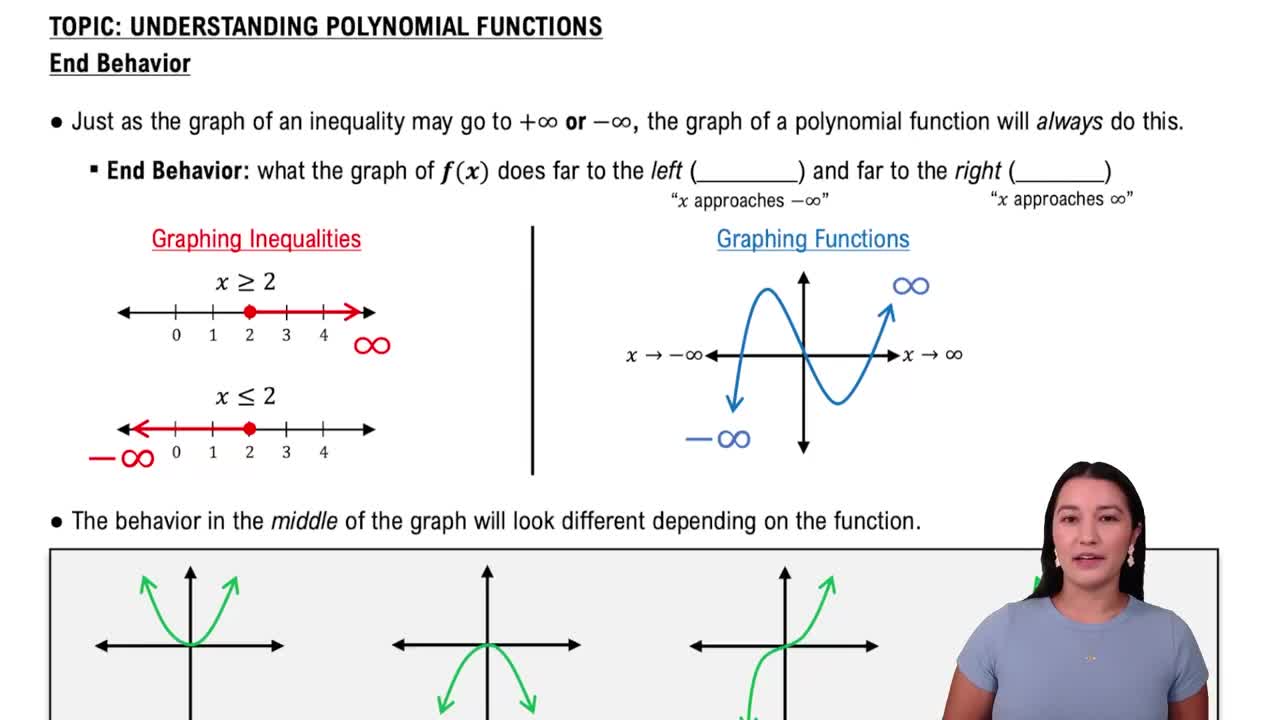
End Behavior of Polynomial Functions

End Behavior Diagrams

End behavior diagrams visually represent how the graph of a polynomial behaves as x approaches positive or negative infinity. They use arrows or symbols to show whether the function values rise or fall at the ends. These diagrams help summarize the long-term trends of polynomial graphs without plotting every point.
Recommended video:
06:08
End Behavior of Polynomial Functions