Use an end behavior diagram, as shown below, to describe the end behavior of the graph of each polynomial function. ƒ(x)=-x3-4x2+2x-1
Ch. 3 - Polynomial and Rational Functions

Chapter 4, Problem 22
Factor ƒ(x) into linear factors given that k is a zero.
Verified step by step guidance1
Since k = 1 is a zero of the polynomial ƒ(x) = 2x^3 - 3x^2 - 5x + 6, use synthetic division or polynomial division to divide ƒ(x) by (x - 1).
Set up synthetic division with the coefficients of ƒ(x): 2, -3, -5, and 6, and use 1 as the divisor.
Perform the synthetic division step-by-step to find the quotient polynomial, which will be a quadratic expression.
Write ƒ(x) as the product of (x - 1) and the quotient polynomial obtained from the division.
Factor the quadratic quotient further, if possible, into linear factors to express ƒ(x) completely as a product of linear factors.

Verified video answer for a similar problem:
This video solution was recommended by our tutors as helpful for the problem above.
Video duration:
10mKey Concepts
Here are the essential concepts you must grasp in order to answer the question correctly.
Polynomial Zeros and the Factor Theorem
A zero of a polynomial is a value of x that makes the polynomial equal to zero. The Factor Theorem states that if k is a zero of ƒ(x), then (x - k) is a factor of ƒ(x). This allows us to factor the polynomial by dividing it by (x - k).
Recommended video:
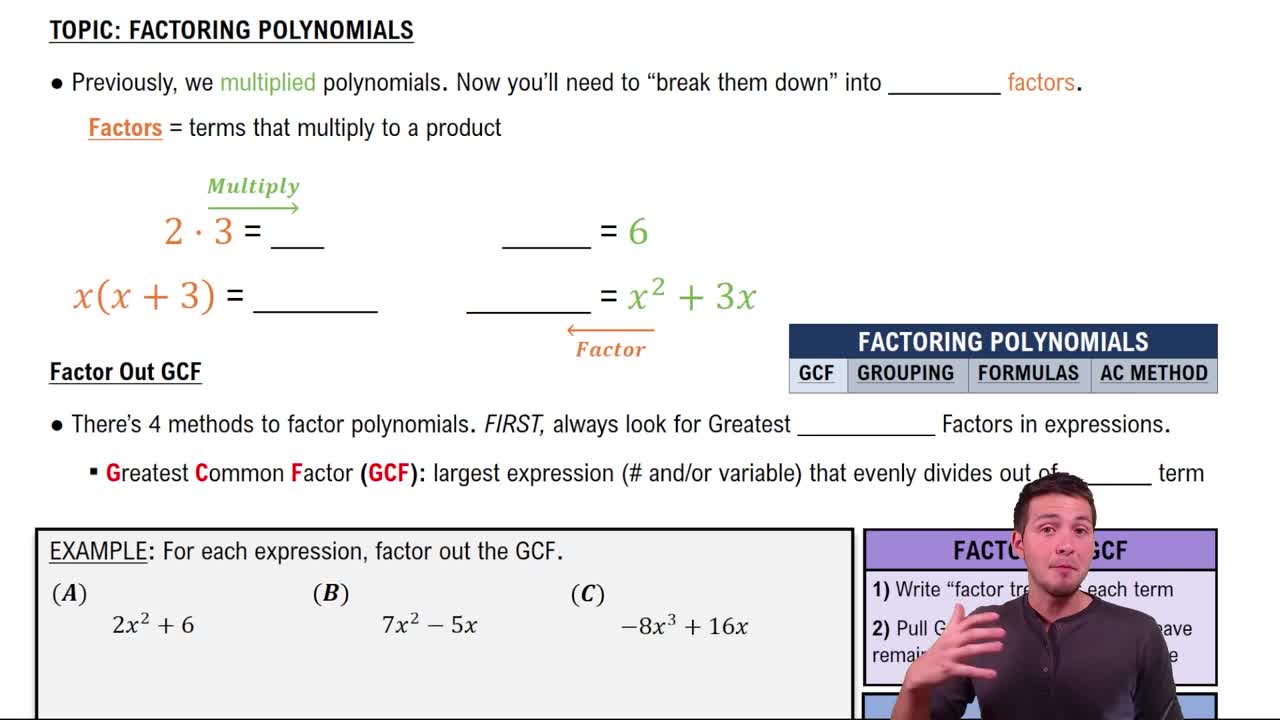
Introduction to Factoring Polynomials
Polynomial Division (Synthetic or Long Division)
Polynomial division is used to divide a polynomial by a linear factor like (x - k). Synthetic division is a shortcut method for dividing by linear factors and helps find the quotient polynomial after factoring out (x - k). This simplifies the polynomial into lower-degree factors.
Recommended video:
Introduction to Factoring Polynomials
Factoring Polynomials into Linear Factors
After dividing out a known factor, the resulting polynomial can often be factored further into linear factors by finding its zeros. Factoring completely into linear factors means expressing the polynomial as a product of first-degree polynomials, which corresponds to all its roots.
Recommended video:
Introduction to Factoring Polynomials
Related Practice
Textbook Question
Textbook Question
Use one of the end behavior diagrams below, to describe the end behavior of the graph of each polynomial function.
Textbook Question
Write each formula as an English phrase using the word varies or proportional. r = d/t, where r is the speed when traveling d miles in t hours.
Textbook Question
Use an end behavior diagram, as shown below, to describe the end behavior of the graph of each polynomial function. ƒ(x)=5x5+2x3-3x+4
Textbook Question
Use synthetic division to perform each division. x4-1 / x-1
Textbook Question
Solve each polynomial inequality. Give the solution set in interval notation.
(a) -x(x - 1)(x - 2) ≥ 0
(b) -x(x - 1)(x - 2) > 0
(c) -x(x - 1)(x - 2) ≤ 0
(d) -x(x - 1)(x - 2) < 0