Determine the different possibilities for the numbers of positive, negative, and nonreal complex zeros of each function.
Ch. 3 - Polynomial and Rational Functions

Chapter 4, Problem 87
Use a graphing calculator to find the coordinates of the turning points of the graph of each polynomial function in the given domain interval. Give answers to the nearest hundredth. ƒ(x)=x3+4x2-8x-8; [-3.8, -3]
Verified step by step guidance1
Understand that turning points of a polynomial function occur where its derivative equals zero, as these points correspond to local maxima or minima on the graph.
Find the first derivative of the function \( f(x) = x^3 + 4x^2 - 8x - 8 \). Use the power rule for differentiation: \( f'(x) = 3x^2 + 8x - 8 \).
Use the graphing calculator to plot the derivative function \( f'(x) = 3x^2 + 8x - 8 \) over the domain interval \( [-3.8, -3] \) to identify where \( f'(x) = 0 \) within this interval.
Find the x-values where the derivative equals zero (the roots of \( f'(x) \)) within the given domain. These x-values are the x-coordinates of the turning points.
Substitute each x-value found back into the original function \( f(x) \) to calculate the corresponding y-coordinates, giving the coordinates of the turning points to the nearest hundredth.

Verified video answer for a similar problem:
This video solution was recommended by our tutors as helpful for the problem above.
Video duration:
2mWas this helpful?
Key Concepts
Here are the essential concepts you must grasp in order to answer the question correctly.
Turning Points of a Polynomial Function
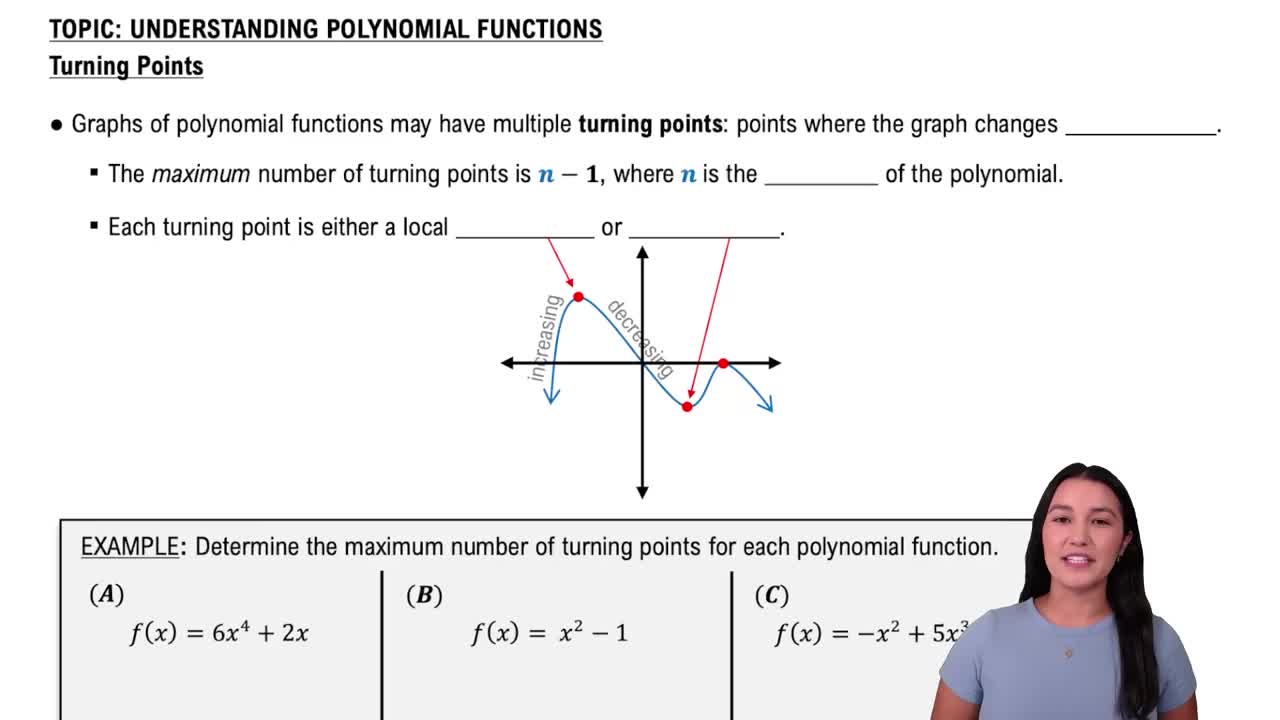
Turning points are points on the graph where the function changes direction from increasing to decreasing or vice versa. For polynomial functions, these correspond to local maxima or minima and occur where the derivative equals zero. Identifying turning points helps understand the shape and behavior of the graph.
Recommended video:
Maximum Turning Points of a Polynomial Function
Using a Graphing Calculator to Find Turning Points
A graphing calculator can plot the function and use built-in tools to locate turning points by finding where the slope (derivative) is zero. It allows zooming into a specific domain interval and provides numerical coordinates, which can be rounded to the nearest hundredth for precision.
Recommended video:
Maximum Turning Points of a Polynomial Function
Domain Restriction and Interval Analysis
Restricting the domain to a specific interval, such as [-3.8, -3], limits the search for turning points to that range. This focuses the analysis on relevant parts of the graph and ensures that only turning points within the given interval are considered, which is important for accurate and context-specific answers.
Recommended video:
Domain Restrictions of Composed Functions
Related Practice
Textbook Question
Textbook Question
Use a graphing calculator to find the coordinates of the turning points of the graph of each polynomial function in the given domain interval. Give answers to the nearest hundredth. ƒ(x)=x4-7x3+13x2+6x-28; [-1, 0]
Textbook Question
Graph each rational function. ƒ(x)=(18+6x-4x2)/(4+6x+2x2)
3
views
Textbook Question
Determine the different possibilities for the numbers of positive, negative, and nonreal complex zeros of each function.
Textbook Question
Determine the different possibilities for the numbers of positive, negative, and nonreal complex zeros of each function.
6
views
Textbook Question
Determine the different possibilities for the numbers of positive, negative, and nonreal complex zeros of each function.