Ch. 3 - Polynomial and Rational Functions
Lial - College Algebra 13th Edition
Lial13th EditionCollege AlgebraISBN: 9780136881063Not the one you use?Change textbook
Chapter 4, Problem 87

Determine the different possibilities for the numbers of positive, negative, and nonreal complex zeros of each function. ƒ(x)=x5+3x4x3+2x+3ƒ(x)=x^5+3x^4-x^3+2x+3

Verified step by step guidance
1
Identify the degree of the polynomial function. Here, the degree is 5, so there are 5 zeros in total (counting multiplicities and including complex zeros).
Use Descartes' Rule of Signs to determine the possible number of positive real zeros by counting the sign changes in ƒ(x) = x^5 + 3x^4 - x^3 + 2x + 3. Each sign change indicates a possible positive zero or fewer by an even number.
Apply Descartes' Rule of Signs to ƒ(-x) to find the possible number of negative real zeros. Substitute -x into the polynomial and count the sign changes in the resulting expression.
Determine the possible number of nonreal complex zeros by subtracting the possible number of positive and negative real zeros from the total degree (5). Remember that complex zeros come in conjugate pairs, so the number of nonreal zeros must be even.
List all combinations of positive, negative, and nonreal zeros that satisfy the above conditions, ensuring the total number of zeros sums to 5.

Verified video answer for a similar problem:

This video solution was recommended by our tutors as helpful for the problem above.
Video duration:
6m
Was this helpful?

Key Concepts

Here are the essential concepts you must grasp in order to answer the question correctly.

Fundamental Theorem of Algebra

This theorem states that a polynomial of degree n has exactly n roots in the complex number system, counting multiplicities. For the given fifth-degree polynomial, there are five zeros total, which can be real or nonreal complex numbers.
Recommended video:
Guided course
05:09
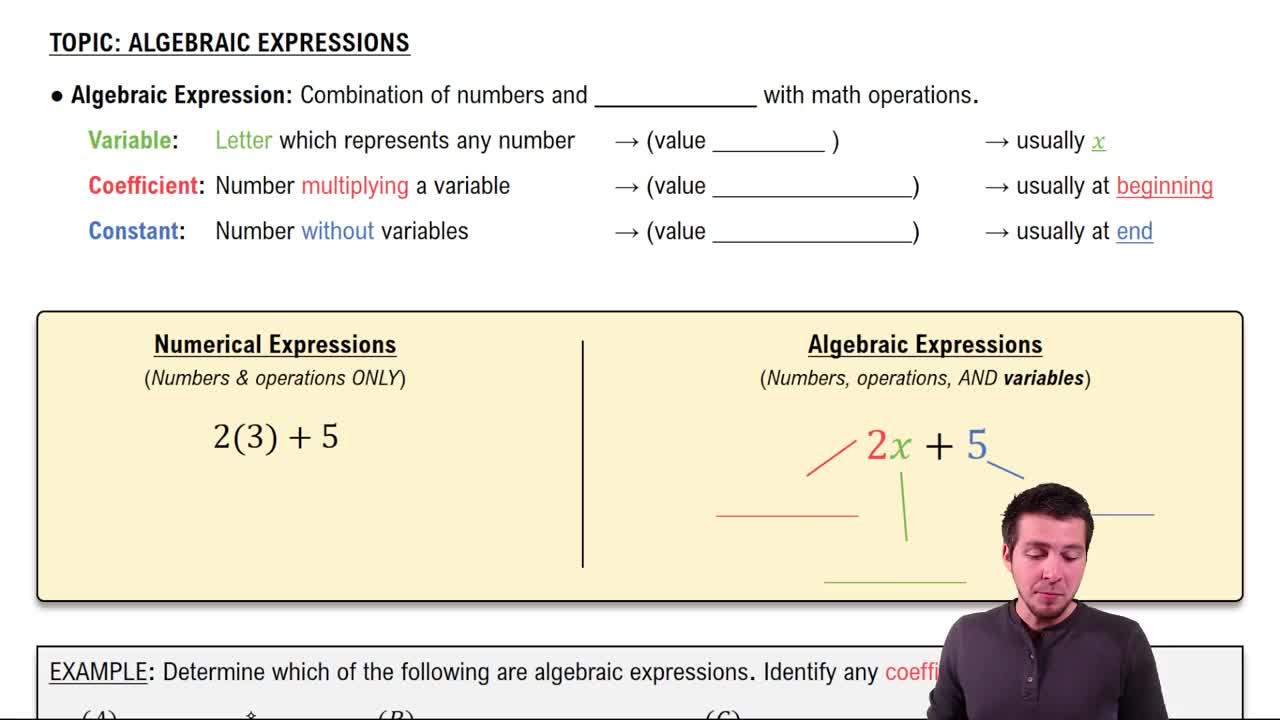
Introduction to Algebraic Expressions

Descartes' Rule of Signs

Descartes' Rule of Signs helps determine the possible number of positive and negative real zeros of a polynomial by counting sign changes in f(x) and f(-x). It provides the maximum number of positive and negative roots and their possible variations.
Recommended video:
Guided course
6:54
Cramer's Rule - 2 Equations with 2 Unknowns

Complex Conjugate Root Theorem

This theorem states that nonreal complex roots of polynomials with real coefficients occur in conjugate pairs. Therefore, the number of nonreal zeros must be even, which restricts the possible counts of nonreal roots for the polynomial.
Recommended video:
05:33
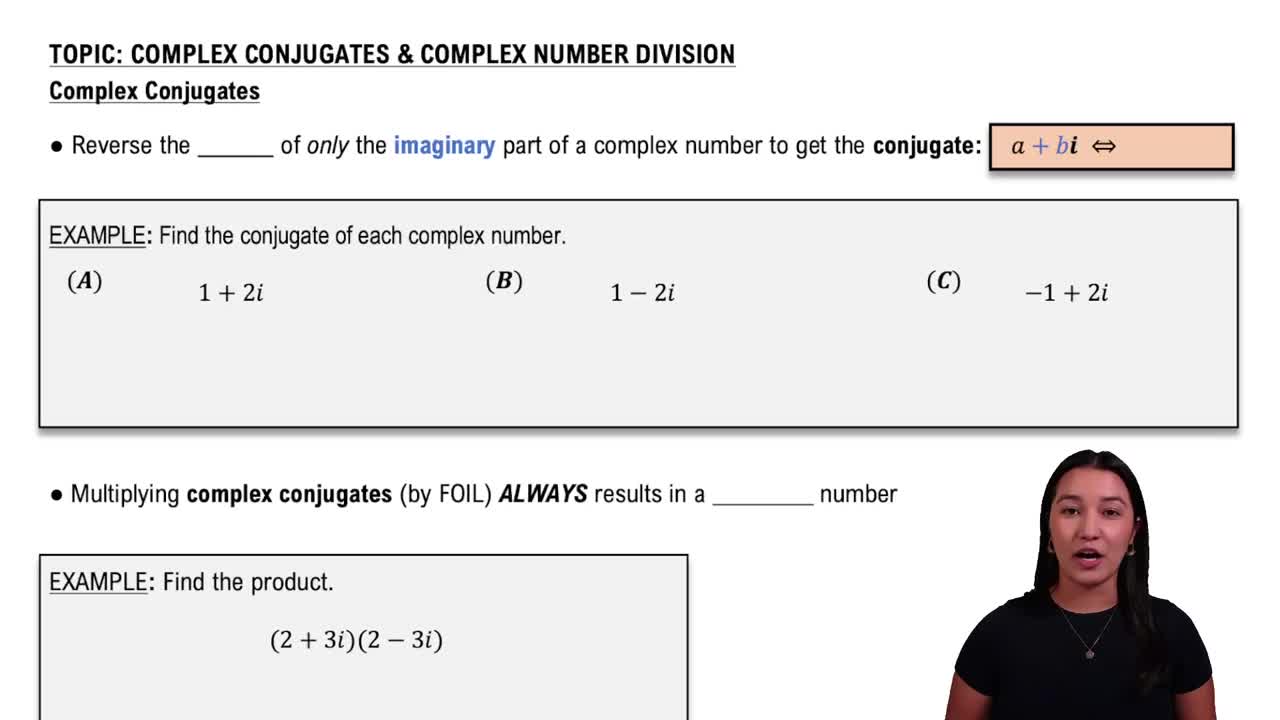
Complex Conjugates