Ch. 3 - Polynomial and Rational Functions
Lial - College Algebra 13th Edition
Lial13th EditionCollege AlgebraISBN: 9780136881063Not the one you use?Change textbook
Chapter 4, Problem 42b

Solve each problem. Give the maximum number of turning points of the graph of each function. ƒ(x)=4x^3-6x^2+2

Verified step by step guidance
1
Identify the degree of the polynomial function. The given function is \(f(x) = 4x^3 - 6x^2 + 2\), which is a cubic polynomial of degree 3.
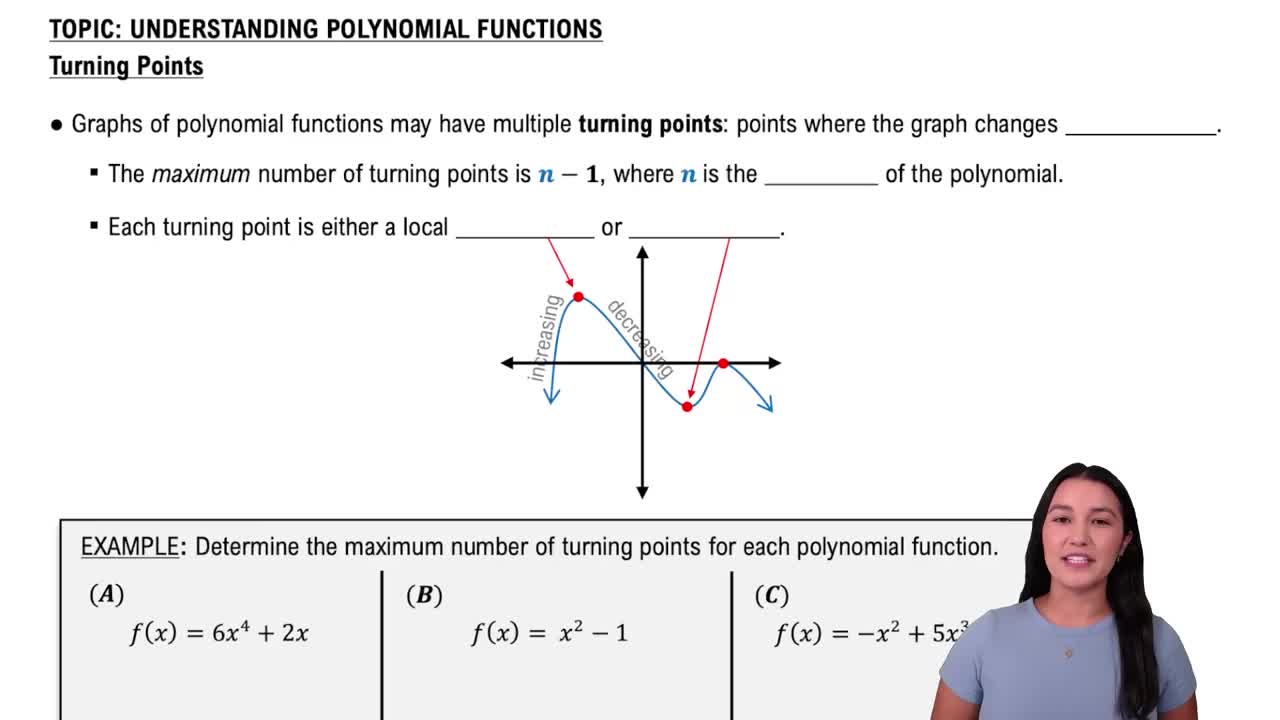
Recall the rule for the maximum number of turning points of a polynomial function: it is at most one less than the degree of the polynomial. So, for a polynomial of degree \(n\), the maximum number of turning points is \(n - 1\).
Apply this rule to the given function. Since the degree is 3, the maximum number of turning points is \(3 - 1\).
Understand that turning points correspond to local maxima or minima, which occur where the first derivative changes sign. To find these points, you would take the derivative \(f'(x)\) and solve for critical points.
Although not required to find the exact turning points here, knowing the maximum number helps in graphing and understanding the behavior of the function.

Verified video answer for a similar problem:

This video solution was recommended by our tutors as helpful for the problem above.
Video duration:
1m
Was this helpful?

Key Concepts

Here are the essential concepts you must grasp in order to answer the question correctly.

Turning Points of a Polynomial Function

Turning points are points on the graph where the function changes direction from increasing to decreasing or vice versa. For polynomial functions, these correspond to local maxima or minima, where the slope of the tangent (derivative) is zero.
Recommended video:
02:44
Maximum Turning Points of a Polynomial Function

Degree of a Polynomial and Maximum Turning Points

The maximum number of turning points of a polynomial function is at most one less than its degree. For example, a cubic function (degree 3) can have up to 2 turning points.
Recommended video:
02:44
Maximum Turning Points of a Polynomial Function

Using the Derivative to Find Turning Points

The derivative of a function gives the slope of the tangent line. Setting the derivative equal to zero helps find critical points, which are candidates for turning points. Analyzing these points determines the actual turning points on the graph.
Recommended video:
02:44
Maximum Turning Points of a Polynomial Function