Force of Wind The force of the wind blowing on a vertical surface varies jointly as the area of the surface and the square of the velocity. If a wind of 40 mph exerts a force of 50 lb on a surface of 1/2 ft2, how much force will a wind of 80 mph place on a surface of 2 ft2?
Ch. 3 - Polynomial and Rational Functions

Chapter 4, Problem 41
For each polynomial function, use the remainder theorem to find ƒ(k). ƒ(x) = x2 + 4; k = 2i
Verified step by step guidance1
Recall the Remainder Theorem, which states that the remainder when a polynomial ƒ(x) is divided by (x - k) is equal to ƒ(k). So, to find ƒ(k), we simply substitute k into the polynomial ƒ(x).
Given the polynomial function ƒ(x) = x^2 + 4, and k = 2i, substitute x with 2i in the polynomial: ƒ(2i) = (2i)^2 + 4.
Calculate the square of 2i: (2i)^2 = 2^2 * i^2 = 4 * i^2.
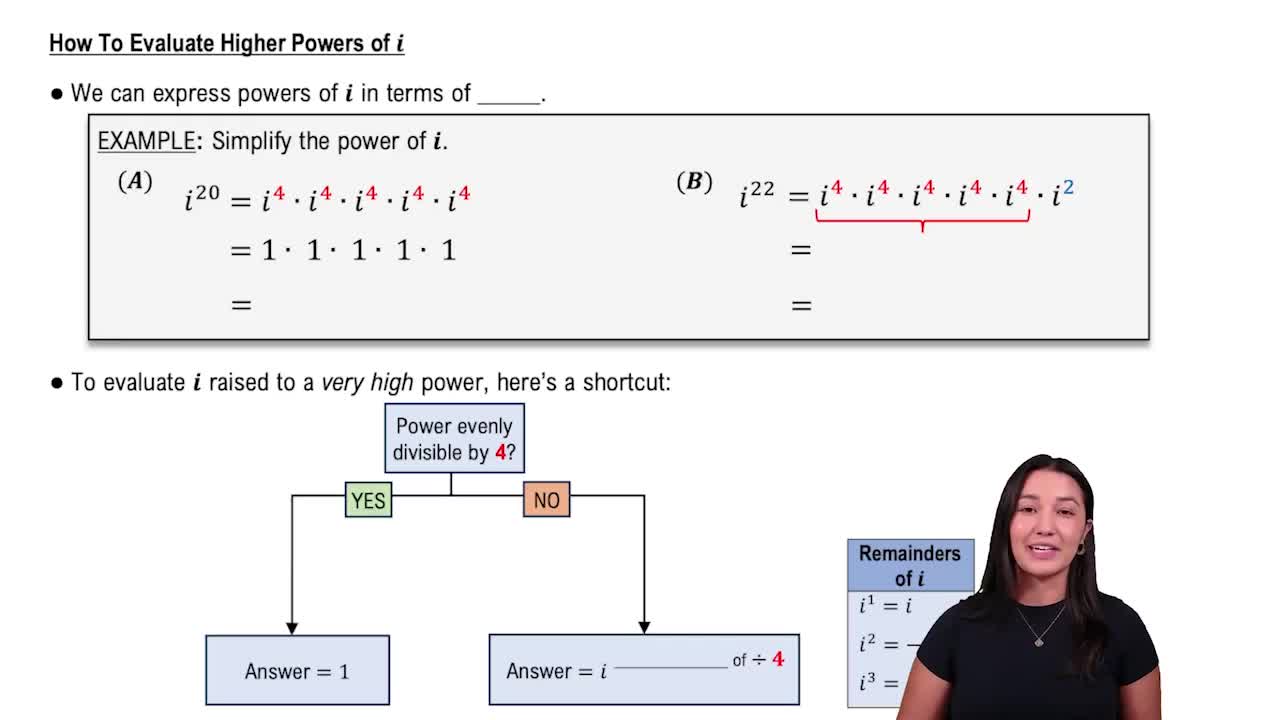
Recall that i is the imaginary unit where i^2 = -1, so replace i^2 with -1 in the expression: 4 * (-1) = -4.
Now, add the constant term: ƒ(2i) = -4 + 4. This expression represents the value of ƒ(k) using the Remainder Theorem.

Verified video answer for a similar problem:
This video solution was recommended by our tutors as helpful for the problem above.
Video duration:
2mWas this helpful?
Key Concepts
Here are the essential concepts you must grasp in order to answer the question correctly.
Polynomial Functions
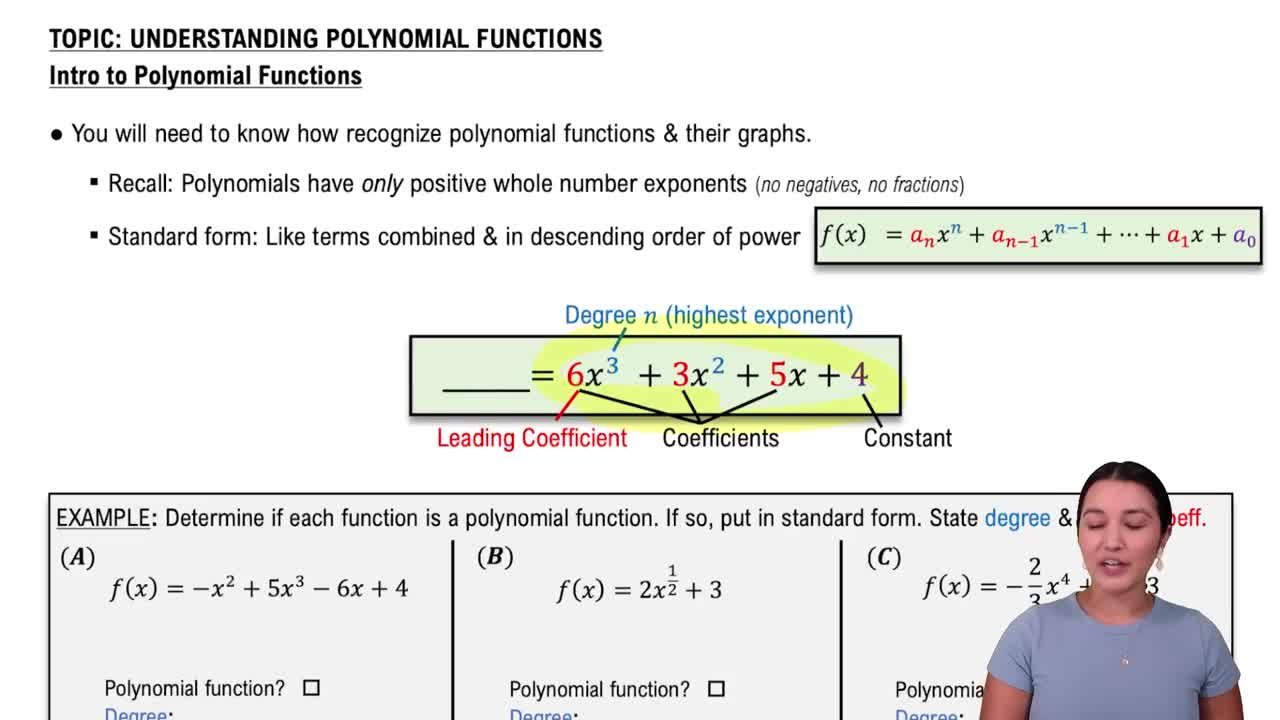
A polynomial function is an expression consisting of variables and coefficients combined using addition, subtraction, multiplication, and non-negative integer exponents. Understanding the structure of polynomial functions helps in evaluating them at specific values, including complex numbers.
Recommended video:
Introduction to Polynomial Functions
Remainder Theorem
The Remainder Theorem states that when a polynomial ƒ(x) is divided by (x - k), the remainder is equal to ƒ(k). This allows us to find the value of the polynomial at k by simply evaluating ƒ(k), without performing full polynomial division.
Recommended video:
Higher Powers of i
Complex Numbers
Complex numbers include a real part and an imaginary part, expressed as a + bi, where i is the imaginary unit with i² = -1. Evaluating polynomials at complex values requires substituting and simplifying using the properties of i.
Recommended video:
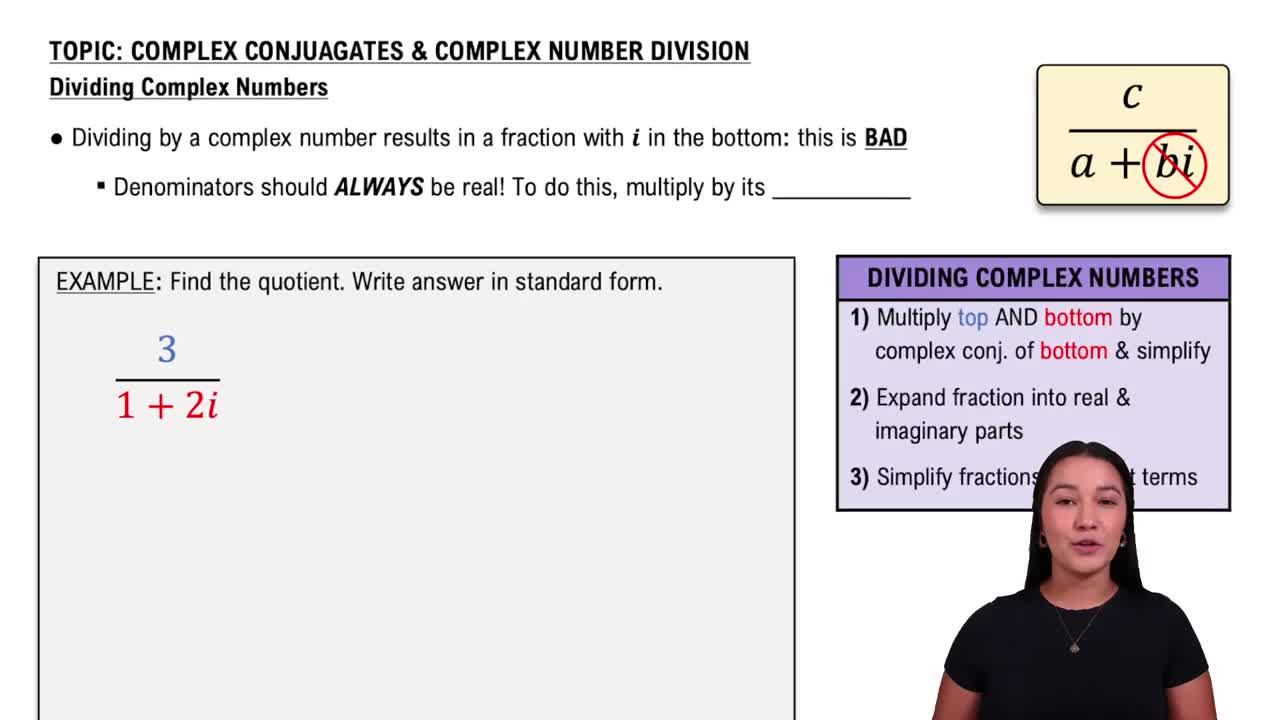
Dividing Complex Numbers
Related Practice
Textbook Question
6
views
Textbook Question
Solve each polynomial inequality. Give the solution set in interval notation. x4 - x3 - 10x2 - 8x < 0
Textbook Question
Determine the largest open interval of the domain (a) over which the function is increasing and (b) over which it is decreasing. ƒ(x) = x2 - 4x + 3
Textbook Question
Give the equations of any vertical, horizontal, or oblique asymptotes for the graph of each rational function. See Example 4.
Textbook Question
Solve each problem. Give the maximum number of turning points of the graph of each function. ƒ(x)=4x^3-6x^2+2
Textbook Question
For each polynomial function, use the remainder theorem to find ƒ(k). ƒ(x) = 2x5 - 10x3 - 19x2 - 50; k=3
