Ch. 3 - Polynomial and Rational Functions
Lial - College Algebra 13th Edition
Lial13th EditionCollege AlgebraISBN: 9780136881063Not the one you use?Change textbook
Chapter 4, Problem 43

Give the equations of any vertical, horizontal, or oblique asymptotes for the graph of each rational function. ƒ(x)=(x2-2x-3)/(2x2-x-10)

Verified step by step guidance
1
Identify the rational function: \(f(x) = \frac{x^2 - 2x - 3}{2x^2 - x - 10}\).
Find the vertical asymptotes by setting the denominator equal to zero and solving for \(x\): solve \(2x^2 - x - 10 = 0\).
Find the horizontal or oblique asymptotes by comparing the degrees of the numerator and denominator polynomials. Since both numerator and denominator are degree 2, find the horizontal asymptote by dividing the leading coefficients.
If the degree of the numerator were exactly one more than the denominator, perform polynomial long division to find the oblique asymptote. In this case, since degrees are equal, no oblique asymptote exists.
Summarize the asymptotes: vertical asymptotes come from the roots of the denominator, and the horizontal asymptote is \(y = \frac{\text{leading coefficient of numerator}}{\text{leading coefficient of denominator}}\).

Verified video answer for a similar problem:

This video solution was recommended by our tutors as helpful for the problem above.
Video duration:
8m
Was this helpful?

Key Concepts

Here are the essential concepts you must grasp in order to answer the question correctly.

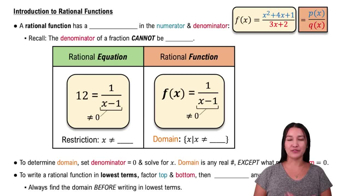
Rational Functions

A rational function is a ratio of two polynomials, expressed as f(x) = P(x)/Q(x). Understanding the behavior of rational functions involves analyzing their numerator and denominator, especially where the denominator equals zero, which often leads to asymptotes or undefined points.
Recommended video:
6:04
Intro to Rational Functions

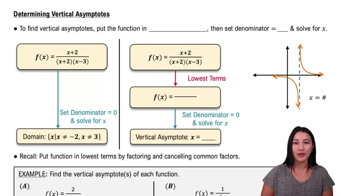
Vertical Asymptotes

Vertical asymptotes occur where the denominator of a rational function equals zero and the numerator is nonzero, causing the function to approach infinity or negative infinity. These are found by solving Q(x) = 0 and checking for factors that do not cancel with the numerator.
Recommended video:
3:12
Determining Vertical Asymptotes

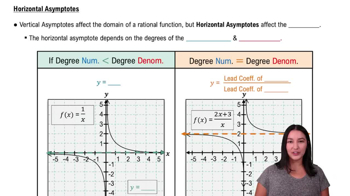
Horizontal and Oblique Asymptotes

Horizontal asymptotes describe the end behavior of a rational function as x approaches infinity, determined by comparing the degrees of numerator and denominator. If the numerator's degree is one more than the denominator's, an oblique (slant) asymptote exists, found via polynomial division.
Recommended video:
4:48
Determining Horizontal Asymptotes