Force of Wind The force of the wind blowing on a vertical surface varies jointly as the area of the surface and the square of the velocity. If a wind of 40 mph exerts a force of 50 lb on a surface of 1/2 ft2, how much force will a wind of 80 mph place on a surface of 2 ft2?
Ch. 3 - Polynomial and Rational Functions

Chapter 4, Problem 41
Give the equations of any vertical, horizontal, or oblique asymptotes for the graph of each rational function. ƒ(x)=(x2-1)/(x+3)
Verified step by step guidance1
Identify the rational function given: \(f(x) = \frac{x^2 - 1}{x + 3}\).
Find the vertical asymptotes by setting the denominator equal to zero and solving for \(x\): solve \(x + 3 = 0\) to find values where the function is undefined.
Determine the horizontal or oblique asymptotes by comparing the degrees of the numerator and denominator polynomials. Here, the numerator degree is 2 and the denominator degree is 1.
Since the numerator degree is greater than the denominator degree by exactly 1, perform polynomial long division of \(x^2 - 1\) by \(x + 3\) to find the oblique asymptote.
Write the oblique asymptote as the quotient from the division (ignoring the remainder), and summarize the vertical asymptote(s) found in step 2.

Verified video answer for a similar problem:
This video solution was recommended by our tutors as helpful for the problem above.
Video duration:
8mWas this helpful?
Key Concepts
Here are the essential concepts you must grasp in order to answer the question correctly.
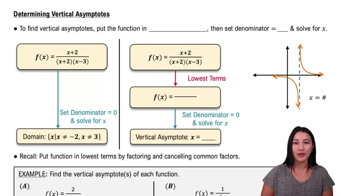
Vertical Asymptotes
Vertical asymptotes occur where the denominator of a rational function equals zero, causing the function to approach infinity or negative infinity. To find them, set the denominator equal to zero and solve for x, ensuring these values do not cancel with factors in the numerator.
Recommended video:
Determining Vertical Asymptotes
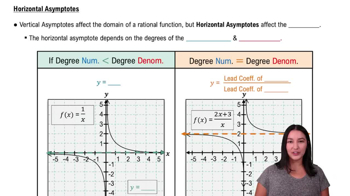
Horizontal Asymptotes
Horizontal asymptotes describe the behavior of a function as x approaches infinity or negative infinity. For rational functions, compare the degrees of the numerator and denominator: if the numerator's degree is less, the asymptote is y=0; if equal, it's the ratio of leading coefficients.
Recommended video:
Determining Horizontal Asymptotes
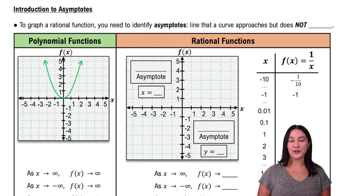
Oblique (Slant) Asymptotes
Oblique asymptotes occur when the degree of the numerator is exactly one more than the denominator. They are found by performing polynomial division of numerator by denominator; the quotient (without the remainder) gives the equation of the slant asymptote.
Recommended video:
Introduction to Asymptotes
Related Practice
Textbook Question
6
views
Textbook Question
Determine the largest open interval of the domain (a) over which the function is increasing and (b) over which it is decreasing. ƒ(x) = x2 - 4x + 3
Textbook Question
Give the equations of any vertical, horizontal, or oblique asymptotes for the graph of each rational function. ƒ(x)=(4-3x)/(2x+1)
1
views
Textbook Question
Graph each polynomial function. Factor first if the polynomial is not in factored form. See Examples 3 and 4.
Textbook Question
Graph each polynomial function. Factor first if the polynomial is not in factored form. ƒ(x)=2x3(x2-4)(x-1)
Textbook Question
Give the equations of any vertical, horizontal, or oblique asymptotes for the graph of each rational function. ƒ(x)=(2x+6)/(x-4)