Determine the largest open interval of the domain (a) over which the function is increasing and (b) over which it is decreasing. ƒ(x) = -(x - 2)2 - 5
Ch. 3 - Polynomial and Rational Functions

Chapter 4, Problem 40
Give the equations of any vertical, horizontal, or oblique asymptotes for the graph of each rational function. ƒ(x)=(2x+6)/(x-4)
Verified step by step guidance1
Identify the rational function given: \(f(x) = \frac{2x + 6}{x - 4}\).
Find the vertical asymptotes by setting the denominator equal to zero and solving for \(x\): solve \(x - 4 = 0\) to find the vertical asymptote(s).
Determine the horizontal or oblique asymptotes by comparing the degrees of the numerator and denominator polynomials. Here, both numerator and denominator are degree 1.
Since the degrees of numerator and denominator are equal, find the horizontal asymptote by dividing the leading coefficients: the horizontal asymptote is \(y = \frac{\text{leading coefficient of numerator}}{\text{leading coefficient of denominator}}\).
Summarize the asymptotes: vertical asymptote(s) from step 2 and horizontal asymptote from step 4. There is no oblique asymptote because the degrees are equal.

Verified video answer for a similar problem:
This video solution was recommended by our tutors as helpful for the problem above.
Video duration:
5mWas this helpful?
Key Concepts
Here are the essential concepts you must grasp in order to answer the question correctly.
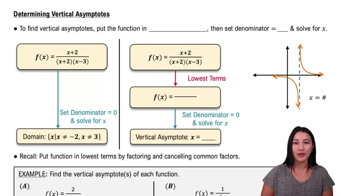
Vertical Asymptotes
Vertical asymptotes occur where the denominator of a rational function equals zero, causing the function to approach infinity or negative infinity. For ƒ(x) = (2x+6)/(x-4), setting the denominator x-4 = 0 gives x = 4, indicating a vertical asymptote at x = 4.
Recommended video:
Determining Vertical Asymptotes
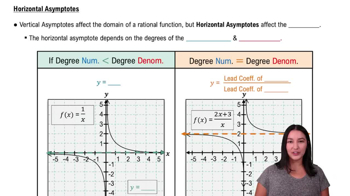
Horizontal Asymptotes
Horizontal asymptotes describe the behavior of a function as x approaches infinity or negative infinity. They depend on the degrees of the numerator and denominator polynomials. If degrees are equal, the horizontal asymptote is the ratio of leading coefficients; for ƒ(x), both are degree 1, so y = 2/1 = 2.
Recommended video:
Determining Horizontal Asymptotes
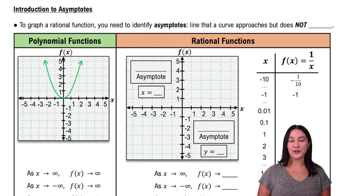
Oblique (Slant) Asymptotes
Oblique asymptotes occur when the degree of the numerator is exactly one more than the denominator. They are found by performing polynomial division. Since ƒ(x) has numerator and denominator of the same degree, there is no oblique asymptote in this case.
Recommended video:
Introduction to Asymptotes
Related Practice
Textbook Question
2
views
Textbook Question
Give the equations of any vertical, horizontal, or oblique asymptotes for the graph of each rational function. ƒ(x)=(4-3x)/(2x+1)
1
views
Textbook Question
Graph each polynomial function. Factor first if the polynomial is not in factored form. See Examples 3 and 4.
Textbook Question
Give the equations of any vertical, horizontal, or oblique asymptotes for the graph of each rational function. ƒ(x)=(x2-1)/(x+3)
Textbook Question
Graph each polynomial function. Factor first if the polynomial is not in factored form. ƒ(x)=2x3(x2-4)(x-1)
Textbook Question
Simple Interest Simple interest varies jointly as principal and time. If \$1000 invested for 2 yr earned \$70, find the amount of interest earned by \$5000 invested for 5 yr.