Ch. 2 - Graphs and Functions
Lial - College Algebra 13th Edition
Lial13th EditionCollege AlgebraISBN: 9780136881063Not the one you use?Change textbook
Chapter 3, Problem 12

Let ƒ(x)=x2+3ƒ(x)=x^2+3 and g(x)=2x+6g(x)=-2x+6. Find each of the following. See Example 1.
(ƒ+g)(5)(ƒ+g)(-5)

Verified step by step guidance
1
Understand that (ƒ+g)(x) means you add the functions ƒ(x) and g(x) together, so (ƒ+g)(x) = ƒ(x) + g(x).
Write the expressions for ƒ(x) and g(x): ƒ(x) = x^2 + 3 and g(x) = -2x + 6.
Add the two functions together: (ƒ+g)(x) = (x^2 + 3) + (-2x + 6).
Simplify the expression by combining like terms: (ƒ+g)(x) = x^2 - 2x + (3 + 6).
Evaluate the simplified expression at x = -5 by substituting -5 for x: (ƒ+g)(-5) = (-5)^2 - 2(-5) + 9.

Verified video answer for a similar problem:

This video solution was recommended by our tutors as helpful for the problem above.
Video duration:
2m
Was this helpful?

Key Concepts

Here are the essential concepts you must grasp in order to answer the question correctly.

Function Notation and Evaluation

Function notation, such as ƒ(x), represents a rule that assigns each input x to an output. Evaluating a function means substituting a specific value for x and calculating the result. For example, ƒ(-5) means replacing x with -5 in the function ƒ(x).
Recommended video:
4:26
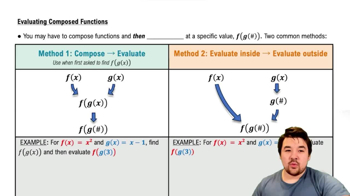
Evaluating Composed Functions

Function Addition

The sum of two functions (ƒ + g)(x) is defined as ƒ(x) + g(x). To find (ƒ + g)(-5), evaluate each function at -5 separately, then add the results. This operation combines the outputs of both functions for the same input.
Recommended video:
4:46
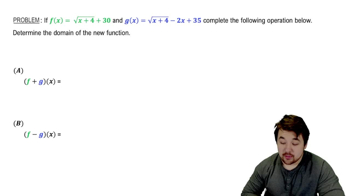
Adding & Subtracting Functions Example 1

Polynomial and Linear Functions

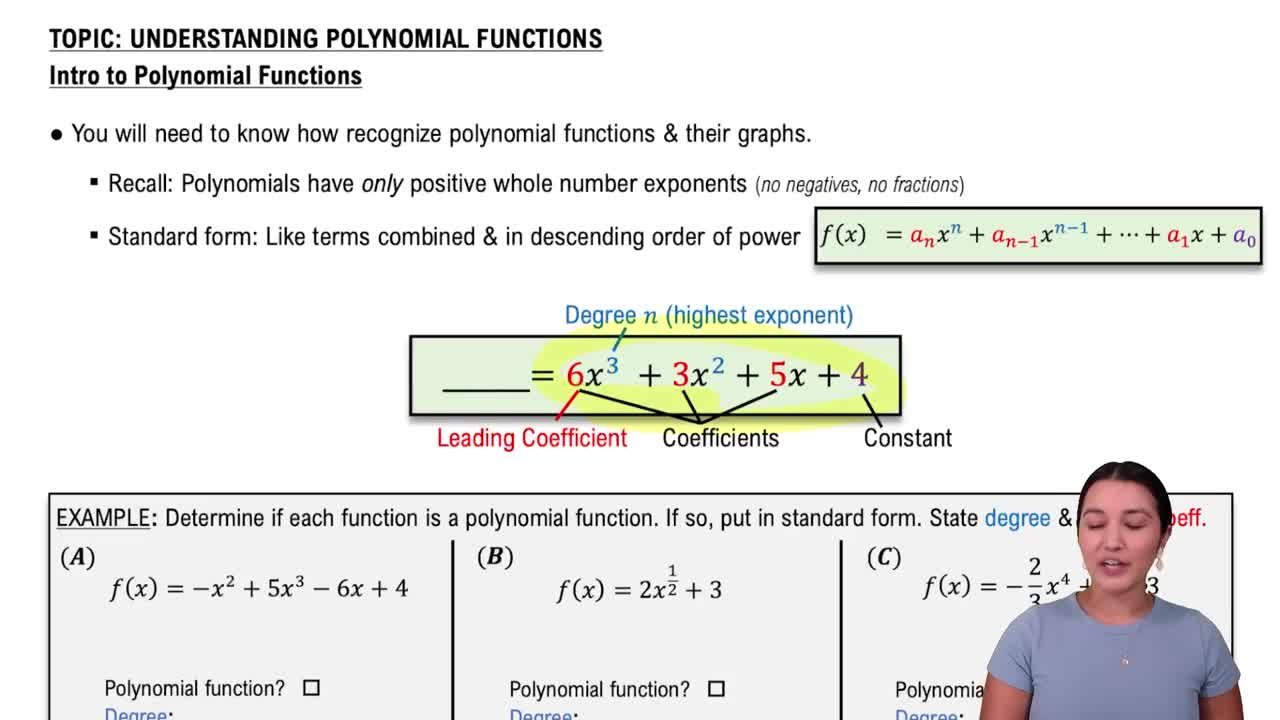
ƒ(x) = x² + 3 is a polynomial function of degree 2, and g(x) = -2x + 6 is a linear function. Understanding their forms helps in correctly substituting values and performing arithmetic operations on their outputs.
Recommended video:
06:04
Introduction to Polynomial Functions