Ch. 2 - Graphs and Functions
Lial - College Algebra 13th Edition
Lial13th EditionCollege AlgebraISBN: 9780136881063Not the one you use?Change textbook
Chapter 3, Problem 13

In the following exercises, (a) find the center-radius form of the equation of each circle described, and (b) graph it. center (2, 0), radius 6

Verified step by step guidance
1
Identify the given information: the center of the circle is at the point (2, 0) and the radius is 6.
Recall the center-radius form of a circle's equation: \( (x - h)^2 + (y - k)^2 = r^2 \), where \((h, k)\) is the center and \(r\) is the radius.
Substitute the center coordinates \((h, k) = (2, 0)\) and the radius \(r = 6\) into the formula to get the equation: \( (x - 2)^2 + (y - 0)^2 = 6^2 \).
Simplify the equation by squaring the radius: \( (x - 2)^2 + y^2 = 36 \).
To graph the circle, plot the center at (2, 0), then mark points 6 units away in all directions (up, down, left, right) from the center, and sketch the circle passing through these points.

Verified video answer for a similar problem:

This video solution was recommended by our tutors as helpful for the problem above.
Video duration:
1m
Was this helpful?

Key Concepts

Here are the essential concepts you must grasp in order to answer the question correctly.

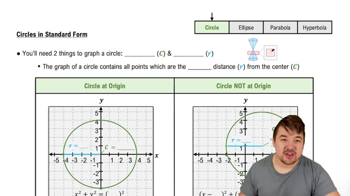
Equation of a Circle in Center-Radius Form

The center-radius form of a circle's equation is (x - h)^2 + (y - k)^2 = r^2, where (h, k) is the center and r is the radius. This form directly shows the circle's location and size, making it easier to graph and analyze.
Recommended video:
5:18
Circles in Standard Form

Identifying the Center and Radius

Given the center coordinates (h, k) and radius r, you substitute these values into the center-radius formula. For example, with center (2, 0) and radius 6, the equation becomes (x - 2)^2 + (y - 0)^2 = 36.
Recommended video:
05:01
Identifying Intervals of Unknown Behavior

Graphing a Circle

To graph a circle, plot the center point first, then use the radius to mark points in all directions (up, down, left, right) from the center. Connect these points smoothly to form the circle, ensuring the radius is consistent throughout.
Recommended video:
5:18
Circles in Standard Form