Ch. 2 - Graphs and Functions
Lial - College Algebra 13th Edition
Lial13th EditionCollege AlgebraISBN: 9780136881063Not the one you use?Change textbook
Chapter 3, Problem 41

Give a rule for each piecewise-defined function. Also give the domain and range.
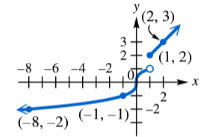
Graph of a piecewise function with arrows and points showing domain and range on x and y axes.

Verified step by step guidance
1
Step 1: Identify the different pieces of the piecewise function by looking at the graph and noting where the function changes its rule. Here, the graph has two distinct parts: one for x-values less than or equal to -1, and another for x-values greater than -1.
Step 2: For the first piece (x ≤ -1), observe the graph's behavior. The graph is a horizontal line at y = -2 from x = -8 to x = -1, including the point (-1, -2) (solid dot). So, the rule for this piece is \(f(x) = -2\) for \(x \leq -1\).
Step 3: For the second piece (x > -1), the graph shows a curve starting just after x = -1 (open circle at (-1, 0)) and increasing through points like (1, 2) and (2, 3). This looks like a quadratic function. The curve resembles \(f(x) = x^2\) shifted down by 1 unit, so the rule is \(f(x) = x^2 - 1\) for \(x > -1\).
Step 4: Write the piecewise function combining both parts: \[ f(x) = \begin{cases} -2 & \text{if } x \leq -1 \\ x^2 - 1 & \text{if } x > -1 \end{cases} \]
Step 5: Determine the domain and range. The domain is all x-values covered by the graph, which is from -8 to 2 (including -8 and 2). The range is the set of y-values the function takes: from -2 (lowest value on the horizontal line) up to 3 (highest point on the curve). So, domain: \([-8, 2]\), range: \([-2, 3]\).

Key Concepts

Here are the essential concepts you must grasp in order to answer the question correctly.

Piecewise-Defined Functions

A piecewise-defined function is a function composed of multiple sub-functions, each applying to a specific interval of the domain. Understanding how to write the rule for each piece involves identifying the function's behavior on different parts of the x-axis and expressing each part with its own formula.
Recommended video:
3:51
Domain Restrictions of Composed Functions

Domain and Range

The domain of a function is the set of all possible input values (x-values), while the range is the set of all possible output values (y-values). For piecewise functions, the domain is often split into intervals, and the range is determined by the outputs of each piece.
Recommended video:
4:22
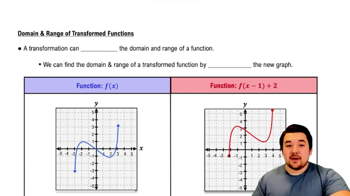
Domain & Range of Transformed Functions

Interpreting Graphs with Open and Closed Points

Graphs of piecewise functions often use open circles to indicate that a point is not included in the function (excluded endpoint) and closed circles to show inclusion. Recognizing these helps determine the exact domain intervals and whether endpoints are included or excluded.
Recommended video:
Guided course
04:29
Graphing Equations of Two Variables by Plotting Points