Use the method described in Exercises 83–86, if applicable, and properties of absolute value to solve each equation or inequality. (Hint: Exercises 99 and 100 can be solved by inspection.) | 4x2 - 23x - 6 | = 0
Ch. 1 - Equations and Inequalities

Chapter 2, Problem 94
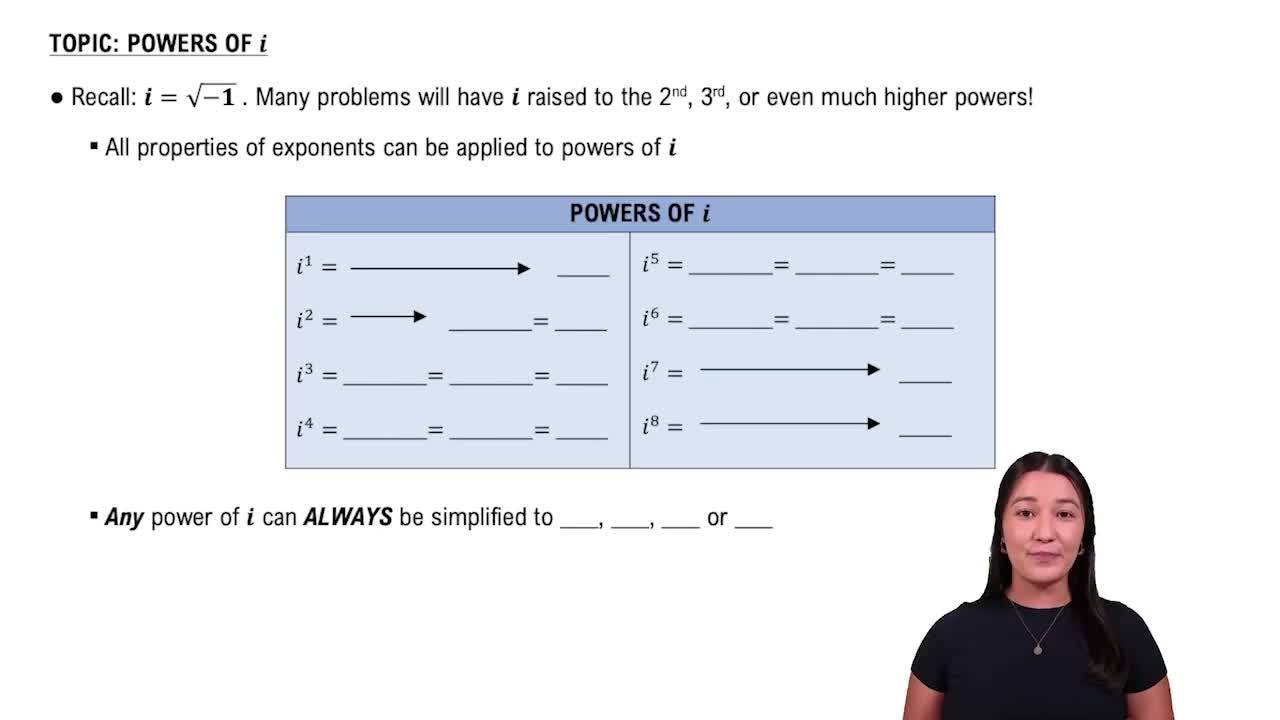
Simplify each power of i. i27
Verified step by step guidance1
Recall that the imaginary unit \(i\) is defined such that \(i^2 = -1\).
Recognize that powers of \(i\) repeat in a cycle of 4: \(i^1 = i\), \(i^2 = -1\), \(i^3 = -i\), and \(i^4 = 1\).
To simplify \(i^{27}\), find the remainder when 27 is divided by 4, since the powers repeat every 4.
Calculate \(27 \div 4\) which gives a quotient of 6 and a remainder of 3, so \(27 \equiv 3 \pmod{4}\).
Therefore, \(i^{27} = i^3\), and from the cycle, \(i^3 = -i\).

Verified video answer for a similar problem:
This video solution was recommended by our tutors as helpful for the problem above.
Video duration:
3mKey Concepts
Here are the essential concepts you must grasp in order to answer the question correctly.
Imaginary Unit (i)
The imaginary unit i is defined as the square root of -1, satisfying i² = -1. It is the foundation of complex numbers and allows for the extension of real numbers to include solutions to equations like x² + 1 = 0.
Recommended video:
Powers of i
Powers of i and Their Cyclic Pattern
Powers of i repeat in a cycle of four: i¹ = i, i² = -1, i³ = -i, and i⁴ = 1. This pattern repeats for higher powers, so simplifying i raised to any integer power involves finding the remainder when the exponent is divided by 4.
Recommended video:
Powers of i
Modular Arithmetic for Exponent Simplification
Modular arithmetic helps simplify powers by reducing the exponent modulo 4 in this context. For example, to simplify i^27, compute 27 mod 4 = 3, so i^27 = i³ = -i, making complex exponentiation manageable.
Recommended video:
Arithmetic Sequences - General Formula
Related Practice
Textbook Question
Textbook Question
Answer each question. Find the values of a, b, and c for which the quadratic equation. has the given numbers as solutions. (Hint: Use the zero-factor property in reverse.)
4
views
Textbook Question
Solve each equation. (x+5)2/3+(x+5)1/3-20=0
Textbook Question
Use the method described in Exercises 83–86, if applicable, and properties of absolute value to solve each equation or inequality. (Hint: Exercises 99 and 100 can be solved by inspection.) | x2 - 9 | = x + 3
3
views
Textbook Question
Solve each problem. Velocity of an Object The velocity of an object, v, after t seconds is given by v=3t2-18t+24.Find the interval where the velocity is negative.
Textbook Question
Solve each equation. 4(x+1)4-13(x+1)2=-9