Ch. P - Fundamental Concepts of Algebra
Blitzer - College Algebra 8th Edition
Blitzer8th EditionCollege AlgebraISBN: 9780136970514Not the one you use?Change textbook
Chapter 1, Problem 4

Let A = {a, b, c}, B = {a, c, d, e}, and C = {a, d, f, g}. Find the indicated set A ∩ B.

Verified step by step guidance
1
Identify the elements in set A: \( \{a, b, c\} \).
Identify the elements in set B: \( \{a, c, d, e\} \).
The intersection of two sets, \( A \cap B \), includes only the elements that are present in both sets.
Compare the elements of set A with set B to find common elements.
List the common elements found in both sets A and B to determine \( A \cap B \).

Verified video answer for a similar problem:

This video solution was recommended by our tutors as helpful for the problem above.
Video duration:
1m
Was this helpful?

Key Concepts

Here are the essential concepts you must grasp in order to answer the question correctly.

Set Intersection

Set intersection is a fundamental operation in set theory that identifies the common elements between two or more sets. For sets A and B, the intersection, denoted as A ∩ B, includes all elements that are present in both sets. Understanding this concept is crucial for solving problems involving multiple sets and their relationships.
Recommended video:
Guided course
07:52
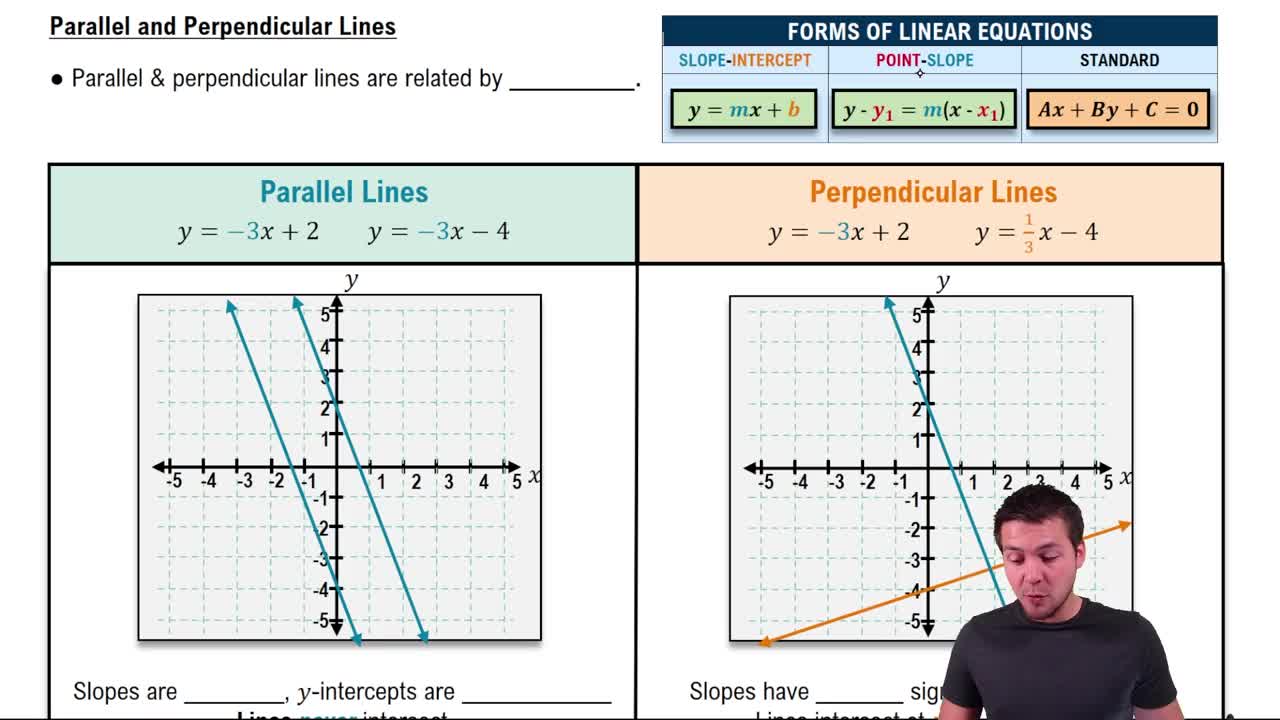
Parallel & Perpendicular Lines

Set Notation

Set notation is a way to represent sets and their operations using specific symbols and terminology. Common symbols include curly braces for sets, the intersection symbol (∩) for common elements, and the union symbol (∪) for all elements from both sets. Familiarity with set notation is essential for accurately interpreting and solving set-related problems.
Recommended video:
05:18
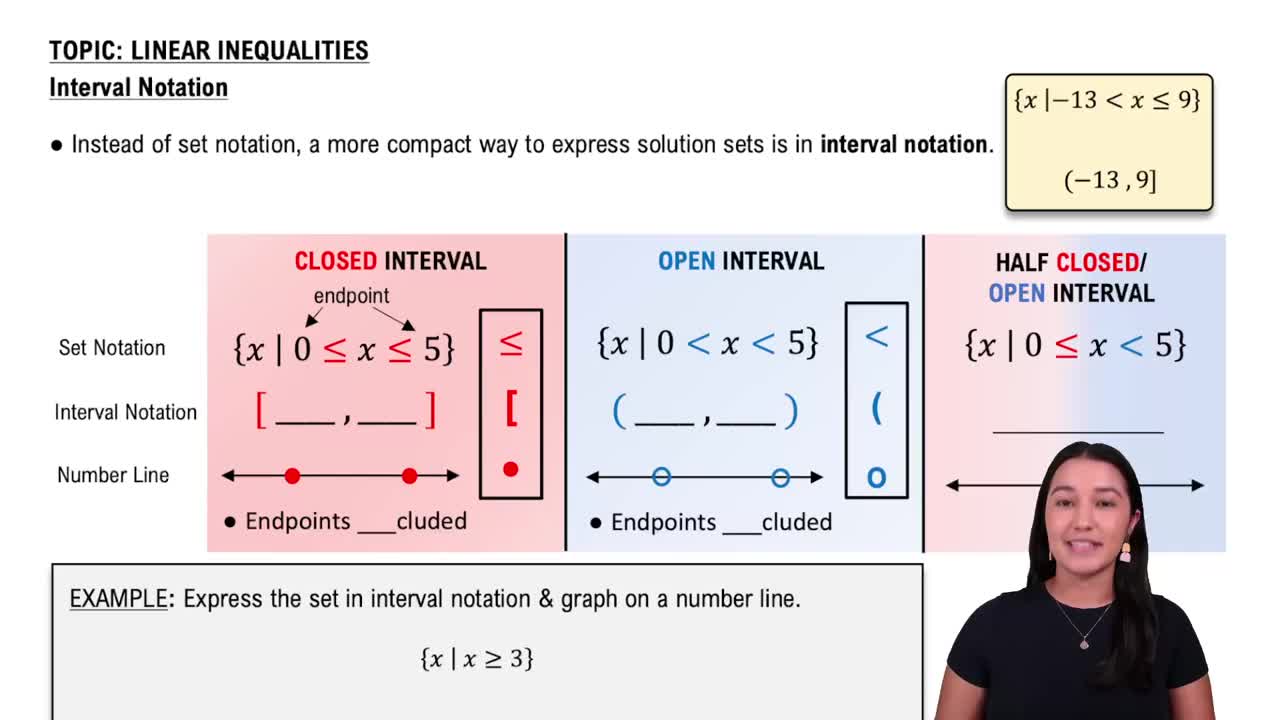
Interval Notation

Element Membership

Element membership refers to the relationship between an element and a set, indicating whether the element is part of the set. This is denoted by the symbol '∈', meaning 'is an element of'. Understanding element membership is vital for determining the contents of sets and performing operations like intersection, as it helps identify which elements belong to both sets involved.
Recommended video:
02:44
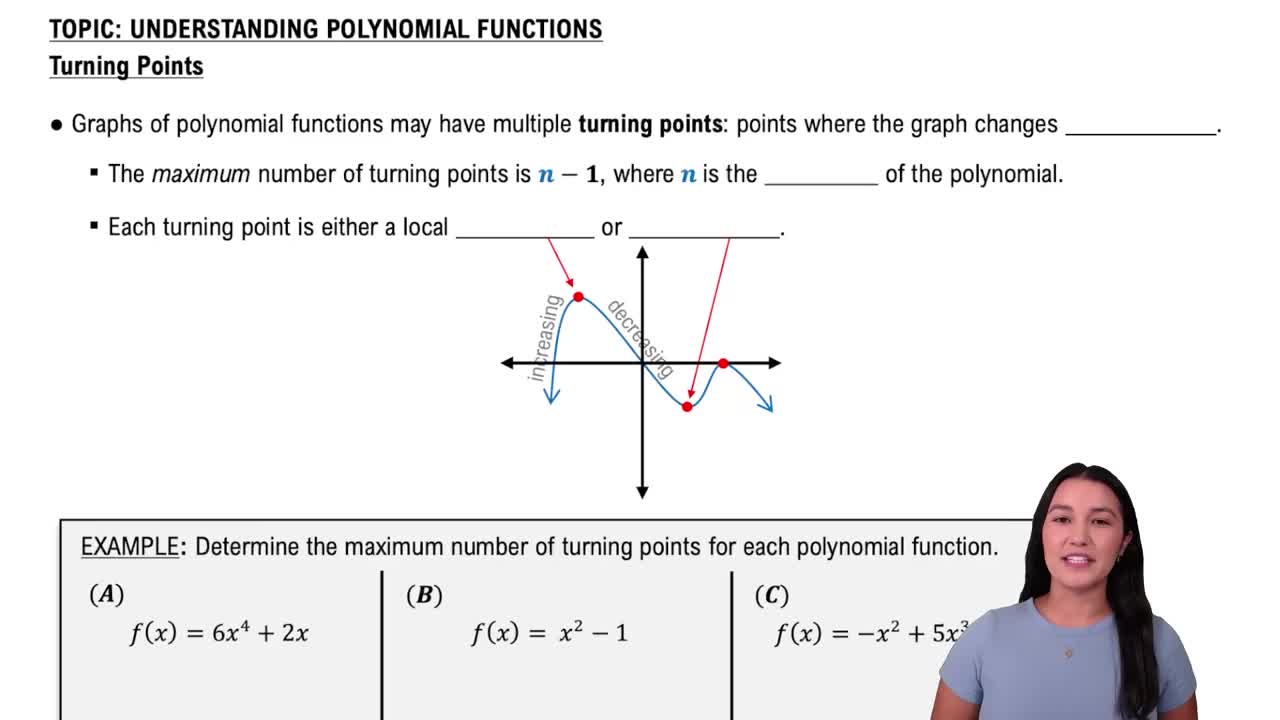
Maximum Turning Points of a Polynomial Function