Ch. P - Fundamental Concepts of Algebra
Blitzer - College Algebra 8th Edition
Blitzer8th EditionCollege AlgebraISBN: 9780136970514Not the one you use?Change textbook
Chapter 1, Problem 5

In Exercises 1–6, find all numbers that must be excluded from the domain of each rational expression. (x−1)/(x2+11x+10)

Verified step by step guidance
1
Step 1: Recall that the domain of a rational expression includes all real numbers except those that make the denominator equal to zero. To find the excluded values, set the denominator equal to zero and solve for x.
Step 2: Write the denominator of the given rational expression: x^2 + 11x + 10. Set it equal to zero: x^2 + 11x + 10 = 0.
Step 3: Factor the quadratic expression x^2 + 11x + 10. Look for two numbers that multiply to 10 (the constant term) and add to 11 (the coefficient of x). These numbers are 10 and 1, so the factored form is (x + 10)(x + 1).
Step 4: Set each factor of the denominator equal to zero to find the excluded values: x + 10 = 0 and x + 1 = 0. Solve each equation to find x = -10 and x = -1.
Step 5: Conclude that the numbers x = -10 and x = -1 must be excluded from the domain of the rational expression, as they make the denominator equal to zero.

Verified video answer for a similar problem:

This video solution was recommended by our tutors as helpful for the problem above.
Video duration:
2m
Was this helpful?

Key Concepts

Here are the essential concepts you must grasp in order to answer the question correctly.

Rational Expressions

A rational expression is a fraction where both the numerator and the denominator are polynomials. Understanding rational expressions is crucial because they can have restrictions on their domain, specifically where the denominator equals zero, as division by zero is undefined.
Recommended video:
Guided course
02:58
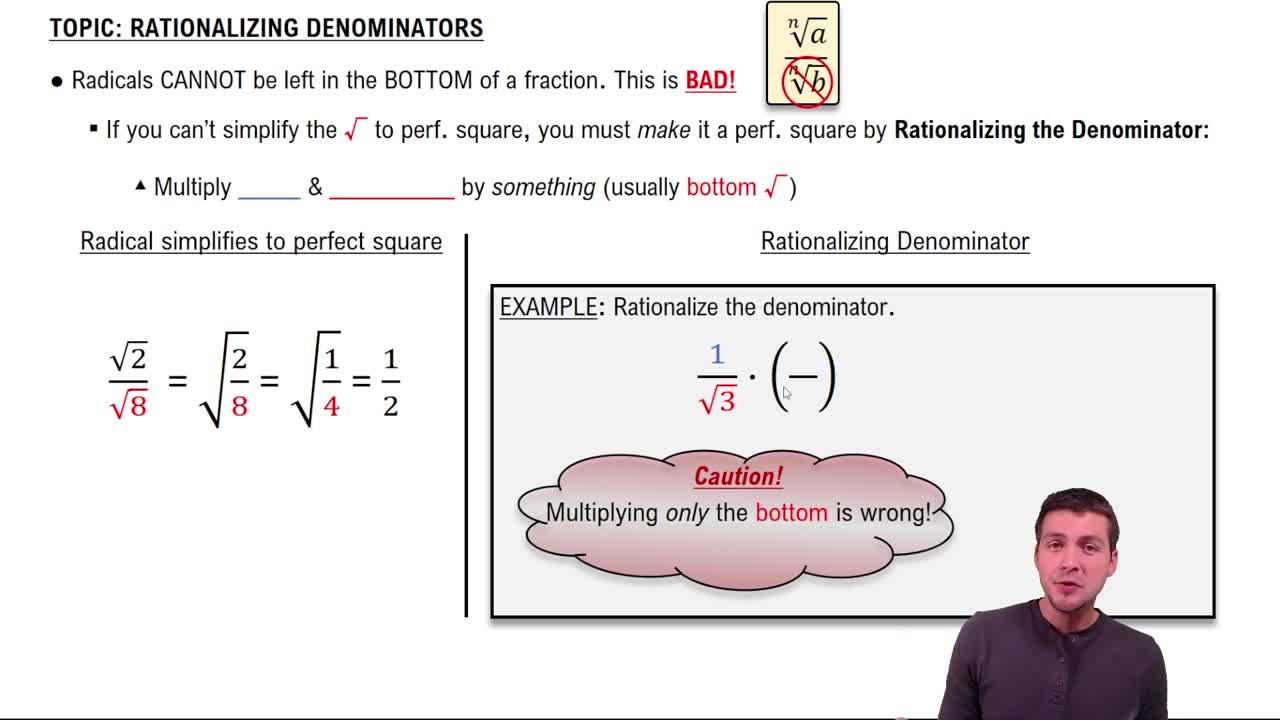
Rationalizing Denominators

Finding the Domain

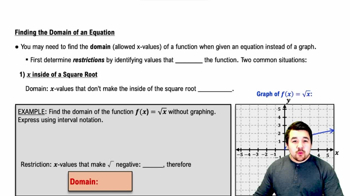
The domain of a rational expression consists of all real numbers except those that make the denominator zero. To find the domain, one must identify the values of the variable that lead to a zero denominator and exclude them from the set of possible inputs.
Recommended video:
3:43
Finding the Domain of an Equation

Factoring Polynomials

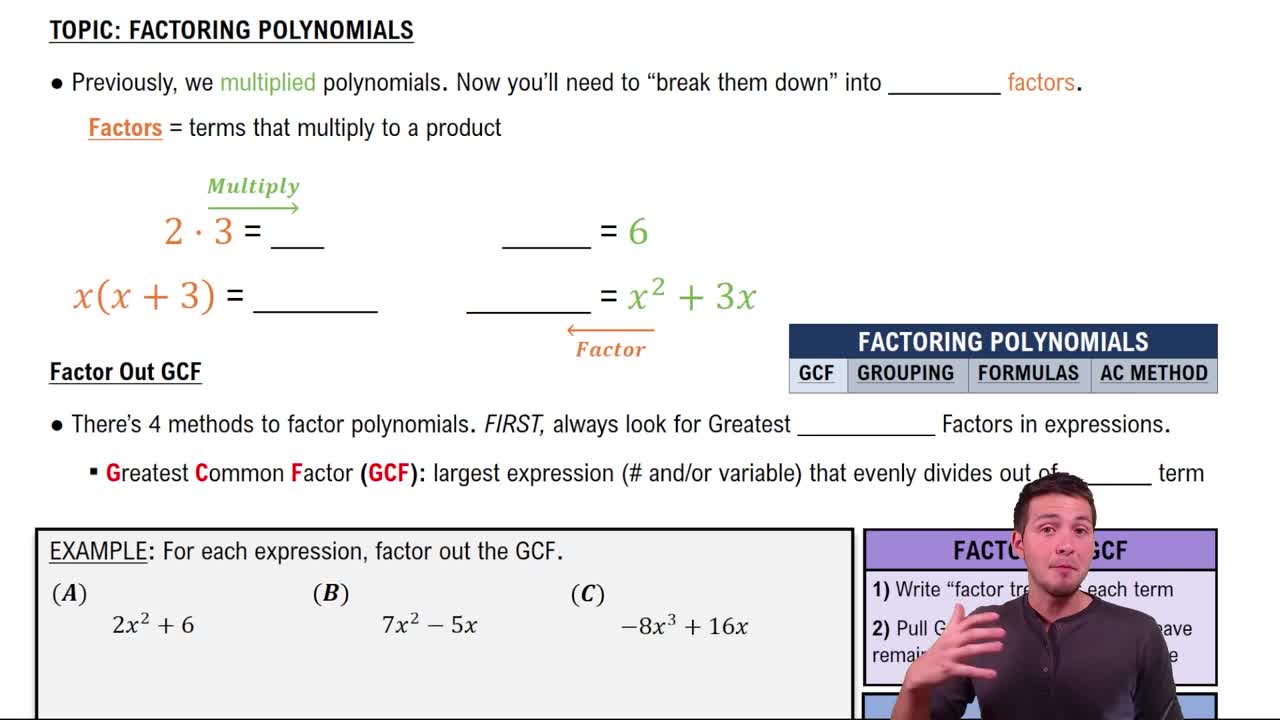
Factoring polynomials is the process of breaking down a polynomial into simpler components (factors) that, when multiplied together, yield the original polynomial. This is essential for identifying the roots of the denominator, which helps determine the values to exclude from the domain of the rational expression.
Recommended video:
Guided course
07:30
Introduction to Factoring Polynomials