Ch. P - Fundamental Concepts of Algebra
Blitzer - College Algebra 8th Edition
Blitzer8th EditionCollege AlgebraISBN: 9780136970514Not the one you use?Change textbook
Chapter 1, Problem 80

State the name of the property illustrated. 7⋅(11⋅8)=(11⋅8)⋅7

Verified step by step guidance
1
Identify the given expression: \(7 \cdot (11 \cdot 8) = (11 \cdot 8) \cdot 7\).
Notice that the grouping of the numbers changes from \(7\) multiplied by the product of \(11\) and \(8\), to the product of \(11\) and \(8\) multiplied by \(7\).
Observe that the order of the numbers is also changed, but the multiplication operation remains the same.
Recall that the Commutative Property of Multiplication states that changing the order of factors does not change the product: \(a \cdot b = b \cdot a\).
Therefore, this equation illustrates the Commutative Property of Multiplication because the factors are rearranged but the product remains unchanged.

Verified video answer for a similar problem:

This video solution was recommended by our tutors as helpful for the problem above.
Video duration:
2m
Was this helpful?

Key Concepts

Here are the essential concepts you must grasp in order to answer the question correctly.

Associative Property of Multiplication

This property states that when multiplying three or more numbers, the way in which the numbers are grouped does not affect the product. For example, (a ⋅ b) ⋅ c = a ⋅ (b ⋅ c). It focuses on the grouping of factors, not their order.
Recommended video:
5:36
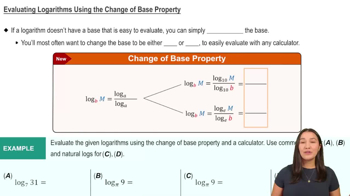
Change of Base Property

Commutative Property of Multiplication

This property states that the order of factors can be changed without affecting the product. For example, a ⋅ b = b ⋅ a. It emphasizes that multiplication is independent of the sequence of numbers.
Recommended video:
5:36
Change of Base Property

Understanding Mathematical Notation and Grouping Symbols

Parentheses indicate the grouping of numbers or operations to be performed first. Recognizing how parentheses affect the order of operations is essential to identify properties like associative or commutative in expressions.
Recommended video:
06:08
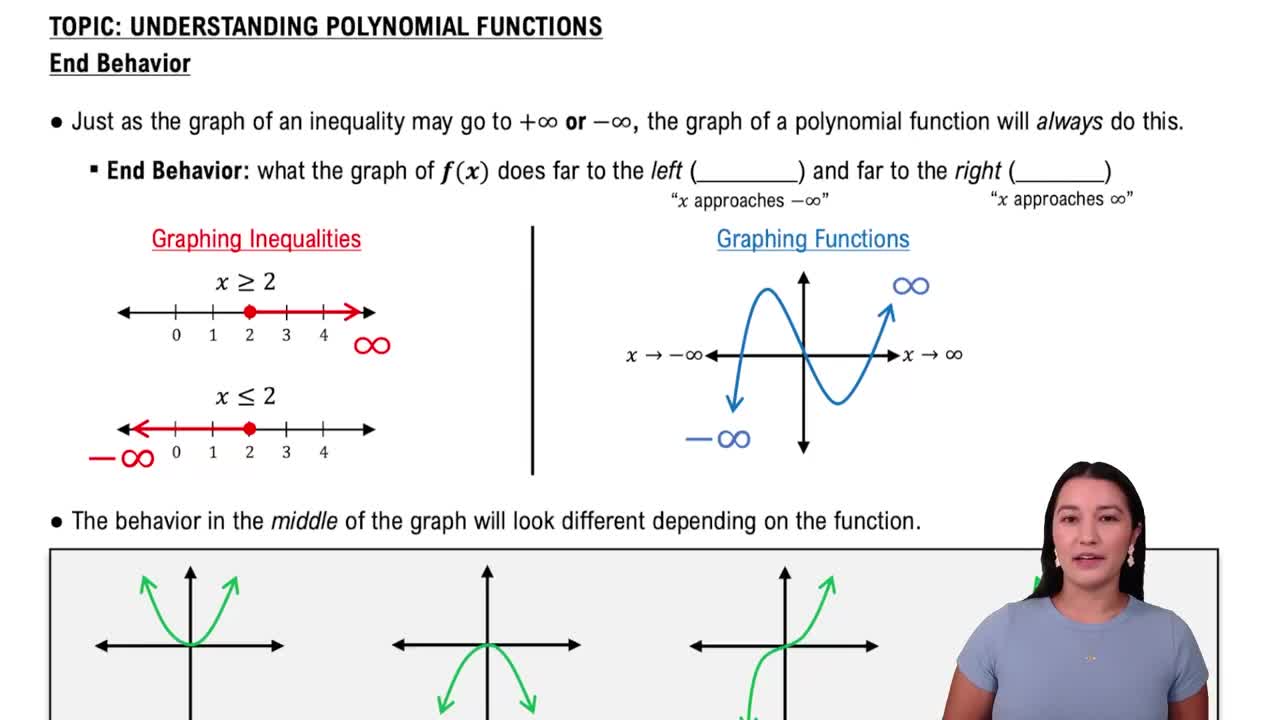
End Behavior of Polynomial Functions