Ch. P - Fundamental Concepts of Algebra
Blitzer - College Algebra 8th Edition
Blitzer8th EditionCollege AlgebraISBN: 9780136970514Not the one you use?Change textbook
Chapter 1, Problem 81

In Exercises 69–82, simplify each complex rational expression. (1/(x+h)2 − 1/x2)/h

Verified step by step guidance
1
Step 1: Recognize that the given expression is a complex rational expression. A complex rational expression is a fraction where the numerator and/or denominator contains fractions. The given expression is (1/(x+h)^2 − 1/x^2)/h.
Step 2: Simplify the numerator of the complex fraction, which is 1/(x+h)^2 − 1/x^2. To do this, find a common denominator for the two fractions in the numerator. The least common denominator (LCD) of (x+h)^2 and x^2 is (x+h)^2 * x^2.
Step 3: Rewrite each fraction in the numerator with the LCD as the denominator. For 1/(x+h)^2, multiply numerator and denominator by x^2 to get x^2/((x+h)^2 * x^2). For 1/x^2, multiply numerator and denominator by (x+h)^2 to get (x+h)^2/((x+h)^2 * x^2).
Step 4: Combine the two fractions in the numerator over the common denominator. This gives (x^2 - (x+h)^2)/((x+h)^2 * x^2). Expand (x+h)^2 in the numerator to simplify further.
Step 5: Divide the simplified numerator by h, which is the denominator of the original complex fraction. This is equivalent to multiplying the simplified numerator by 1/h. Simplify the resulting expression by factoring and canceling terms where possible.

Verified video answer for a similar problem:

This video solution was recommended by our tutors as helpful for the problem above.
Video duration:
8m
Was this helpful?

Key Concepts

Here are the essential concepts you must grasp in order to answer the question correctly.

Complex Rational Expressions

A complex rational expression is a fraction where the numerator, the denominator, or both contain rational expressions. Simplifying these expressions often involves finding a common denominator, combining terms, and reducing the fraction to its simplest form. Understanding how to manipulate these expressions is crucial for solving problems involving them.
Recommended video:
05:33
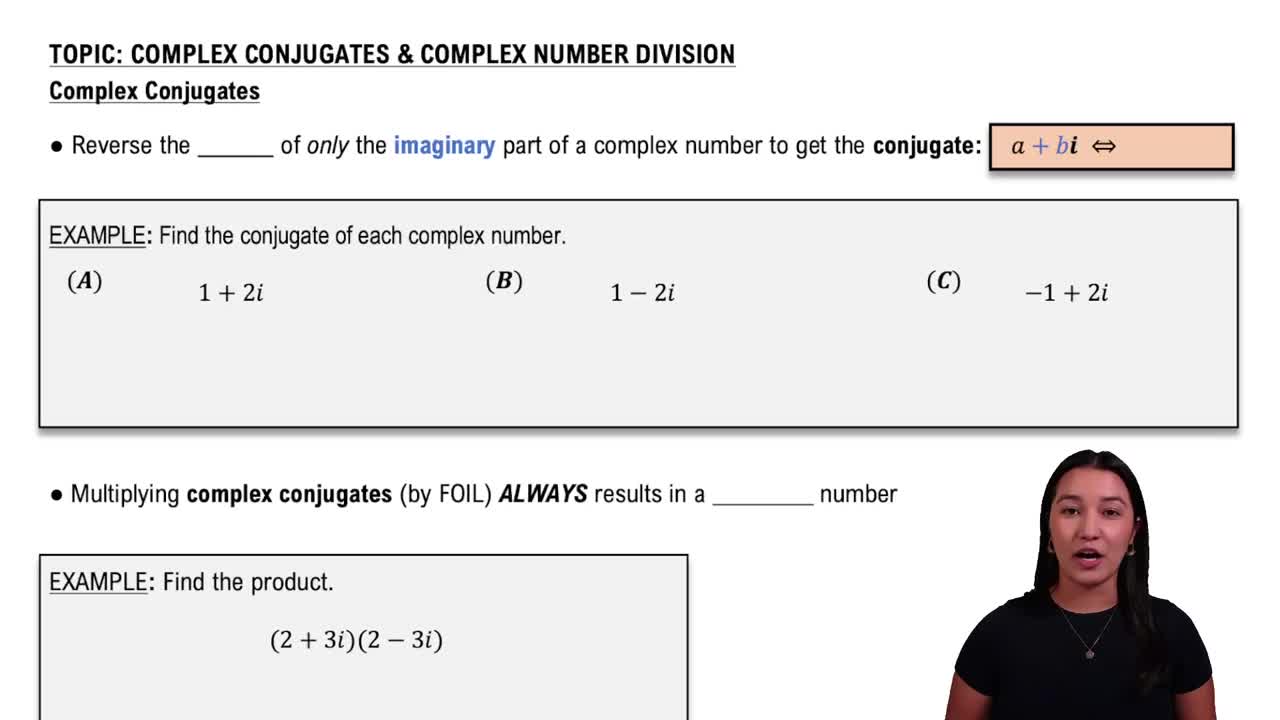
Complex Conjugates

Finding a Common Denominator

To simplify complex rational expressions, it is essential to find a common denominator for the fractions involved. This process allows you to combine the fractions into a single expression, making it easier to simplify. The common denominator is typically the least common multiple (LCM) of the individual denominators.
Recommended video:
Guided course
02:58
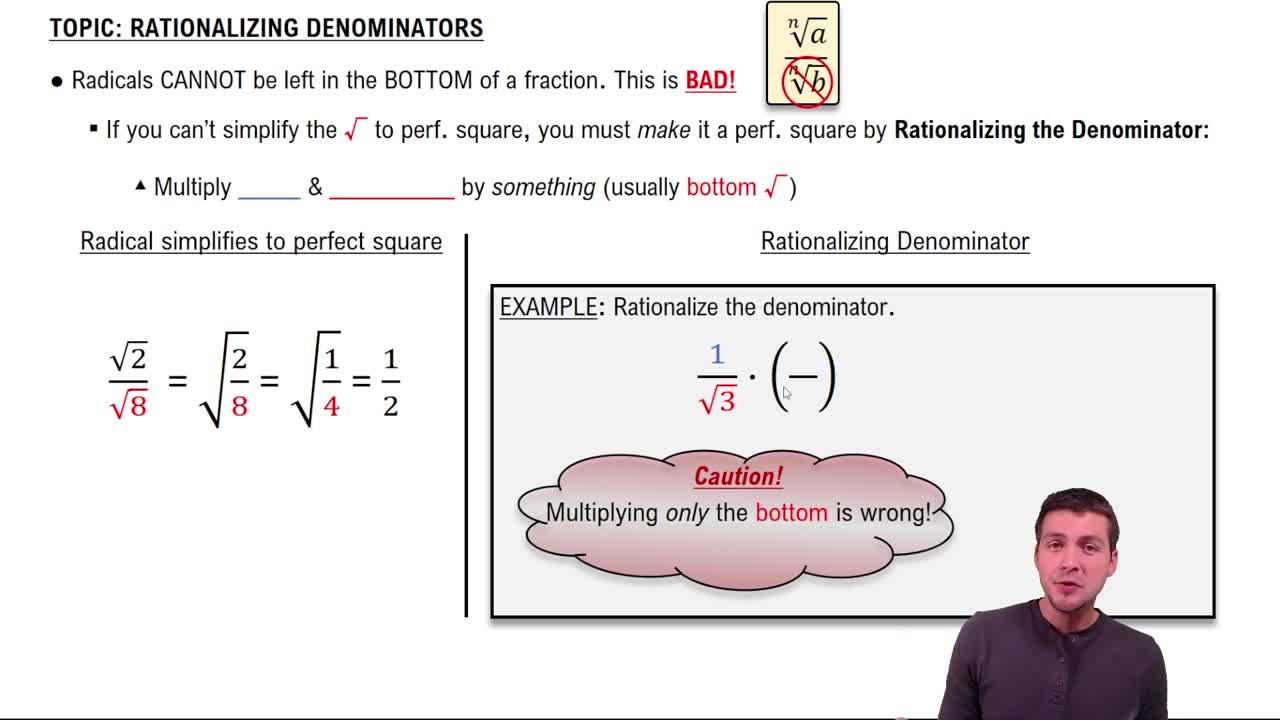
Rationalizing Denominators

Limits and Simplification

In calculus and algebra, simplification often involves considering limits, especially when dealing with expressions that approach indeterminate forms. In the given expression, as h approaches zero, understanding how to simplify the expression can help in evaluating limits and understanding the behavior of functions near specific points.
Recommended video:
05:18
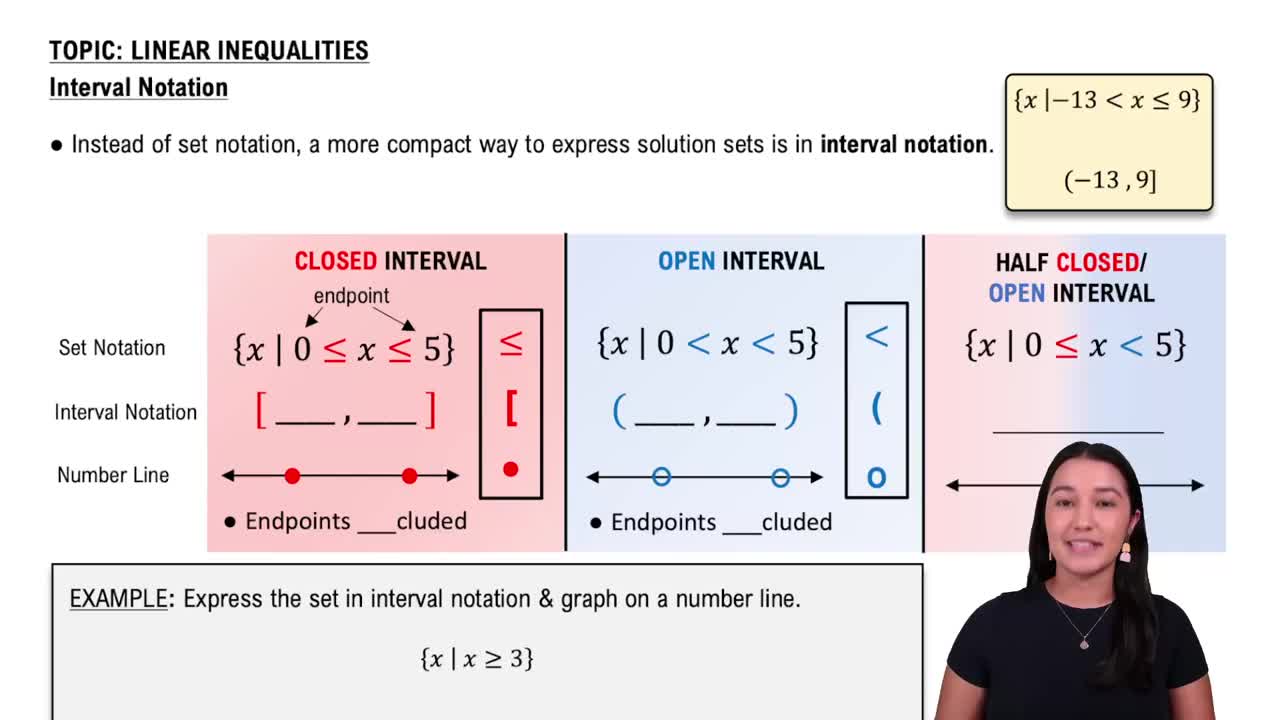
Interval Notation