Ch. P - Fundamental Concepts of Algebra
Blitzer - College Algebra 8th Edition
Blitzer8th EditionCollege AlgebraISBN: 9780136970514Not the one you use?Change textbook
Chapter 1, Problem 31

Find the union of the sets. {1,3,5,7}∪{2,4,6,8,10}

Verified step by step guidance
1
Identify the two sets given: the first set is \(\{1,3,5,7\}\) and the second set is \(\{2,4,6,8,10\}\).
Recall that the union of two sets, denoted by \(\cup\), combines all elements from both sets without repeating any elements.
List all elements from the first set: \$1, 3, 5, 7$.
Add all elements from the second set: \$2, 4, 6, 8, 10$, making sure not to repeat any elements already listed.
Write the union set by combining all unique elements from both sets into one set.

Verified video answer for a similar problem:

This video solution was recommended by our tutors as helpful for the problem above.
Video duration:
1m
Was this helpful?

Key Concepts

Here are the essential concepts you must grasp in order to answer the question correctly.

Set Union

The union of two sets combines all unique elements from both sets into one set. It is denoted by the symbol ∪. For example, if A = {1, 2} and B = {2, 3}, then A ∪ B = {1, 2, 3}.
Recommended video:
5:10
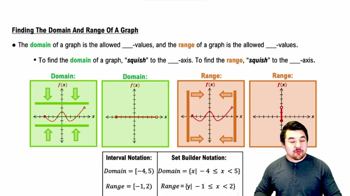
Finding the Domain and Range of a Graph

Set Notation

Set notation uses curly braces {} to list elements of a set. Elements are separated by commas, and each element is unique within the set. Understanding this notation helps in identifying and manipulating sets.
Recommended video:
05:18
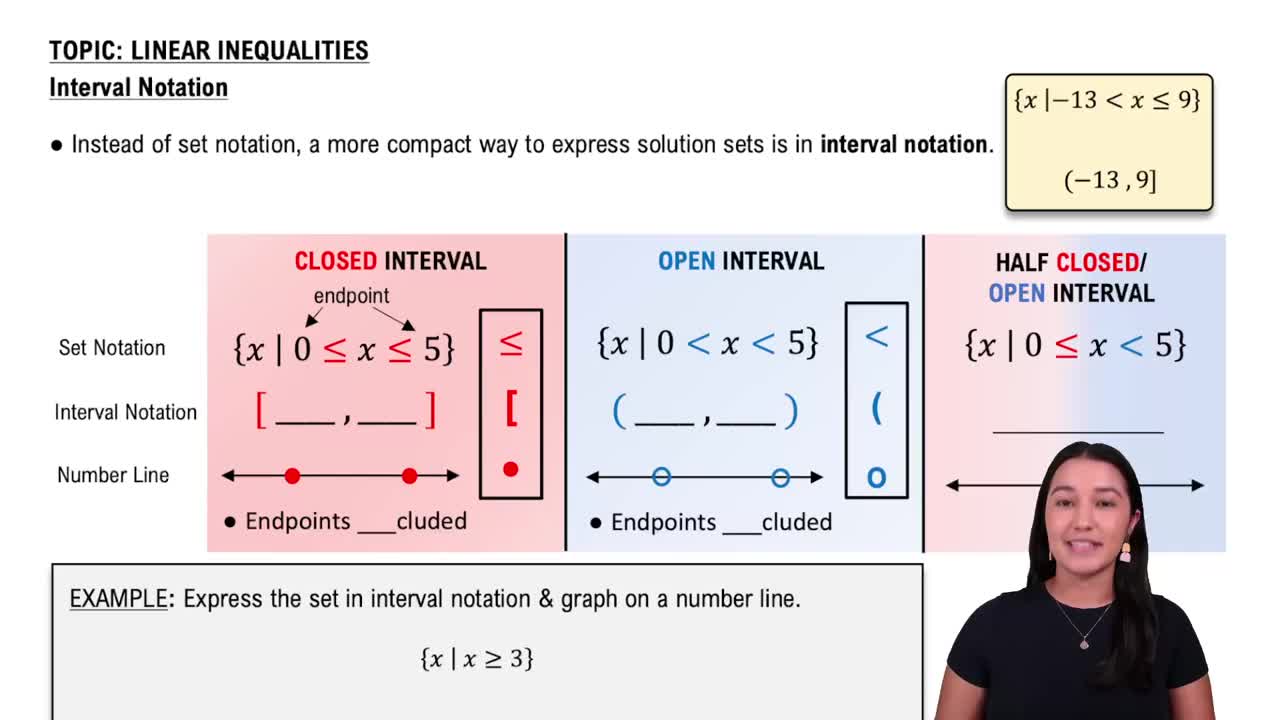
Interval Notation

Distinct Elements in Sets

When forming unions, repeated elements are only listed once. Recognizing that sets do not include duplicates ensures the union contains each element a single time, regardless of how many times it appears in the original sets.
Recommended video:
6:37
Permutations of Non-Distinct Objects