Ch. P - Fundamental Concepts of Algebra
Blitzer - College Algebra 8th Edition
Blitzer8th EditionCollege AlgebraISBN: 9780136970514Not the one you use?Change textbook
Chapter 1, Problem 30

In Exercises 15–58, find each product. (7x3+5)(x2−2)

Verified step by step guidance
1
Distribute the first term of the first polynomial, \(7x^3\), to each term in the second polynomial \((x^2 - 2)\). This gives \(7x^3 \cdot x^2\) and \(7x^3 \cdot (-2)\).
Simplify the results of the first distribution: \(7x^3 \cdot x^2 = 7x^5\) and \(7x^3 \cdot (-2) = -14x^3\).
Distribute the second term of the first polynomial, \(5\), to each term in the second polynomial \((x^2 - 2)\). This gives \(5 \cdot x^2\) and \(5 \cdot (-2)\).
Simplify the results of the second distribution: \(5 \cdot x^2 = 5x^2\) and \(5 \cdot (-2) = -10\).
Combine all the terms from the distributions: \(7x^5 - 14x^3 + 5x^2 - 10\). This is the expanded form of the product.

Verified video answer for a similar problem:

This video solution was recommended by our tutors as helpful for the problem above.
Video duration:
3m
Was this helpful?

Key Concepts

Here are the essential concepts you must grasp in order to answer the question correctly.

Polynomial Multiplication

Polynomial multiplication involves distributing each term in one polynomial to every term in another polynomial. This process is often referred to as the distributive property, where you multiply each term in the first polynomial by each term in the second. For example, in the expression (7x^3 + 5)(x^2 - 2), you would multiply 7x^3 by both x^2 and -2, and then multiply 5 by both x^2 and -2.
Recommended video:
03:42
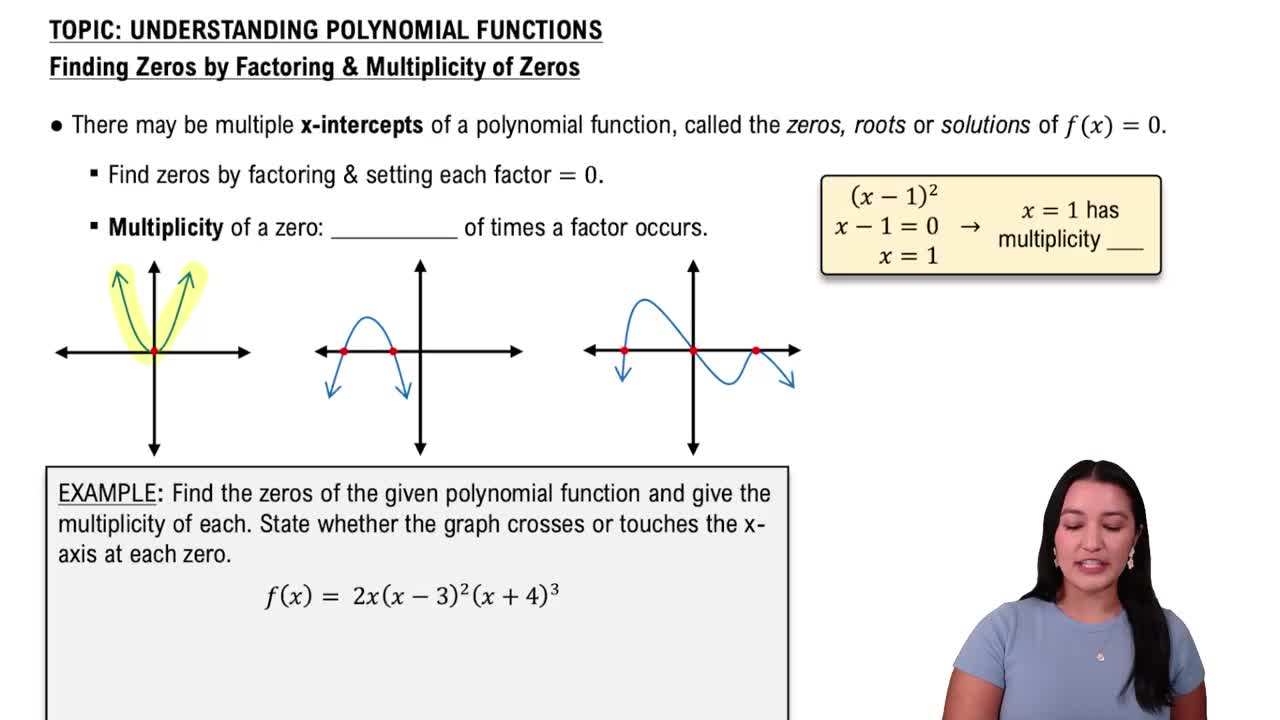
Finding Zeros & Their Multiplicity

Combining Like Terms

After multiplying polynomials, the next step is to combine like terms, which are terms that have the same variable raised to the same power. This simplification is crucial for expressing the final result in its simplest form. For instance, if the multiplication yields terms such as 7x^5, -14x^3, and 5x^2, you would ensure that all similar terms are added or subtracted accordingly.
Recommended video:
5:22
Combinations

Degree of a Polynomial

The degree of a polynomial is the highest power of the variable in the polynomial expression. Understanding the degree is important because it helps in determining the behavior of the polynomial function, such as its end behavior and the number of roots. In the given expression, the degree of the resulting polynomial after multiplication will be the sum of the degrees of the individual polynomials, which influences the overall shape of the graph.
Recommended video:
Guided course
05:16
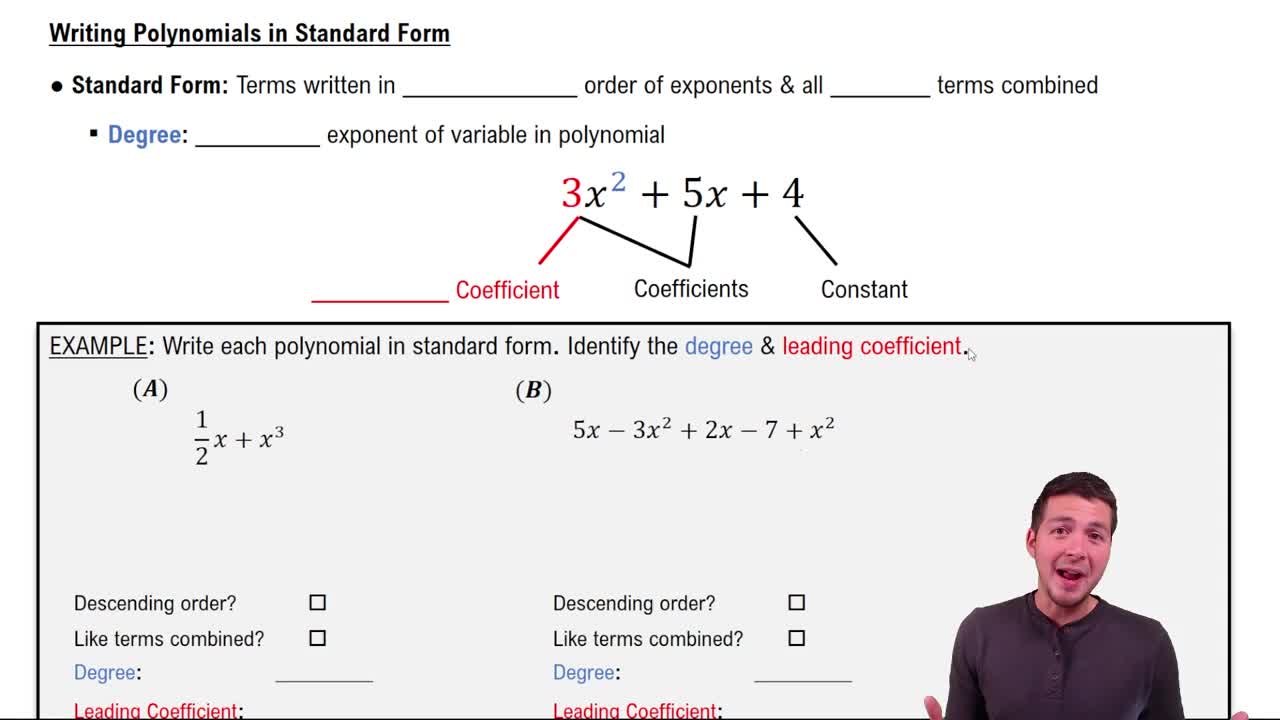
Standard Form of Polynomials