Ch. P - Fundamental Concepts of Algebra
Blitzer - College Algebra 8th Edition
Blitzer8th EditionCollege AlgebraISBN: 9780136970514Not the one you use?Change textbook
Chapter 1, Problem 18

In Exercises 15–32, multiply or divide as indicated. (x2−4)/(x2−4x+4) ⋅ (2x−4)/(x+2)

Verified step by step guidance
1
Factorize all the polynomials in the given expression. For the numerator \(x^2 - 4\), recognize it as a difference of squares and factor it as \((x - 2)(x + 2)\). For the denominator \(x^2 - 4x + 4\), recognize it as a perfect square trinomial and factor it as \((x - 2)^2\).
For the second fraction, factorize \(2x - 4\) in the numerator by factoring out the greatest common factor (GCF), which is 2, resulting in \(2(x - 2)\). The denominator \(x + 2\) remains as is since it cannot be factored further.
Rewrite the entire expression with the factored forms: \(\frac{(x - 2)(x + 2)}{(x - 2)^2} \cdot \frac{2(x - 2)}{x + 2}\).
Simplify the expression by canceling out common factors in the numerator and denominator. Specifically, cancel \(x - 2\) and \(x + 2\) where appropriate, being careful to note any restrictions on \(x\) (e.g., \(x \neq 2\) and \(x \neq -2\) to avoid division by zero).
Combine the remaining terms after cancellation to form the simplified expression. Ensure that the final result is expressed in its simplest form.

Verified video answer for a similar problem:

This video solution was recommended by our tutors as helpful for the problem above.
Video duration:
2m
Was this helpful?

Key Concepts

Here are the essential concepts you must grasp in order to answer the question correctly.

Factoring Polynomials

Factoring polynomials involves rewriting a polynomial as a product of simpler polynomials. In the given expression, both the numerator and denominator can be factored to simplify the multiplication. For example, x^2 - 4 can be factored as (x - 2)(x + 2), and x^2 - 4x + 4 can be factored as (x - 2)^2.
Recommended video:
Guided course
07:30
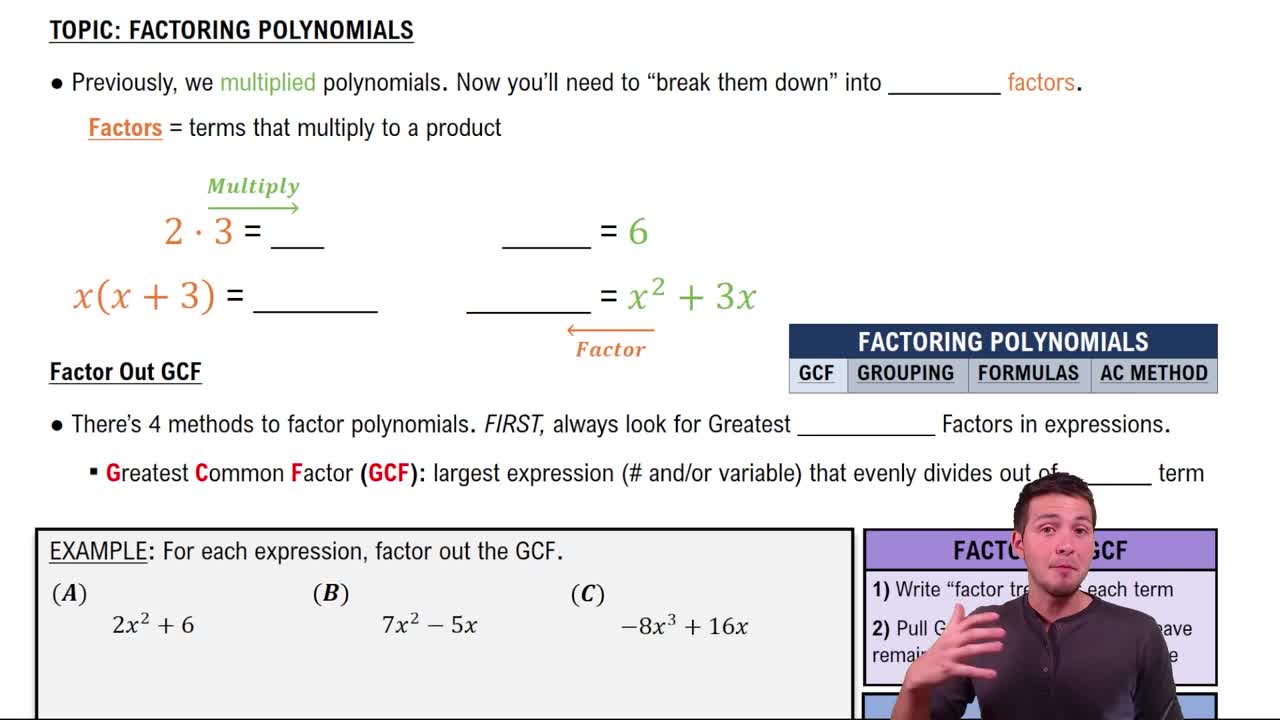
Introduction to Factoring Polynomials

Multiplication of Rational Expressions

Multiplying rational expressions requires multiplying the numerators together and the denominators together. After factoring, any common factors in the numerator and denominator can be canceled out to simplify the expression. This process is essential for reducing the complexity of the expression before performing the multiplication.
Recommended video:
Guided course
02:58
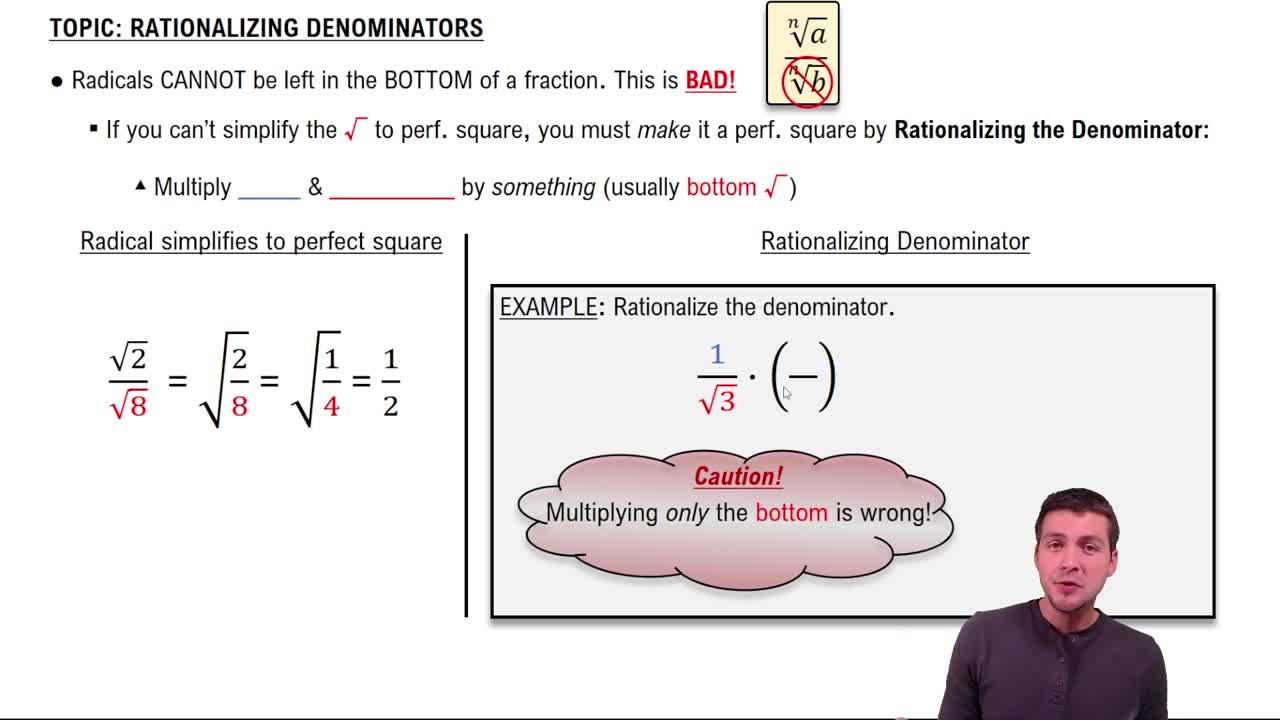
Rationalizing Denominators

Simplifying Rational Expressions

Simplifying rational expressions involves reducing the expression to its lowest terms by canceling out common factors. This is crucial for obtaining a clearer and more manageable form of the expression. After multiplication, it is important to check for any remaining common factors that can be simplified further.
Recommended video:
Guided course
05:07
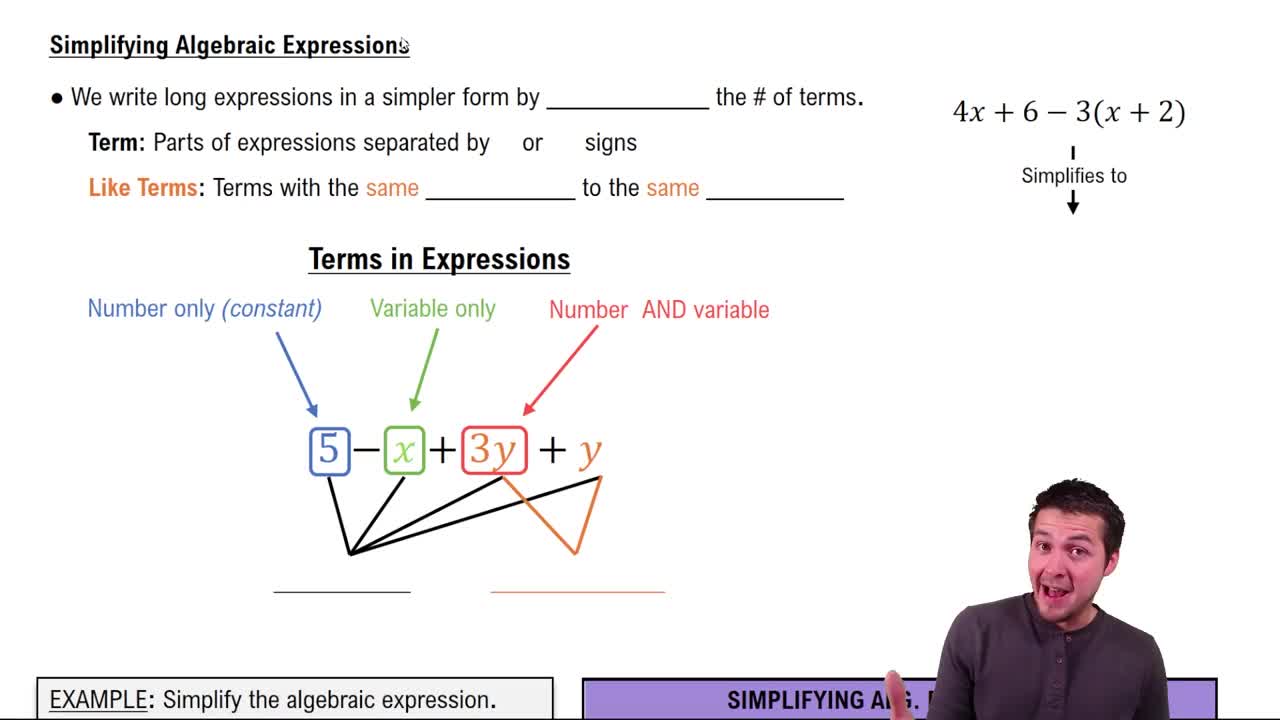
Simplifying Algebraic Expressions