Ch. 8 - Sequences, Induction, and Probability
Blitzer - College Algebra 8th Edition
Blitzer8th EditionCollege AlgebraISBN: 9780136970514Not the one you use?Change textbook
Chapter 9, Problem 61

Let {an} = - 5, 10, - 20, 40, ..., {bn} = 10, - 5, - 20, - 35, ..., {cn} = - 2, 1, - 1/2, 1/4 Find the difference between the sum of the first 6 terms of {an} and the sum of the infinite seris containing all the terms of {cn}.

Verified step by step guidance
1
Identify the type of each sequence. For \( \{a_n\} = -5, 10, -20, 40, \ldots \), observe the pattern of terms to determine if it is geometric or arithmetic. Notice the sign changes and the ratio between consecutive terms.
Once confirmed that \( \{a_n\} \) is geometric, find the common ratio \( r \) by dividing the second term by the first term: \( r = \frac{a_2}{a_1} \).
Calculate the sum of the first 6 terms of \( \{a_n\} \) using the formula for the sum of the first \( n \) terms of a geometric sequence: \[ S_n = a_1 \cdot \frac{1 - r^n}{1 - r} \], where \( a_1 \) is the first term and \( r \) is the common ratio.
Analyze the sequence \( \{c_n\} = -2, 1, -\frac{1}{2}, \frac{1}{4}, \ldots \) to confirm it is geometric by checking the ratio between consecutive terms. Then, find the common ratio \( r_c \).
Since \( \{c_n\} \) is an infinite geometric series with \( |r_c| < 1 \), find its sum using the infinite geometric series sum formula: \[ S_\infty = \frac{a_1}{1 - r_c} \]. Finally, find the difference between the sum of the first 6 terms of \( \{a_n\} \) and the sum of the infinite series \( \{c_n\} \) by subtracting the two sums.

Key Concepts

Here are the essential concepts you must grasp in order to answer the question correctly.

Arithmetic and Geometric Sequences

Sequences are ordered lists of numbers following a specific pattern. Arithmetic sequences have a constant difference between terms, while geometric sequences have a constant ratio. Identifying the type of sequence helps determine formulas for terms and sums.
Recommended video:
Guided course
4:18
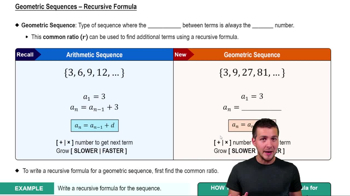
Geometric Sequences - Recursive Formula

Sum of a Finite Number of Terms

The sum of the first n terms of a sequence can be found using specific formulas. For arithmetic sequences, use the average of the first and nth term multiplied by n. For geometric sequences, use the sum formula involving the first term and common ratio.
Recommended video:
4:47
The Number e

Sum of an Infinite Geometric Series

An infinite geometric series converges if the common ratio's absolute value is less than 1. Its sum is calculated by dividing the first term by (1 minus the common ratio). This concept is essential for finding sums of infinite series like {c_n}.
Recommended video:
Guided course
4:18
Geometric Sequences - Recursive Formula