In Exercises 55–60, express each sum using summation notation. Use a lower limit of summation of your choice and k for the index of summation.
Ch. 8 - Sequences, Induction, and Probability

Chapter 9, Problem 59
Let {an} = - 5, 10, - 20, 40, ..., {bn} = 10, - 5, - 20, - 35, ..., {cn} = - 2, 1, - 1/2, 1/4 Find the difference between the sum of the first 10 terms of {an} and the sum of the first 10 terms of {bn}.
Verified step by step guidance1
Identify the sequences {a_n} and {b_n} and determine their types (arithmetic or geometric). For {a_n} = -5, 10, -20, 40, ..., observe the pattern of terms and check if there is a common ratio or common difference.
For {a_n}, calculate the common ratio \( r_a \) by dividing the second term by the first term: \( r_a = \frac{10}{-5} \). Verify if this ratio holds for subsequent terms to confirm it is geometric.
Similarly, analyze the sequence {b_n} = 10, -5, -20, -35, ... to determine if it is arithmetic or geometric. Calculate the differences between consecutive terms to check for a common difference \( d_b \).
Once the nature of both sequences is confirmed, use the appropriate formula to find the sum of the first 10 terms for each sequence. For a geometric sequence, use \( S_n = a_1 \frac{1 - r^n}{1 - r} \) where \( a_1 \) is the first term and \( r \) is the common ratio. For an arithmetic sequence, use \( S_n = \frac{n}{2} (2a_1 + (n-1)d) \) where \( d \) is the common difference.
Calculate the difference between the sum of the first 10 terms of {a_n} and the sum of the first 10 terms of {b_n} by subtracting \( S_{10}^{b} \) from \( S_{10}^{a} \).

Verified video answer for a similar problem:
This video solution was recommended by our tutors as helpful for the problem above.
Video duration:
8mWas this helpful?
Key Concepts
Here are the essential concepts you must grasp in order to answer the question correctly.
Arithmetic and Geometric Sequences
Sequences are ordered lists of numbers following a specific pattern. Arithmetic sequences have a constant difference between terms, while geometric sequences have a constant ratio. Identifying the type helps determine the formula for the nth term and the sum of terms.
Recommended video:
Guided course
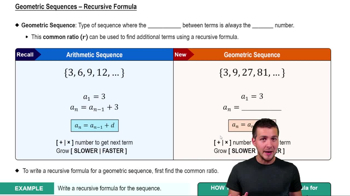
Geometric Sequences - Recursive Formula
Sum of the First n Terms of a Sequence
The sum of the first n terms of a sequence can be found using specific formulas. For arithmetic sequences, use S_n = n/2 (first term + last term). For geometric sequences, use S_n = a(1 - r^n)/(1 - r), where a is the first term and r is the common ratio.
Recommended video:
Guided course
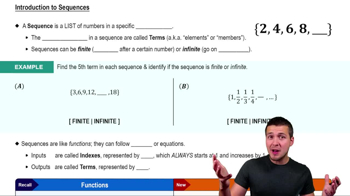
Introduction to Sequences
Term-by-Term Operations on Sequences
When comparing sums of sequences, understanding how to perform operations like subtraction between sums is essential. This involves calculating each sum separately and then finding their difference, ensuring careful handling of signs and sequence types.
Recommended video:
Guided course
Introduction to Sequences
Related Practice
Textbook Question
Textbook Question
Use mathematical induction to prove that the statement is true for every positive integer n. 1 + 4 + 4^2 + ... + 4^(n-1) = ((4^n)-1)/3
4
views
Textbook Question
Let {an} = - 5, 10, - 20, 40, ..., {bn} = 10, - 5, - 20, - 35, ..., {cn} = - 2, 1, - 1/2, 1/4 Find a10 + b10.
3
views
Textbook Question
In Exercises 61–68, use the graphs of and to find each indicated sum.
1
views
Textbook Question
Express each sum using summation notation. Use a lower limit of summation of your choice and k for the index of summation. a+ar+ar2+⋯+ ar12
Textbook Question
Let {an} = - 5, 10, - 20, 40, ..., {bn} = 10, - 5, - 20, - 35, ..., {cn} = - 2, 1, - 1/2, 1/4 Find the difference between the sum of the first 6 terms of {an} and the sum of the infinite seris containing all the terms of {cn}.