Ch. 6 - Matrices and Determinants
Blitzer - College Algebra 8th Edition
Blitzer8th EditionCollege AlgebraISBN: 9780136970514Not the one you use?Change textbook
Chapter 7, Problem 43

Solve the system: (Hint: Let A = ln w, B = ln x, C = ln y, and D = ln z. Solve the system for A, B, C, and D. Then use the logarithmic equations to find w, x, y, and z.)
{2lnw+lnx+3lny2lnz=64lnw+3lnx+lnylnz=2lnw+lnx+lny+lnz=5lnw+lnxlnylnz=5\(\begin{cases}\)2 \(\ln\) w + \(\ln\) x + 3 \(\ln\) y - 2 \(\ln\) z = -6 \\4 \(\ln\) w + 3 \(\ln\) x + \(\ln\) y - \(\ln\) z = -2 \(\ln\) w + \(\ln\) x + \(\ln\) y + \(\ln\) z = -5 \(\ln\) w + \(\ln\) x - \(\ln\) y - \(\ln\) z = 5\(\end{cases}\)

Verified step by step guidance
1
Step 1: Introduce the substitutions as given: let \(A = \ln w\), \(B = \ln x\), \(C = \ln y\), and \(D = \ln z\). Rewrite the system of equations in terms of \(A\), \(B\), \(C\), and \(D\).
Step 2: Rewrite each equation by replacing \(\ln w\) with \(A\), \(\ln x\) with \(B\), \(\ln y\) with \(C\), and \(\ln z\) with \(D\). The system becomes: \[\begin{cases}$ 2A + B + 3C - 2D = -6 \\ 4A + 3B + C - D = -2 \\ A + B + C + D = -5 \\ A + B - C - D = 5 $\end{cases}\]
Step 3: Solve this system of linear equations for \(A\), \(B\), \(C\), and \(D\) using methods such as substitution, elimination, or matrix operations (e.g., Gaussian elimination).
Step 4: Once you find the values of \(A\), \(B\), \(C\), and \(D\), recall that these are logarithms of the original variables. Use the inverse logarithm (exponentiation) to find \(w\), \(x\), \(y\), and \(z\): \(w = e^{A}\), \(x = e^{B}\), \(y = e^{C}\), \(z = e^{D}\).
Step 5: Verify your solutions by substituting \(w\), \(x\), \(y\), and \(z\) back into the original system of equations to ensure all equations are satisfied.

Verified video answer for a similar problem:

This video solution was recommended by our tutors as helpful for the problem above.
Video duration:
19m
Was this helpful?

Key Concepts

Here are the essential concepts you must grasp in order to answer the question correctly.

Logarithmic Properties and Transformations

Understanding the properties of logarithms, such as the product, quotient, and power rules, is essential. These properties allow the conversion of multiplicative relationships into additive ones, simplifying the system. In this problem, variables are expressed as natural logarithms, enabling linearization of the equations.
Recommended video:
4:37
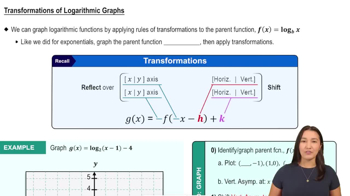
Transformations of Logarithmic Graphs

Solving Systems of Linear Equations

Once the logarithmic variables (A, B, C, D) are defined, the system becomes linear. Techniques such as substitution, elimination, or matrix methods (e.g., Gaussian elimination) can be used to find the values of A, B, C, and D. Mastery of these methods is crucial for efficiently solving the system.
Recommended video:
Guided course
4:27
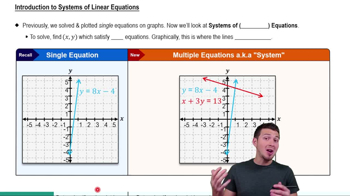
Introduction to Systems of Linear Equations

Exponentiation to Reverse Logarithms

After solving for A = ln w, B = ln x, C = ln y, and D = ln z, exponentiation is used to find the original variables w, x, y, and z. This step involves applying the inverse of the natural logarithm, the exponential function, to convert back from logarithmic form to the original variables.
Recommended video:
7:30
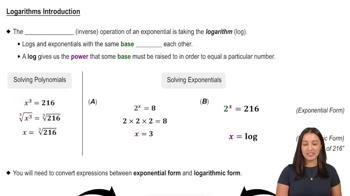
Logarithms Introduction
Related Practice
Textbook Question

Perform the indicated matrix operations given that A, B and C are defined as follows. If an operation is not defined, state the reason.

A=[403501],B=[5122],C=[1111]A=\(\begin{bmatrix}\)4 & 0\\ -3 & 5\\ 0 & 1\(\end{bmatrix}\),B=\(\begin{bmatrix}\)5 & 1\\ -2 & -2\(\end{bmatrix}\),C=\(\begin{bmatrix}\)1 & -1\\ -1 & 1\(\end{bmatrix}\)

A - C

Textbook Question

In Exercises 37 - 44, perform the indicated matrix operations given that A, B and C are defined as follows. If an operation is not defined, state the reason.

A=[403501],B=[5122],C=[1111]A=\(\begin{bmatrix}\)4 & 0\\ -3 & 5\\ 0 & 1\(\end{bmatrix}\),B=\(\begin{bmatrix}\)5 & 1\\ -2 & -2\(\end{bmatrix}\),C=\(\begin{bmatrix}\)1 & -1\\ -1 & 1\(\end{bmatrix}\)

A(BC)

2
views
Textbook Question

In Exercises 45–48, explain why the system of equations cannot be solved using Cramer's Rule. Then use Gaussian elimination to solve the system.

Textbook Question

In Exercises 43–44, (a) Write each linear system as a matrix equation in the form AX = B (b) Solve the system using the inverse that is given for the coefficient matrix.

Textbook Question

In Exercises 37–44, use Cramer's Rule to solve each system. {x+2z=42yz=52x+3y=13\(\begin{cases}\)x + 2z = 4 \\2y - z = 5 \\2x + 3y = 13\(\end{cases}\)

5
views
Textbook Question

In Exercises 37–44, use Cramer's Rule to solve each system. {x+y+z=4x2y+z=7x+3y+2z=4\(\begin{cases}\)x + y + z = 4 \(\x\) - 2y + z = 7 \(\x\) + 3y + 2z = 4\(\end{cases}\)