Ch. 6 - Matrices and Determinants
Blitzer - College Algebra 8th Edition
Blitzer8th EditionCollege AlgebraISBN: 9780136970514Not the one you use?Change textbook
Chapter 7, Problem 43

In Exercises 37–44, use Cramer's Rule to solve each system. {x+2z=42yz=52x+3y=13\(\begin{cases}\)x + 2z = 4 \\2y - z = 5 \\2x + 3y = 13\(\end{cases}\)

Verified step by step guidance
1
Write the system of equations in standard form, aligning variables x, y, and z: \(\begin{cases} x + 0y + 2z = 4 \\ 0x + 2y - z = 5 \\ 2x + 3y + 0z = 13 \end{cases}\)
Form the coefficient matrix \(A\) from the coefficients of \(x\), \(y\), and \(z\): \(A = \begin{bmatrix} 1 & 0 & 2 \\ 0 & 2 & -1 \\ 2 & 3 & 0 \end{bmatrix}\)
Calculate the determinant of matrix \(A\), denoted as \(\det(A)\), to ensure it is not zero (which would mean the system has a unique solution).
Form matrices \(A_x\), \(A_y\), and \(A_z\) by replacing the respective columns of \(A\) with the constants vector \(\begin{bmatrix} 4 \\ 5 \\ 13 \end{bmatrix}\): - \(A_x\) replaces the first column, - \(A_y\) replaces the second column, - \(A_z\) replaces the third column.
Calculate the determinants \(\det(A_x)\), \(\det(A_y)\), and \(\det(A_z)\), then use Cramer's Rule to find the variables: \( x = \frac{\det(A_x)}{\det(A)}\), \( y = \frac{\det(A_y)}{\det(A)}\), \( z = \frac{\det(A_z)}{\det(A)}\).

Verified video answer for a similar problem:

This video solution was recommended by our tutors as helpful for the problem above.
Video duration:
9m
Was this helpful?

Key Concepts

Here are the essential concepts you must grasp in order to answer the question correctly.

Cramer's Rule

Cramer's Rule is a method for solving systems of linear equations using determinants. It applies when the system has the same number of equations as unknowns and the coefficient matrix has a non-zero determinant. Each variable is found by replacing the corresponding column in the coefficient matrix with the constants vector and calculating the determinant ratio.
Recommended video:
Guided course
6:54
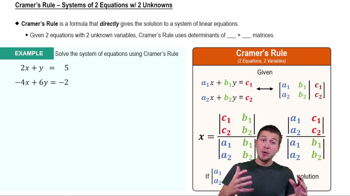
Cramer's Rule - 2 Equations with 2 Unknowns

Determinants of Matrices

The determinant is a scalar value that can be computed from a square matrix and provides important properties about the matrix, such as invertibility. For a 3x3 matrix, the determinant is calculated using a specific formula involving minors and cofactors. A non-zero determinant indicates the system has a unique solution.
Recommended video:
Guided course
4:36
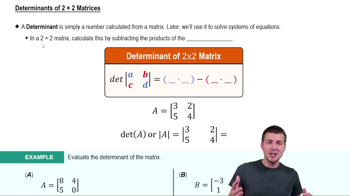
Determinants of 2×2 Matrices

Setting up the Coefficient Matrix and Constants Vector

To apply Cramer's Rule, the system of equations must be expressed in matrix form: Ax = b, where A is the coefficient matrix, x is the vector of variables, and b is the constants vector. Correctly identifying coefficients and constants from the equations is essential for forming these matrices accurately.
Recommended video:
Guided course
4:35
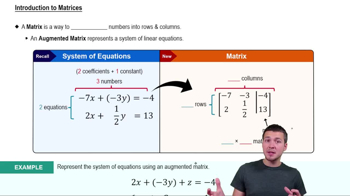
Introduction to Matrices
Related Practice
Textbook Question

Perform the indicated matrix operations given that A, B and C are defined as follows. If an operation is not defined, state the reason.

A=[403501],B=[5122],C=[1111]A=\(\begin{bmatrix}\)4 & 0\\ -3 & 5\\ 0 & 1\(\end{bmatrix}\),B=\(\begin{bmatrix}\)5 & 1\\ -2 & -2\(\end{bmatrix}\),C=\(\begin{bmatrix}\)1 & -1\\ -1 & 1\(\end{bmatrix}\)

A - C

Textbook Question

In Exercises 37 - 44, perform the indicated matrix operations given that A, B and C are defined as follows. If an operation is not defined, state the reason.

A=[403501],B=[5122],C=[1111]A=\(\begin{bmatrix}\)4 & 0\\ -3 & 5\\ 0 & 1\(\end{bmatrix}\),B=\(\begin{bmatrix}\)5 & 1\\ -2 & -2\(\end{bmatrix}\),C=\(\begin{bmatrix}\)1 & -1\\ -1 & 1\(\end{bmatrix}\)

A(BC)

2
views
Textbook Question

Solve the system: (Hint: Let A = ln w, B = ln x, C = ln y, and D = ln z. Solve the system for A, B, C, and D. Then use the logarithmic equations to find w, x, y, and z.)

{2lnw+lnx+3lny2lnz=64lnw+3lnx+lnylnz=2lnw+lnx+lny+lnz=5lnw+lnxlnylnz=5\(\begin{cases}\)2 \(\ln\) w + \(\ln\) x + 3 \(\ln\) y - 2 \(\ln\) z = -6 \\4 \(\ln\) w + 3 \(\ln\) x + \(\ln\) y - \(\ln\) z = -2 \(\ln\) w + \(\ln\) x + \(\ln\) y + \(\ln\) z = -5 \(\ln\) w + \(\ln\) x - \(\ln\) y - \(\ln\) z = 5\(\end{cases}\)

4
views
Textbook Question

In Exercises 43–44, (a) Write each linear system as a matrix equation in the form AX = B (b) Solve the system using the inverse that is given for the coefficient matrix.

Textbook Question

In Exercises 37–44, use Cramer's Rule to solve each system. {x+y+z=4x2y+z=7x+3y+2z=4\(\begin{cases}\)x + y + z = 4 \(\x\) - 2y + z = 7 \(\x\) + 3y + 2z = 4\(\end{cases}\)

Textbook Question

a. Write each linear system as a matrix equation in the form AX = B. b. Solve the system using the inverse that is given for the coefficient matrix.

{wx+2y=3xy+z=4w+xy+2z=2x+y2z=4The inverse of [1120011111120112] is [0011141312120101]\(\begin{cases}\)w - x + 2y \(\quad\]\quad\) = -3 \(\quad\[\quad\) x - y + z = 4 \\-w + x - y + 2z = 2 \(\quad\]\quad\) -x + y - 2z = -4\(\end{cases}\[\text{The inverse of }\]\begin{bmatrix}\)1 & -1 & 2 & 0 \\0 & 1 & -1 & 1 \\-1 & 1 & -1 & 2 \\0 & -1 & 1 & -2\(\end{bmatrix}\[\text{ is }\]\begin{bmatrix}\)0 & 0 & -1 & -1 \\1 & 4 & 1 & 3 \\1 & 2 & 1 & 2 \\0 & -1 & 0 & -1\(\end{bmatrix}\)