Ch. 5 - Systems of Equations and Inequalities
Blitzer - College Algebra 8th Edition
Blitzer8th EditionCollege AlgebraISBN: 9780136970514Not the one you use?Change textbook
Chapter 6, Problem 75

Use a system of linear equations to solve Exercises 73–84. How many ounces of a 15% alcohol solution must be mixed with 4 ounces of a 20% alcohol solution to make a 17% alcohol solution?

Verified step by step guidance
1
Define the variable: Let x represent the number of ounces of the 15% alcohol solution to be mixed.
Set up the equation based on the total amount of alcohol in the mixture: The amount of alcohol from the 15% solution is 0.15x, and from the 20% solution is 0.204.
Express the total amount of alcohol in the final mixture, which has a concentration of 17% and a total volume of x + 4 ounces, as 0.17(x + 4).
Write the equation representing the balance of alcohol content: 0.15x + 0.20 imes 4 = 0.17(x + 4).
Solve the equation for x by first expanding the right side, then collecting like terms, and finally isolating x to find the number of ounces of the 15% solution needed.

Verified video answer for a similar problem:

This video solution was recommended by our tutors as helpful for the problem above.
Video duration:
3m
Was this helpful?

Key Concepts

Here are the essential concepts you must grasp in order to answer the question correctly.

Systems of Linear Equations

A system of linear equations consists of two or more linear equations with the same variables. Solving the system means finding values for the variables that satisfy all equations simultaneously. In mixture problems, these equations represent relationships between quantities and concentrations.
Recommended video:
Guided course
4:27
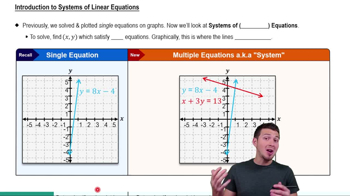
Introduction to Systems of Linear Equations

Mixture Problems and Concentration

Mixture problems involve combining substances with different concentrations to achieve a desired concentration. The key is to set up equations based on the total amount and the amount of the substance of interest (e.g., alcohol) in each part of the mixture.
Recommended video:
Guided course
03:11
Evaluating Algebraic Expressions

Setting Up and Solving Equations from Word Problems

Translating a word problem into equations requires identifying variables, writing expressions for quantities and concentrations, and forming equations that represent the problem conditions. Accurate setup is crucial for solving the problem correctly.
Recommended video:
5:02
Solving Logarithmic Equations