Ch. 5 - Systems of Equations and Inequalities
Blitzer - College Algebra 8th Edition
Blitzer8th EditionCollege AlgebraISBN: 9780136970514Not the one you use?Change textbook
Chapter 6, Problem 67

In Exercises 65–68, write the given sentences as a system of inequalities in two variables. Then graph the system. The sum of the x-variable and the y-variable is no more than 2. The y-variabe is no less than the difference between the square of the x-variable and 4.

Verified step by step guidance
1
Identify the variables: let the x-variable be x and the y-variable be y.
Translate the first sentence "The sum of the x-variable and the y-variable is no more than 2" into an inequality: x + y \(\leq\) 2.
Translate the second sentence "The y-variable is no less than the difference between the square of the x-variable and 4" into an inequality: y \(\geq\) x^2 - 4.
Write the system of inequalities as: \(\begin{cases}\) x + y \(\leq\) 2 \\ y \(\geq\) x^2 - 4 \(\end{cases}\).
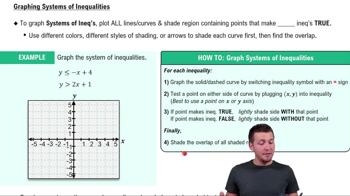
To graph the system, first graph the boundary lines: the line x + y = 2 and the parabola y = x^2 - 4. Then, shade the region below or on the line x + y \(\leq\) 2 and above or on the parabola y \(\geq\) x^2 - 4 to represent the solution set.

Verified video answer for a similar problem:

This video solution was recommended by our tutors as helpful for the problem above.
Video duration:
5m
Was this helpful?

Key Concepts

Here are the essential concepts you must grasp in order to answer the question correctly.

Translating Verbal Statements into Inequalities

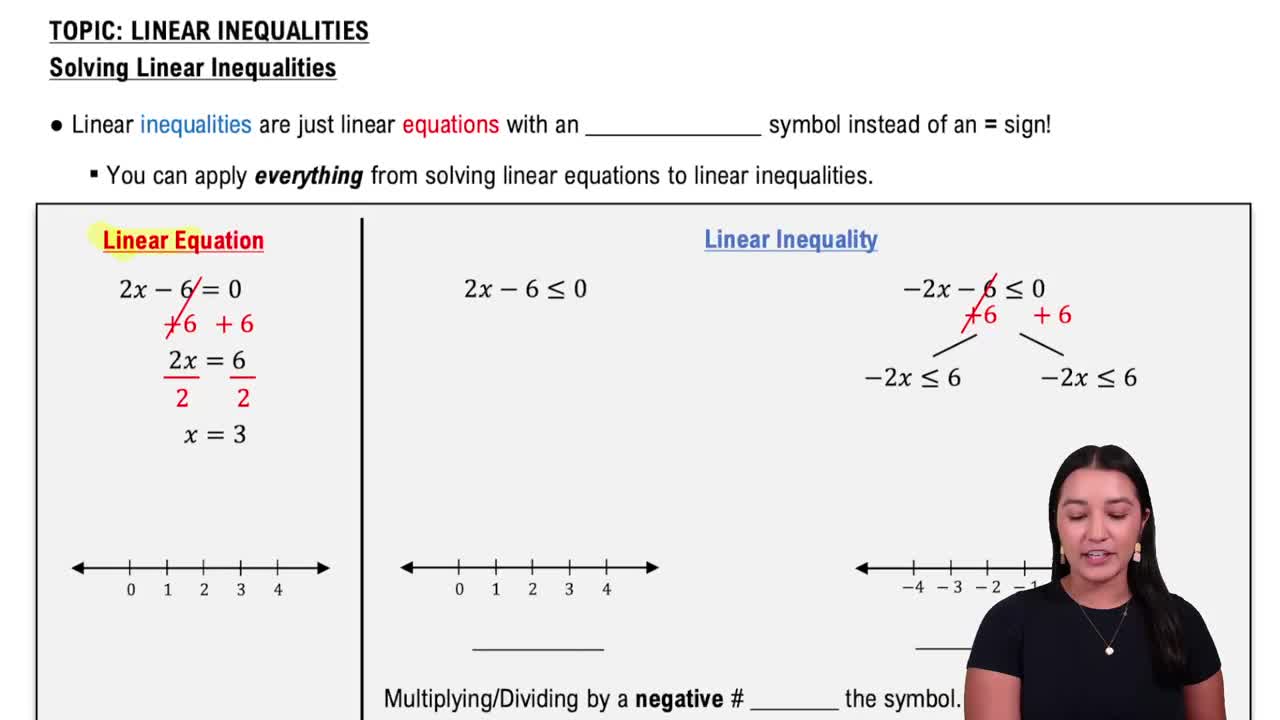
This involves converting written descriptions into mathematical inequalities. For example, 'no more than' translates to 'less than or equal to (≤)', and 'no less than' translates to 'greater than or equal to (≥)'. Understanding this helps in accurately forming the system of inequalities from the given sentences.
Recommended video:
06:07
Linear Inequalities

Systems of Inequalities in Two Variables

A system of inequalities consists of two or more inequalities involving the same variables. Solutions to the system satisfy all inequalities simultaneously, often represented as a region on the coordinate plane. Recognizing how to combine and interpret these inequalities is key to solving the problem.
Recommended video:
Guided course
6:19
Systems of Inequalities

Graphing Inequalities and Solution Regions

Graphing inequalities involves plotting boundary lines and shading regions that satisfy the inequality. Solid lines represent 'less than or equal to' or 'greater than or equal to', while dashed lines represent strict inequalities. Understanding how to graph and find the intersection of solution regions is essential for visualizing the system.
Recommended video:
Guided course
6:19
Systems of Inequalities