In Exercises 49–50, solve each system for x and y, expressing either value in terms of a or b, if necessary. Assume that a ≠ 0, b ≠ 0 5ax + 4y = 17 ax + 7y = 22
Ch. 5 - Systems of Equations and Inequalities

Chapter 6, Problem 47
In Exercises 47–52, solve each system by the method of your choice.
Verified step by step guidance1
Start by writing down the system of equations clearly: \(2x^{2} + xy = 6\) and \(x^{2} + 2xy = 0\).
From the second equation \(x^{2} + 2xy = 0\), factor out the common term \(x\): \(x(x + 2y) = 0\).
Set each factor equal to zero to find possible cases: either \(x = 0\) or \(x + 2y = 0\).
For the case \(x = 0\), substitute into the first equation \(2(0)^{2} + 0 imes y = 6\) and check if it holds true.
For the case \(x + 2y = 0\), solve for \(y\) as \(y = -\frac{x}{2}\), then substitute this expression for \(y\) into the first equation \(2x^{2} + x\left(-\frac{x}{2}\right) = 6\) to find values of \(x\).

Verified video answer for a similar problem:
This video solution was recommended by our tutors as helpful for the problem above.
Video duration:
7mWas this helpful?
Key Concepts
Here are the essential concepts you must grasp in order to answer the question correctly.
Systems of Nonlinear Equations
A system of nonlinear equations involves two or more equations with variables raised to powers other than one or multiplied together. Solving such systems requires finding values for the variables that satisfy all equations simultaneously, often involving substitution or elimination methods adapted for nonlinear terms.
Recommended video:
Guided course
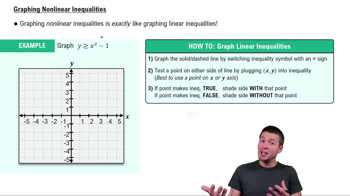
Nonlinear Inequalities
Substitution Method
The substitution method involves solving one equation for one variable and then substituting that expression into the other equation. This reduces the system to a single equation with one variable, which can be solved using algebraic techniques, especially useful when one equation can be easily rearranged.
Recommended video:
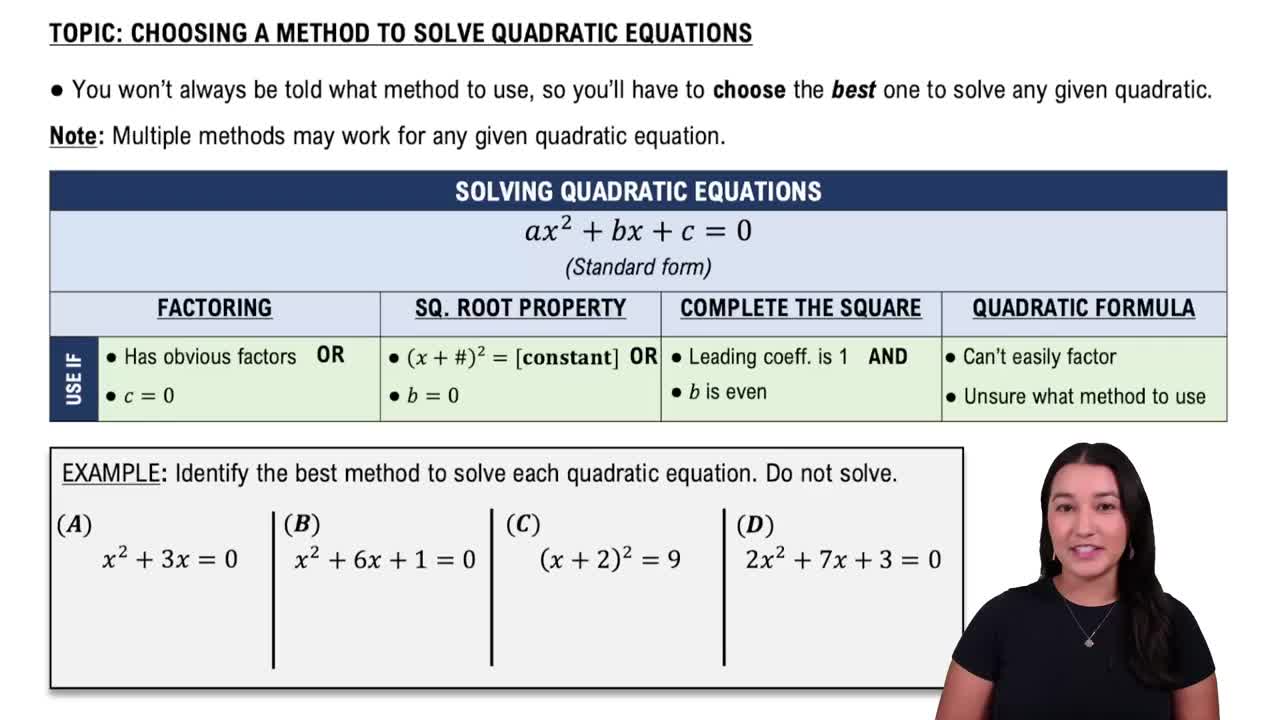
Choosing a Method to Solve Quadratics
Factoring and Quadratic Equations
Factoring is a technique to rewrite expressions as products of simpler expressions, often used to solve quadratic equations. In systems involving quadratic terms, factoring helps find roots or solutions by setting each factor equal to zero, simplifying the process of solving nonlinear systems.
Recommended video:
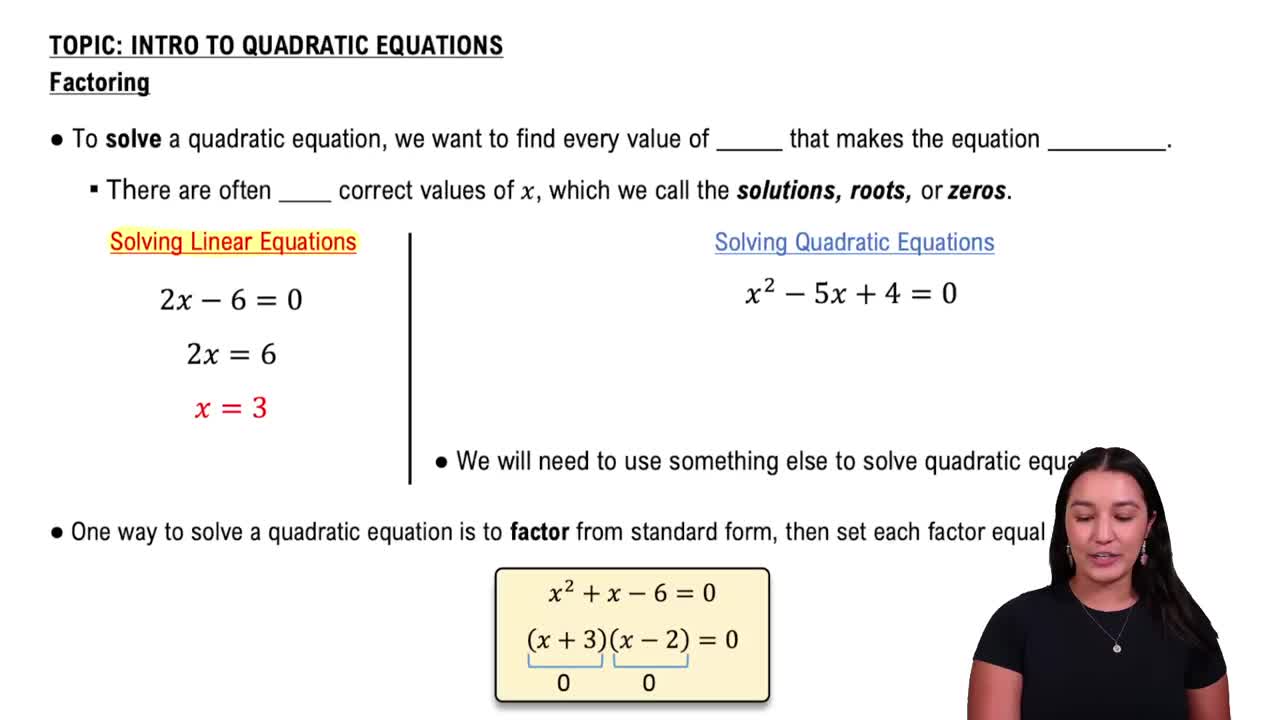
Solving Quadratic Equations by Factoring
Related Practice
Textbook Question
Textbook Question
In Exercises 47–48, solve each system by the method of your choice. (x + 2)/2 - (y + 4)/3 = 3 (x + y)/5 = (x - y)/2 - 5/2
Textbook Question
Graph the solution set of each system of inequalities or indicate that the system has no solution.
4
views
Textbook Question
In Exercises 47–48, solve each system by the method of your choice. (x - y)/3 = (x + y)/2 - 1/2 (x + 2)/2 - 4 = (y + 4)/3
1
views
Textbook Question
Graph the solution set of each system of inequalities or indicate that the system has no solution.
Textbook Question
In Exercises 46–55, graph the solution set of each system of inequalities or indicate that the system has no solution.
This
is a piecewise function. Refer to the textbook.