Ch. 5 - Systems of Equations and Inequalities
Blitzer - College Algebra 8th Edition
Blitzer8th EditionCollege AlgebraISBN: 9780136970514Not the one you use?Change textbook
Chapter 6, Problem 44

In Exercises 39–45, graph each inequality. y ≤ x^2 - 1

Verified step by step guidance
1
Step 1: Start by identifying the inequality. The given inequality is y ≤ x² - 1. This represents a parabola that opens upwards because the coefficient of x² is positive. The inequality symbol '≤' indicates that the region includes the parabola itself and the area below it.
Step 2: Rewrite the inequality as an equation to find the boundary curve. The equation is y = x² - 1. This is the equation of a parabola with its vertex at (0, -1) and its axis of symmetry along the y-axis.
Step 3: Plot the parabola y = x² - 1. To do this, create a table of values by substituting different x-values into the equation to find corresponding y-values. For example, if x = -2, y = (-2)² - 1 = 3. Plot points such as (-2, 3), (-1, 0), (0, -1), (1, 0), and (2, 3), and then draw a smooth curve through these points.
Step 4: Since the inequality is '≤', shade the region below the parabola, including the parabola itself. This indicates that all points (x, y) in this region satisfy the inequality y ≤ x² - 1.
Step 5: Finally, double-check your graph to ensure that the parabola is correctly plotted and the shading accurately represents the solution set. Label the graph clearly to indicate the inequality y ≤ x² - 1.

Verified video answer for a similar problem:

This video solution was recommended by our tutors as helpful for the problem above.
Video duration:
5m
Was this helpful?

Key Concepts

Here are the essential concepts you must grasp in order to answer the question correctly.

Inequalities

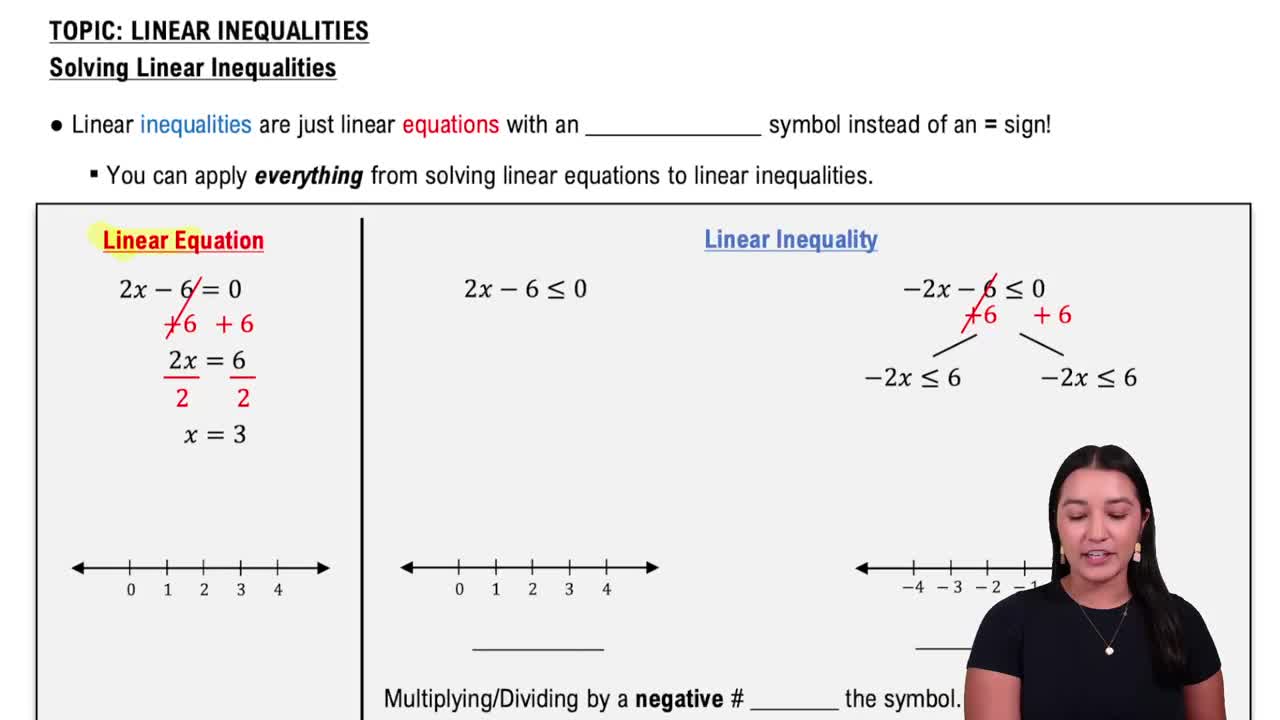
Inequalities express a relationship where one quantity is not equal to another, often using symbols like ≤, ≥, <, or >. In this case, the inequality y ≤ x^2 - 1 indicates that the value of y is less than or equal to the value of the quadratic function x^2 - 1. Understanding how to interpret and graph inequalities is crucial for visualizing the solution set.
Recommended video:
06:07
Linear Inequalities

Quadratic Functions

A quadratic function is a polynomial function of degree two, typically expressed in the form f(x) = ax^2 + bx + c. The graph of a quadratic function is a parabola, which can open upwards or downwards depending on the sign of the coefficient 'a'. In the given inequality, the function x^2 - 1 represents a parabola that opens upwards and is shifted down by one unit.
Recommended video:
06:36
Solving Quadratic Equations Using The Quadratic Formula

Graphing Techniques

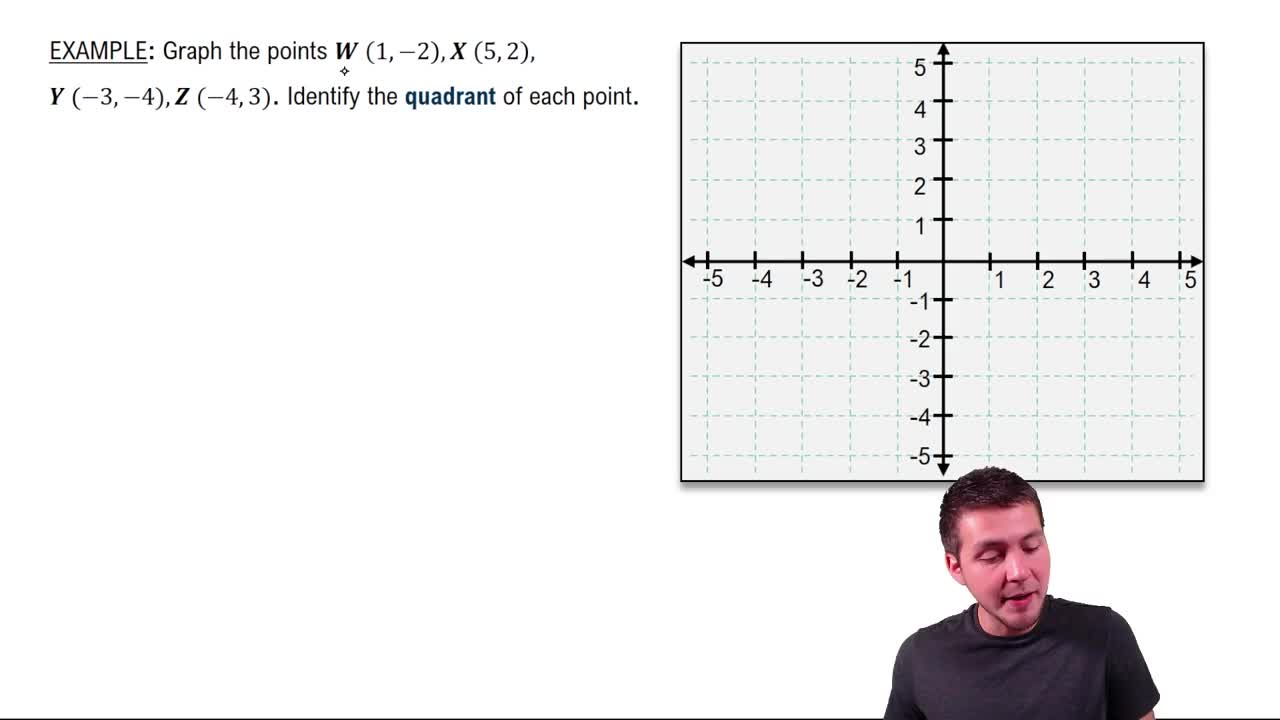
Graphing techniques involve plotting points and understanding the shape of functions to visualize their behavior. For the inequality y ≤ x^2 - 1, one must first graph the boundary line y = x^2 - 1, then shade the region below this curve to represent all points where y is less than or equal to the quadratic function. Mastery of these techniques is essential for accurately representing inequalities on a coordinate plane.
Recommended video:
Guided course
02:16
Graphs and Coordinates - Example