Ch. 5 - Systems of Equations and Inequalities
Blitzer - College Algebra 8th Edition
Blitzer8th EditionCollege AlgebraISBN: 9780136970514Not the one you use?Change textbook
Chapter 6, Problem 45

Graph the solution set of each system of inequalities or indicate that the system has no solution.
{yx21xy1\(\begin{cases}\)y \(\geq\) x^2 - 1 \(\x\) - y \(\geq\) -1\(\end{cases}\)

Verified step by step guidance
1
Step 1: Analyze the first inequality \(y \geq \frac{x^{2}}{2} + 1\). This represents the region on or above the parabola \(y = \frac{x^{2}}{2} + 1\). The parabola opens upward with vertex at \((0,1)\).
Step 2: Analyze the second inequality \(4x - 2y \geq -2\). Rearrange it to slope-intercept form by isolating \(y\): add \$2y\( to both sides and add \(2\) to both sides to get \(4x + 2 \geq 2y\), then divide both sides by 2 to get \(2x + 1 \geq y\), or equivalently \(y \leq 2x + 1\). This represents the region on or below the line \)y = 2x + 1$.
Step 3: Graph both boundary curves: the parabola \(y = \frac{x^{2}}{2} + 1\) and the line \(y = 2x + 1\). Use solid lines because the inequalities include equality (\(\geq\) and \(\leq\)).
Step 4: Determine the solution set by finding the intersection of the two regions: the area on or above the parabola and on or below the line. This overlapping region satisfies both inequalities simultaneously.
Step 5: To better understand the solution set, find the points of intersection between the parabola and the line by setting \(\frac{x^{2}}{2} + 1 = 2x + 1\). Solve this equation for \(x\) to find the intersection points, which will help in accurately shading the solution region.

Verified video answer for a similar problem:

This video solution was recommended by our tutors as helpful for the problem above.
Video duration:
1m
Was this helpful?

Key Concepts

Here are the essential concepts you must grasp in order to answer the question correctly.

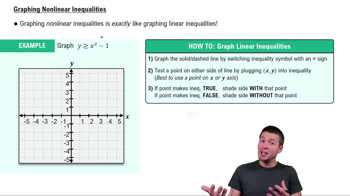
Graphing Quadratic Inequalities

Graphing quadratic inequalities involves plotting the parabola defined by the quadratic equation and shading the region that satisfies the inequality. For example, y ≥ (x²/2) + 1 means shading the area above or on the parabola y = (x²/2) + 1. Understanding the shape and direction of the parabola is essential.
Recommended video:
Guided course
3:21
Nonlinear Inequalities

Graphing Linear Inequalities

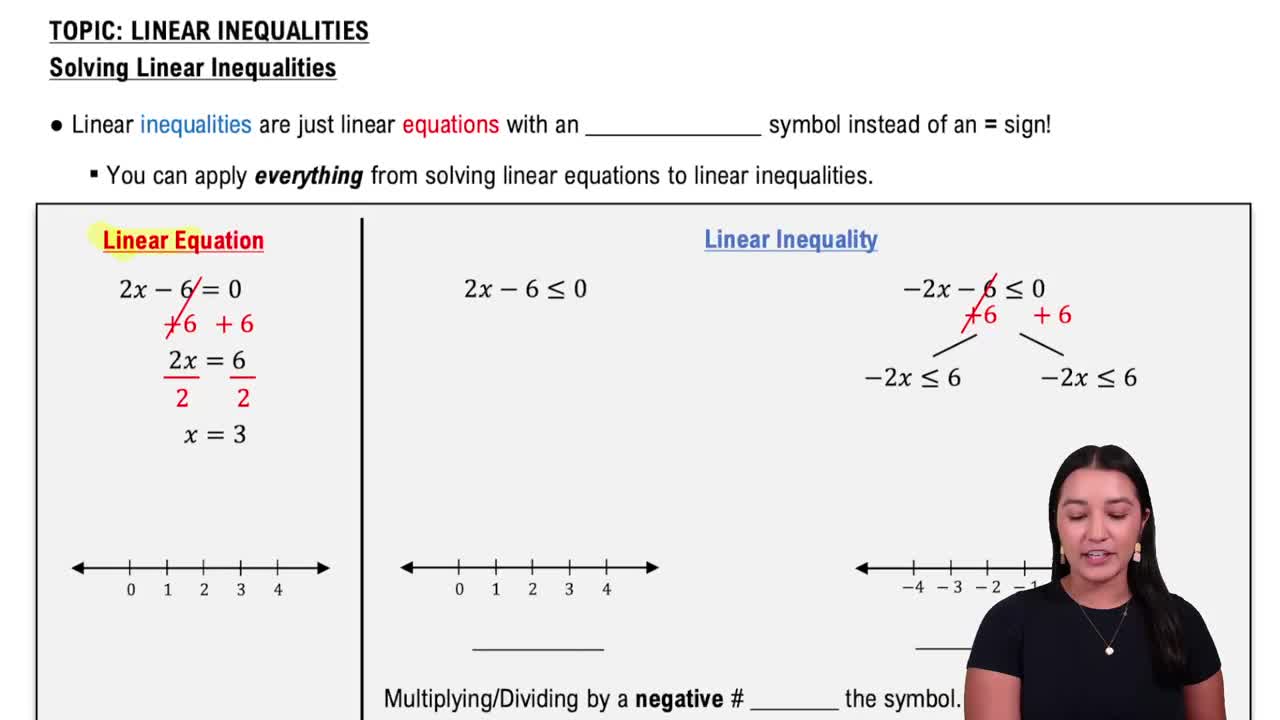
Linear inequalities like 4x - 2y ≥ -2 represent half-planes divided by the line 4x - 2y = -2. To graph, first plot the boundary line (solid if inequality includes equality), then shade the side that satisfies the inequality. Testing points helps determine which side to shade.
Recommended video:
06:07
Linear Inequalities

Solution Set of a System of Inequalities

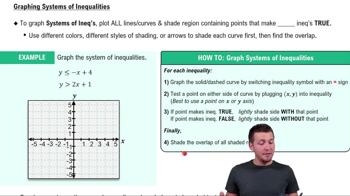
The solution set of a system of inequalities is the intersection of the regions satisfying each inequality. Graphically, it is where the shaded areas overlap. If no overlap exists, the system has no solution. Identifying this region requires combining the graphs of all inequalities.
Recommended video:
Guided course
6:19
Systems of Inequalities