Ch. 4 - Exponential and Logarithmic Functions
Blitzer - College Algebra 8th Edition
Blitzer8th EditionCollege AlgebraISBN: 9780136970514Not the one you use?Change textbook
Chapter 5, Problem 53

Solve each logarithmic equation in Exercises 49–92. Be sure to reject any value of x that is not in the domain of the original logarithmic expressions. Give the exact answer. Then, where necessary, use a calculator to obtain a decimal approximation, correct to two decimal places, for the solution. log4(x+5)=3

Verified step by step guidance
1
Identify the given logarithmic equation: \(\log_{4}(x+5) = 3\).
Recall the definition of logarithm: \(\log_{a}(b) = c\) means \(a^{c} = b\). Apply this to rewrite the equation as \(4^{3} = x + 5\).
Calculate the value of \$4^{3}\( (but do not finalize the numeric value here), so the equation becomes \)x + 5 = 4^{3}$.
Isolate \(x\) by subtracting 5 from both sides: \(x = 4^{3} - 5\).
Check the domain restriction: since the argument of the logarithm \(x + 5\) must be greater than 0, ensure that \(x + 5 > 0\), which means \(x > -5\). Confirm that your solution satisfies this domain condition.

Verified video answer for a similar problem:

This video solution was recommended by our tutors as helpful for the problem above.
Video duration:
1m
Was this helpful?

Key Concepts

Here are the essential concepts you must grasp in order to answer the question correctly.

Definition and Properties of Logarithms

A logarithm log_b(a) answers the question: to what power must the base b be raised to get a? Understanding this definition allows you to rewrite logarithmic equations in exponential form, which is essential for solving equations like log_4(x+5) = 3.
Recommended video:
5:36
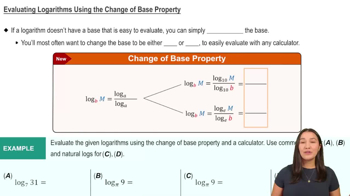
Change of Base Property

Domain of Logarithmic Functions

The domain of a logarithmic function log_b(f(x)) requires that the argument f(x) be positive. This means x+5 > 0 in the given problem, so x must be greater than -5. Checking the domain ensures that any solution found is valid within the original equation.
Recommended video:
5:26
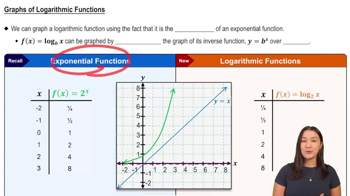
Graphs of Logarithmic Functions

Converting Logarithmic Equations to Exponential Form

To solve log_b(f(x)) = c, rewrite it as f(x) = b^c. For log_4(x+5) = 3, this becomes x+5 = 4^3. This conversion simplifies the problem to solving an algebraic equation, making it easier to find the exact value of x.
Recommended video:
5:02
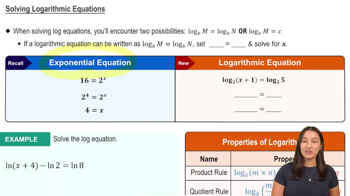
Solving Logarithmic Equations
Related Practice
Textbook Question

Begin by graphing f(x) = log₂ x. Then use transformations of this graph to graph the given function. What is the vertical asymptote? Use the graphs to determine each function's domain and range. g(x) = log₂ (x + 1)

Textbook Question

Graph functions f and g in the same rectangular coordinate system. Graph and give equations of all asymptotes. If applicable, use a graphing utility to confirm your hand-drawn graphs. f(x) = (½)x and g(x) = (½)x-1 + 1

Textbook Question

Use properties of logarithms to condense each logarithmic expression. Write the expression as a single logarithm whose coefficient is 1. Where possible, evaluate logarithmic expressions without using a calculator. 2 logb x + 3 logb y

2
views
Textbook Question

Solve each logarithmic equation in Exercises 49–92. Be sure to reject any value of x that is not in the domain of the original logarithmic expressions. Give the exact answer. Then, where necessary, use a calculator to obtain a decimal approximation, correct to two decimal places, for the solution. ln x=2

Textbook Question

In Exercises 50–53, use properties of logarithms to expand each logarithmic expression as much as possible. Where possible, evaluate logarithmic expressions without using a calculator. lnxe3\(\ln\]\sqrt\)[3]{\(\frac{x}{e}\)}

Textbook Question

Use properties of logarithms to condense each logarithmic expression. Write the expression as a single logarithm whose coefficient is 1. Where possible, evaluate logarithmic expressions without using a calculator. (1/2)ln x + ln y