Ch. 4 - Exponential and Logarithmic Functions
Blitzer - College Algebra 8th Edition
Blitzer8th EditionCollege AlgebraISBN: 9780136970514Not the one you use?Change textbook
Chapter 5, Problem 51

Solve each logarithmic equation in Exercises 49–92. Be sure to reject any value of x that is not in the domain of the original logarithmic expressions. Give the exact answer. Then, where necessary, use a calculator to obtain a decimal approximation, correct to two decimal places, for the solution. ln x=2

Verified step by step guidance
1
Recognize that the equation is given as \(\ln x = 2\), where \(\ln\) denotes the natural logarithm, which is the logarithm with base \(e\) (Euler's number).
Rewrite the logarithmic equation in its equivalent exponential form. Recall that if \(\ln x = 2\), then \(x = e^2\).
Express the solution as \(x = e^2\), which is the exact form of the answer.
Check the domain of the original logarithmic function. Since \(\ln x\) is defined only for \(x > 0\), verify that \(e^2\) is positive, which it is, so no values are rejected.
If a decimal approximation is needed, use a calculator to evaluate \(e^2\) and round the result to two decimal places.

Verified video answer for a similar problem:

This video solution was recommended by our tutors as helpful for the problem above.
Video duration:
1m
Was this helpful?

Key Concepts

Here are the essential concepts you must grasp in order to answer the question correctly.

Properties of Logarithms

Understanding the natural logarithm function ln(x) is essential, where ln(x) is the logarithm base e. Key properties include ln(e) = 1 and the ability to rewrite logarithmic equations in exponential form, such as ln(x) = 2 becoming x = e^2.
Recommended video:
5:36
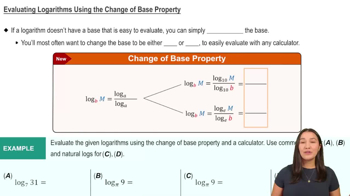
Change of Base Property

Domain of Logarithmic Functions

The domain of ln(x) is x > 0, meaning the argument inside the logarithm must be positive. When solving equations, any solution that results in a non-positive argument must be rejected to ensure the solution is valid within the function's domain.
Recommended video:
5:26
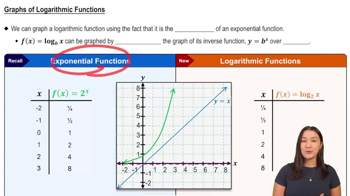
Graphs of Logarithmic Functions

Converting Between Logarithmic and Exponential Forms

Solving logarithmic equations often requires rewriting them in exponential form. For example, ln(x) = 2 can be rewritten as x = e^2, which allows direct computation of x. This conversion simplifies solving and interpreting logarithmic equations.
Recommended video:
04:34
Converting Standard Form to Vertex Form
Related Practice
Textbook Question

Use properties of logarithms to condense each logarithmic expression. Write the expression as a single logarithm whose coefficient is 1. Where possible, evaluate logarithmic expressions without using a calculator. log x + 3 log y

Textbook Question

Graph functions f and g in the same rectangular coordinate system. Graph and give equations of all asymptotes. If applicable, use a graphing utility to confirm your hand-drawn graphs. f(x) = (½)x and g(x) = (½)x-1 + 1

Textbook Question

In Exercises 50–53, use properties of logarithms to expand each logarithmic expression as much as possible. Where possible, evaluate logarithmic expressions without using a calculator. log4(x64)\(\log\)_4\(\left\)(\(\frac{\sqrt{x}\)}{64}\(\right\))

Textbook Question

Solve each logarithmic equation in Exercises 49–92. Be sure to reject any value of x that is not in the domain of the original logarithmic expressions. Give the exact answer. Then, where necessary, use a calculator to obtain a decimal approximation, correct to two decimal places, for the solution. log4(x+5)=3

Textbook Question

Solve each logarithmic equation in Exercises 49–92. Be sure to reject any value of x that is not in the domain of the original logarithmic expressions. Give the exact answer. Then, where necessary, use a calculator to obtain a decimal approximation, correct to two decimal places, for the solution. log3x=4

1
views
Textbook Question

Use properties of logarithms to condense each logarithmic expression. Write the expression as a single logarithm whose coefficient is 1. Where possible, evaluate logarithmic expressions without using a calculator. (1/2)ln x + ln y