Ch. 4 - Exponential and Logarithmic Functions
Blitzer - College Algebra 8th Edition
Blitzer8th EditionCollege AlgebraISBN: 9780136970514Not the one you use?Change textbook
Chapter 5, Problem 73

Solve each logarithmic equation in Exercises 49–92. Be sure to reject any value of x that is not in the domain of the original logarithmic expressions. Give the exact answer. Then, where necessary, use a calculator to obtain a decimal approximation, correct to two decimal places, for the solution. 2 log3(x+4)=log3 9 + 2

Verified step by step guidance
1
Start with the given equation: \(2 \log_{3}(x+4) = \log_{3} 9 + 2\).
Use the logarithm power rule on the left side: \(2 \log_{3}(x+4) = \log_{3}((x+4)^2)\), so rewrite the equation as \(\log_{3}((x+4)^2) = \log_{3} 9 + 2\).
Express the constant 2 on the right side as a logarithm with base 3: since \(2 = \log_{3}(3^2) = \log_{3} 9\), rewrite the right side as \(\log_{3} 9 + \log_{3} 9\).
Use the logarithm addition rule on the right side: \(\log_{3} 9 + \log_{3} 9 = \log_{3}(9 \times 9) = \log_{3} 81\).
Now you have \(\log_{3}((x+4)^2) = \log_{3} 81\). Since the logarithms are equal and have the same base, set the arguments equal: \((x+4)^2 = 81\). Then solve this equation for \(x\), remembering to check the domain restrictions for the original logarithmic expressions.

Verified video answer for a similar problem:

This video solution was recommended by our tutors as helpful for the problem above.
Video duration:
3m
Was this helpful?

Key Concepts

Here are the essential concepts you must grasp in order to answer the question correctly.

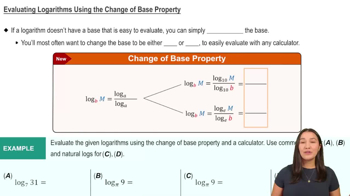
Properties of Logarithms

Understanding the fundamental properties of logarithms, such as the product, quotient, and power rules, is essential. These properties allow you to simplify and manipulate logarithmic expressions to isolate the variable. For example, the power rule lets you move coefficients as exponents, which is crucial in solving equations like 2 log₃(x+4).
Recommended video:
5:36
Change of Base Property

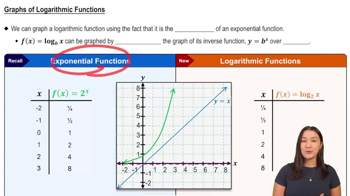
Domain of Logarithmic Functions

The domain of a logarithmic function includes all values for which the argument is positive. When solving logarithmic equations, it is important to check that the solutions do not make any logarithm’s argument zero or negative, as these are undefined. This ensures that only valid solutions are accepted.
Recommended video:
5:26
Graphs of Logarithmic Functions

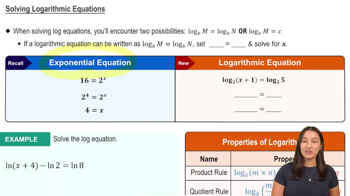
Converting Logarithmic Equations to Exponential Form

Converting logarithmic equations into their equivalent exponential form helps in solving for the variable. For example, log₃(y) = k can be rewritten as y = 3^k. This conversion simplifies the equation and allows you to solve for x algebraically after applying logarithmic properties.
Recommended video:
5:02
Solving Logarithmic Equations