Ch. 4 - Exponential and Logarithmic Functions
Blitzer - College Algebra 8th Edition
Blitzer8th EditionCollege AlgebraISBN: 9780136970514Not the one you use?Change textbook
Chapter 5, Problem 71

Solve each logarithmic equation in Exercises 49–92. Be sure to reject any value of x that is not in the domain of the original logarithmic expressions. Give the exact answer. Then, where necessary, use a calculator to obtain a decimal approximation, correct to two decimal places, for the solution. log2(x+2)−log2(x−5)=3

Verified step by step guidance
1
Recall the logarithmic property that states \( \log_b A - \log_b B = \log_b \left( \frac{A}{B} \right) \). Apply this to the equation \( \log_2 (x+2) - \log_2 (x-5) = 3 \) to combine the logs into one: \( \log_2 \left( \frac{x+2}{x-5} \right) = 3 \).
Rewrite the logarithmic equation in its equivalent exponential form. Since \( \log_b y = x \) means \( y = b^x \), rewrite \( \log_2 \left( \frac{x+2}{x-5} \right) = 3 \) as \( \frac{x+2}{x-5} = 2^3 \).
Simplify the right side of the equation: \( 2^3 = 8 \), so the equation becomes \( \frac{x+2}{x-5} = 8 \).
Solve the resulting rational equation by cross-multiplying: \( x + 2 = 8(x - 5) \). Then, distribute and collect like terms to isolate \( x \).
Check the domain restrictions for the original logarithmic expressions: \( x + 2 > 0 \) and \( x - 5 > 0 \), which means \( x > -2 \) and \( x > 5 \). Only values of \( x \) greater than 5 are valid. Verify that your solution satisfies this domain before finalizing your answer.

Verified video answer for a similar problem:

This video solution was recommended by our tutors as helpful for the problem above.
Video duration:
4m
Was this helpful?

Key Concepts

Here are the essential concepts you must grasp in order to answer the question correctly.

Properties of Logarithms

Understanding the properties of logarithms, especially the subtraction rule log_b(A) - log_b(B) = log_b(A/B), is essential for simplifying and solving logarithmic equations. This allows combining multiple logarithmic terms into a single logarithm, making the equation easier to solve.
Recommended video:
5:36
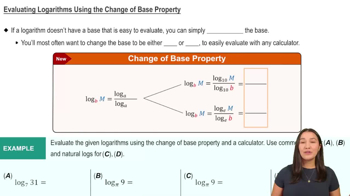
Change of Base Property

Domain of Logarithmic Functions

The domain of a logarithmic function log_b(x) includes only positive values of x. When solving logarithmic equations, it is crucial to identify and exclude any solutions that make the arguments of the logarithms non-positive, ensuring the solution is valid within the function's domain.
Recommended video:
5:26
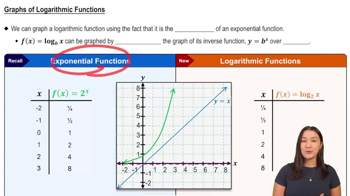
Graphs of Logarithmic Functions

Converting Logarithmic Equations to Exponential Form

To solve logarithmic equations, converting the equation from logarithmic form to exponential form is often necessary. For example, log_b(A) = C can be rewritten as A = b^C, which allows solving for the variable algebraically.
Recommended video:
5:02
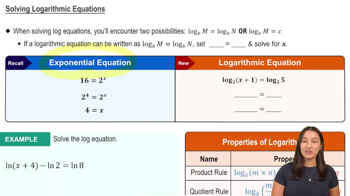
Solving Logarithmic Equations
Related Practice
Textbook Question

In Exercises 71–78, use common logarithms or natural logarithms and a calculator to evaluate to four decimal places. log5 13

Textbook Question

Solve each logarithmic equation in Exercises 49–92. Be sure to reject any value of x that is not in the domain of the original logarithmic expressions. Give the exact answer. Then, where necessary, use a calculator to obtain a decimal approximation, correct to two decimal places, for the solution. 2 log3(x+4)=log3 9 + 2

Textbook Question

Solve each logarithmic equation in Exercises 49–92. Be sure to reject any value of x that is not in the domain of the original logarithmic expressions. Give the exact answer. Then, where necessary, use a calculator to obtain a decimal approximation, correct to two decimal places, for the solution. log2(x−6)+log2(x−4)−log2 x=2

1
views
Textbook Question

Solve each logarithmic equation in Exercises 49–92. Be sure to reject any value of x that is not in the domain of the original logarithmic expressions. Give the exact answer. Then, where necessary, use a calculator to obtain a decimal approximation, correct to two decimal places, for the solution. log3(x+6)+log3(x+4)=1

Textbook Question

In Exercises 71–78, use common logarithms or natural logarithms and a calculator to evaluate to four decimal places. log14 87.5

Textbook Question

Use properties of logarithms to condense each logarithmic expression. Write the expression as a single logarithm whose coefficient is 1. Where possible, evaluate logarithmic expressions without using a calculator. logx+log(x21)log7log(x+1)\(\log\) x + \(\log\)(x^2 - 1) - \(\log\) 7 - \(\log\)(x + 1)