Ch. 4 - Exponential and Logarithmic Functions
Blitzer - College Algebra 8th Edition
Blitzer8th EditionCollege AlgebraISBN: 9780136970514Not the one you use?Change textbook
Chapter 5, Problem 79

Use a graphing utility and the change-of-base property to graph each function. y = log3 x

Verified step by step guidance
1
Understand that the function given is \( y = \log_3 x \), which is a logarithmic function with base 3. This means it gives the exponent to which 3 must be raised to get \( x \).
Recall the change-of-base formula for logarithms: \( \log_a b = \frac{\log_c b}{\log_c a} \), where \( c \) is any positive number different from 1. This allows us to rewrite \( \log_3 x \) in terms of common logarithms (base 10) or natural logarithms (base \( e \)).
Apply the change-of-base formula to rewrite \( y = \log_3 x \) as \( y = \frac{\log x}{\log 3} \) if using common logarithms, or \( y = \frac{\ln x}{\ln 3} \) if using natural logarithms.
Use a graphing utility (such as a graphing calculator or software) to plot the function \( y = \frac{\log x}{\log 3} \) or \( y = \frac{\ln x}{\ln 3} \). This will give the graph of \( y = \log_3 x \).
Analyze the graph: note that the domain is \( x > 0 \), the graph passes through the point \( (1,0) \) because \( \log_3 1 = 0 \), and the graph increases slowly as \( x \) increases.

Verified video answer for a similar problem:

This video solution was recommended by our tutors as helpful for the problem above.
Video duration:
1m
Was this helpful?

Key Concepts

Here are the essential concepts you must grasp in order to answer the question correctly.

Logarithmic Functions

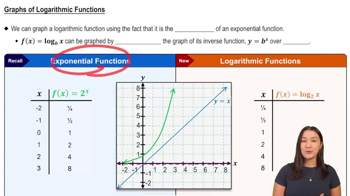
A logarithmic function is the inverse of an exponential function and is written as y = log_b(x), where b is the base. It answers the question: to what power must the base b be raised to produce x? Understanding the domain (x > 0) and range (all real numbers) is essential for graphing.
Recommended video:
5:26
Graphs of Logarithmic Functions

Change-of-Base Formula

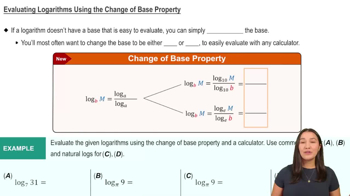
The change-of-base formula allows you to rewrite logarithms with any base b as a ratio of logarithms with a different base, typically base 10 or e: log_b(x) = log_c(x) / log_c(b). This is useful when graphing with calculators or utilities that only support common or natural logs.
Recommended video:
5:36
Change of Base Property

Using Graphing Utilities

Graphing utilities like calculators or software can plot functions by evaluating points. Since many utilities do not support arbitrary log bases directly, applying the change-of-base formula lets you graph y = log_3(x) by inputting y = log(x)/log(3), enabling visualization of the function's shape and behavior.
Recommended video:
5:31
Graphing Rational Functions Using Transformations