Ch. 4 - Exponential and Logarithmic Functions
Blitzer - College Algebra 8th Edition
Blitzer8th EditionCollege AlgebraISBN: 9780136970514Not the one you use?Change textbook
Chapter 5, Problem 77

Use common logarithms or natural logarithms and a calculator to evaluate to four decimal places. logπ 63

Verified step by step guidance
1
Identify the logarithm expression given: \(\log_{\pi} 63\), which means the logarithm of 63 with base \(\pi\).
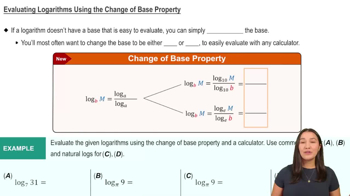
Recall the change of base formula for logarithms: \(\log_a b = \frac{\log_c b}{\log_c a}\), where \(c\) can be any positive number (commonly 10 or \(e\)).
Apply the change of base formula using common logarithms (base 10): \(\log_{\pi} 63 = \frac{\log_{10} 63}{\log_{10} \pi}\).
Use a calculator to find the values of \(\log_{10} 63\) and \(\log_{10} \pi\) separately, making sure to keep at least four decimal places.
Divide the two logarithm values obtained to get the value of \(\log_{\pi} 63\), rounded to four decimal places.

Verified video answer for a similar problem:

This video solution was recommended by our tutors as helpful for the problem above.
Video duration:
1m
Was this helpful?

Key Concepts

Here are the essential concepts you must grasp in order to answer the question correctly.

Logarithms and Their Bases

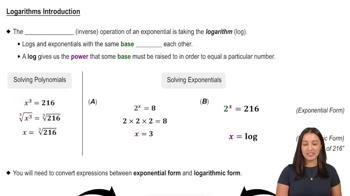
A logarithm answers the question: to what power must the base be raised to produce a given number? Common logarithms use base 10, while natural logarithms use base e (~2.718). Understanding the base is crucial for evaluating or converting logarithmic expressions.
Recommended video:
7:30
Logarithms Introduction

Change of Base Formula

The change of base formula allows you to evaluate logarithms with any base using common or natural logarithms: log_b(a) = log_c(a) / log_c(b), where c is a convenient base like 10 or e. This formula is essential when calculators only provide log base 10 or e.
Recommended video:
5:36
Change of Base Property

Using a Calculator for Logarithms

Calculators typically have buttons for common logarithms (log base 10) and natural logarithms (ln). To evaluate logs with other bases, use the change of base formula and these functions, then round the result to the required decimal places.
Recommended video:
7:30
Logarithms Introduction